The experiment will employ a trio of spacecraft flying in formation in the shape of an equilateral triangle that has sides one million kilometers long, with lasers shining between the craft." The experiment in question refers to
Contents18
- AVoyager-2
- BNew Horizons
- CLISA Pathfinder
- DEvolved LISA
Show answer
Answer: (D) Evolved LISA
Correct Answer: D (Evolved LISA)
Why Option D is Correct
- The Mission: eLISA (Evolved Laser Interferometer Space Antenna) is a massive space-based project designed to detect gravitational waves—ripples in space-time caused by violent cosmic events like colliding black holes.
- The Setup: It uses three separate spacecraft (one "mother" and two "daughter" craft) arranged in a giant equilateral triangle trailing far behind Earth in its orbit around the sun.
- The Lasers: Highly precise lasers shine continuously between the craft across arms that are 1 million kilometers long. When a gravitational wave ripples through the universe, it slightly warps space-time, altering this distance by a tiny fraction. The onboard lasers instantly measure this change to detect the wave.
Why the Other Options Are Incorrect
- Voyager-2 (Option A): A single space probe launched in 1977 to study the outer planets (Jupiter, Saturn, Uranus, and Neptune). It is not a triangular laser setup.
- New Horizons (Option B): A single spacecraft launched in 2006 to fly past Pluto and explore the distant Kuiper Belt.
- LISA Pathfinder (Option C): This was a precursor trial mission containing just a single spacecraft. It was launched to prove that the core technology (like the floating test cubes) would actually work in space before building the full, expensive three-craft network.
The Core Difference
| Detector System | Location | Arm Length | How it avoids noise |
|---|---|---|---|
| LIGO | Earth | 4 Kilometers | Uses underground vacuum tubes. |
| eLISA / LISA | Space | 1 Million Kilometers | Floats in deep space to escape Earth's seismic vibrations. |
Quick Cheat-Sheet
- eLISA = 3 Spacecraft + Triangular Formation + 1 Million Km Laser Arms + Gravitational Waves.
Evolved LISA uses three spacecraft in a triangular formation with million-kilometer sides to detect gravitational waves through laser interferometry.
The 2015 detection of gravitational waves by LIGO made space-based gravitational wave detection a priority, leading to increased focus on LISA missions.
UPSC is testing whether students can distinguish between the test mission (LISA Pathfinder) and the actual operational mission (Evolved LISA).
Evolved LISA (eLISA) Project
Science And Technology trio of spacecraft equilateral triangle one million kilometers lasers
Evolved LISA: Space-Based Gravitational Wave Detection
eLISA uses 3 spacecraft in triangular formation with 1 million km sides
Lasers between spacecraft detect tiny distance changes caused by gravitational waves
Follow-up to successful LISA Pathfinder technology demonstrator mission
ESA-led mission for space-based gravitational wave astronomy
Mission Concept
Evolved LISA (eLISA) is the full-scale gravitational wave detection mission planned after LISA Pathfinder proved the technology works. The mission uses laser interferometry in space to detect gravitational waves that ground-based detectors cannot sense due to Earth's vibrations and size limitations.
How eLISA Works
%%{init: {"flowchart": {"wrappingWidth": 460}}}%%
flowchart TD
  s1["`**Three spacecraft launch**
One mother craft and two daughter craft positioned in space`"]
  s2["`**Triangular formation**
Spacecraft arrange in equilateral triangle with 1 million km sides`"]
  s3["`**Laser links established**
Lasers beam between all three spacecraft continuously`"]
  s4["`**Gravitational wave passes**
Wave slightly changes distances between test masses in spacecraft`"]
  s5["`**Distance change detected**
Laser interferometry measures tiny changes with extreme precision`"]
  s6["`**Wave characteristics analyzed**
Scientists study the gravitational wave source and properties`"]
  s1 --> s2
  s2 --> s3
  s3 --> s4
  s4 --> s5
  s5 --> s6
Technical Specifications
Triangle side length: Exactly 1 million kilometers (compared to LIGO's 4 km arms on Earth)
Laser precision: Can detect distance changes smaller than 1/10,000th the width of a proton
Frequency range: Detects low-frequency gravitational waves (0.1 mHz to 1 Hz) impossible to detect on Earth
Mission duration: Planned for several years of continuous observation
Question Connection
The question's description of "trio of spacecraft flying in formation in the shape of an equilateral triangle that has sides one million kilometers long, with lasers shining between the craft" perfectly matches eLISA's unique configuration, making it the only correct answer among the planetary exploration missions listed.
Trap: Confusing LISA Pathfinder (technology test mission) with Evolved LISA (actual detection mission)
Trap: The 1 million km triangle size is unique to eLISA - no other space mission uses this configuration
Trap: Voyager-2 and New Horizons are planetary probes with completely different objectives
Key identifier: Three spacecraft + triangle + lasers = gravitational wave detection mission
LISA Pathfinder Mission
Science And Technology LISA Pathfinder
LISA Pathfinder: Technology Demonstrator Mission
Technology test mission that proved laser interferometry works in space
Single spacecraft with two test masses, not the triangular formation
ESA mission launched in 2015, operated until 2017
Success led to approval of full Evolved LISA mission
Mission Purpose
LISA Pathfinder was designed to test whether the extremely sensitive laser interferometry technology needed for gravitational wave detection could work in the space environment. It validated the concept before committing to the much larger and more expensive eLISA mission.
LISA Pathfinder vs Evolved LISA
Aspect | LISA Pathfinder | Evolved LISA |
|---|---|---|
Spacecraft | Single spacecraft | Three spacecraft |
Formation | None | Triangular (1 million km sides) |
Purpose | Technology test | Actual detection |
Status | Completed (2015-2017) | Planned |
Laser setup | Internal test masses | Between spacecraft |
Key Achievements
Proved that test masses can be kept in perfect free-fall in space environment
Demonstrated laser interferometry precision needed for gravitational wave detection
Exceeded performance requirements by factor of 5, giving confidence for eLISA
Validated drag-free flight technology essential for the full mission
Critical distinction: LISA Pathfinder was the test, eLISA is the actual experiment
Trap: Pathfinder used one spacecraft, not the triangular formation described in question
Timeline trap: Pathfinder already completed - the question describes future experiment
Gravitational Wave Detection
Science And Technology
Gravitational Wave Detection: Ground vs Space Methods
Gravitational waves are ripples in spacetime caused by accelerating massive objects
Ground-based detectors like LIGO detect high-frequency waves from stellar collisions
Space-based detectors like eLISA detect low-frequency waves from supermassive black holes
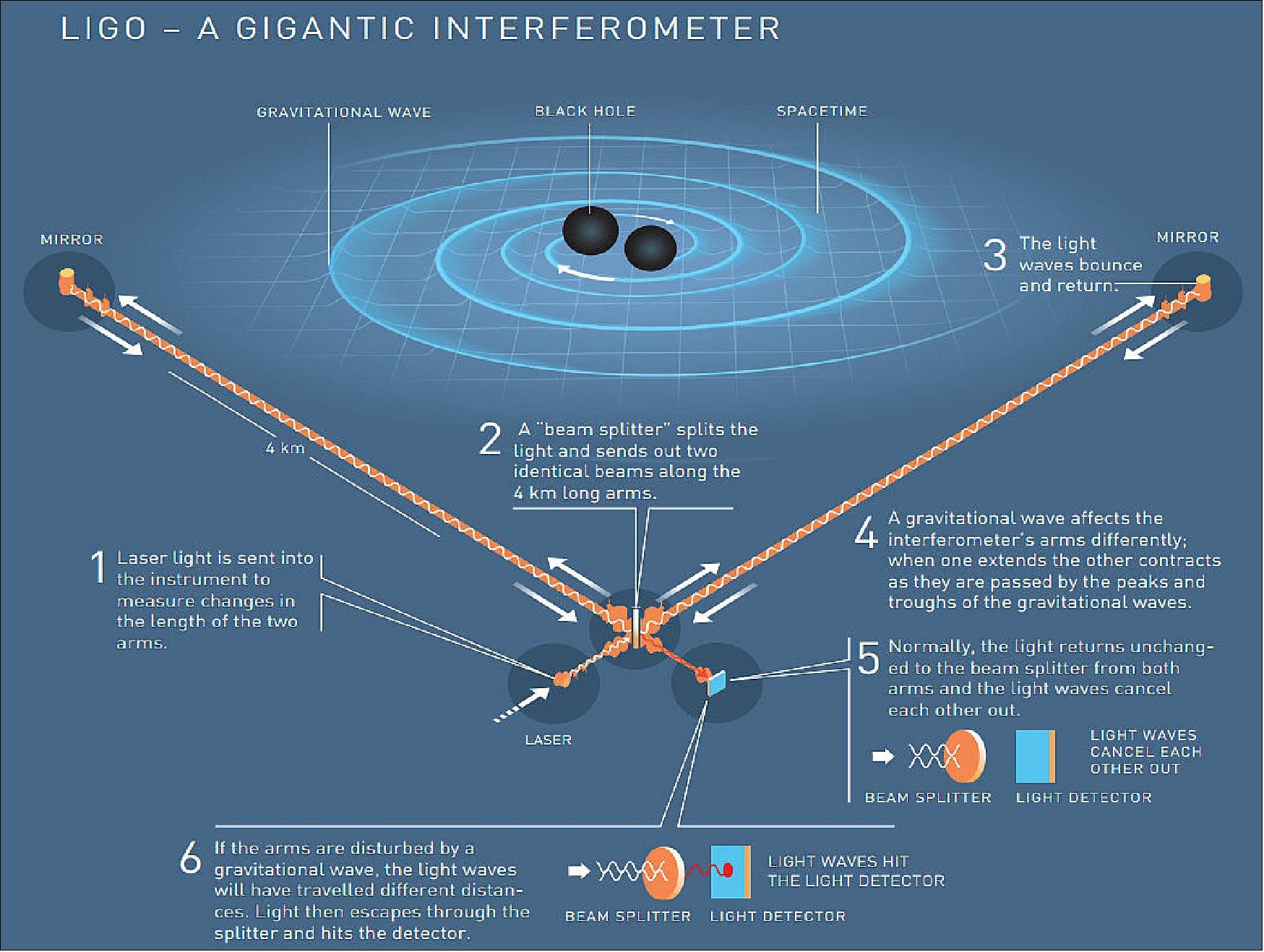
Laser interferometry measures tiny distance changes caused by passing waves
What Are Gravitational Waves
Gravitational waves are ripples in the fabric of spacetime itself, predicted by Einstein's general relativity. When massive objects like black holes or neutron stars accelerate or collide, they create these waves that travel at the speed of light, slightly stretching and compressing space as they pass.
Ground vs Space Detection
Aspect | Ground-Based (LIGO) | Space-Based (eLISA) |
|---|---|---|
Arm length | 4 km | 1 million km |
Frequency range | 10-1000 Hz (high) | 0.1 mHz-1 Hz (low) |
Sources detected | Stellar black holes, neutron stars | Supermassive black holes, galactic binaries |
Interference | Earth vibrations, seismic noise | None - pure space environment |
Detection events | Hundreds since 2015 | Thousands expected per year |
Why Space Detection Matters
Space-based detectors can access low-frequency gravitational waves that Earth-based detectors cannot sense. These waves come from supermassive black hole mergers and provide insights into galaxy formation and the early universe that ground-based detection cannot offer.
Detection Principle
Source: eoPortal — undefined - eoPortal · www.eoportal.org
Major Space Exploration Missions
Science And Technology Voyager-2 New Horizons
Voyager-2 & New Horizons: Planetary Exploration Missions
Voyager-2: Only probe to visit all four outer planets (Jupiter, Saturn, Uranus, Neptune)
New Horizons: First mission to Pluto and continuing to Kuiper Belt objects
Both are single spacecraft on flyby trajectories, not formation flying
No laser interferometry - these are planetary science missions
Mission Comparison
Mission | Launch | Primary Targets | Key Achievement | Current Status |
|---|---|---|---|---|
Voyager-2 | 1977 | Jupiter, Saturn, Uranus, Neptune | Grand Tour of outer planets | Interstellar space |
New Horizons | 2006 | Pluto, Kuiper Belt | First Pluto flyby (2015) | Active in Kuiper Belt |
LISA Pathfinder | 2015 | Technology test | Proved interferometry in space | Completed 2017 |
Evolved LISA | Planned | Gravitational waves | Space-based detection | Development phase |
Why These Missions Don't Fit
Voyager-2: Single probe design focused on planetary flybys, launched in 1977
New Horizons: Single spacecraft mission to Pluto and beyond, no formation flying
No triangular formation: Both missions use single spacecraft on independent trajectories
Different technology: Cameras, spectrometers, and particle detectors - not laser interferometry
Mission Objectives
Voyager-2 exploited a rare planetary alignment to visit all four outer planets in a single mission, while New Horizons gave us our first close look at Pluto. Neither mission involves the formation flying or laser interferometry described in the question - they are traditional planetary science missions.
Trap: Both Voyager-2 and New Horizons are famous missions but completely wrong mission type
Key elimination: Single spacecraft ≠ trio of spacecraft described in question
Technology mismatch: Planetary cameras ≠ laser interferometry for gravitational waves