With reference to 'Astrosat', the astronomical observatory launched by India, which of the following statements is/are correct? 1. Other than USA and Russia, India is the only country to have launched a similar observatory into space. 2. Astrosat is a 2000 kg satellite placed in an orbit at 1650 km above the surface of the Earth. Select the correct answer using the code given below.
Contents9
- A1 only
- B2 only
- CBoth 1 and 2
- DNeither 1 nor 2
Show answer
Answer: (D) Neither 1 nor 2
Answer: (d) Neither 1 nor 2
Both statements about ASTROSAT are wrong.
Statement 1 (✗ WRONG): India is NOT the only country after USA and Russia to launch a space observatory.
Japan launched 'Suzaku' before India.
So India is the FOURTH:
- USA (Hubble),
- Russia (Spektr-R),
- Japan (Suzaku),
- India (ASTROSAT).
Statement 2 (✗ WRONG): The numbers are completely wrong.
Actual mass is about 1,513 kg (NOT 2,000 kg) and actual orbit is 650 km (NOT 1,650 km).
Key ASTROSAT facts:
- India's first dedicated multi-wavelength space observatory;
- launched by PSLV-C30 on September 28, 2015;
- can observe in optical, UV, and X-ray wavelengths simultaneously - this multi-wavelength capability makes it unique.
Exam strategy: When UPSC gives specific numbers, they are often testing if you remember the actual figures.
The real numbers here were significantly different from those stated.
ASTROSAT was India's first dedicated multi-wavelength space observatory launched in September 2015, capable of simultaneous observation in optical, UV, and X-ray wavelengths.
The launch coincided with India's growing space capabilities under the Make in India initiative, making it a relevant current affairs topic for 2016 prelims.
UPSC tests precise technical specifications - ASTROSAT's actual mass is 1513 kg at 650 km orbit, not the incorrect figures given in the statements.
ASTROSAT Space Observatory
Science And Technology Astrosat astronomical observatory 2000 kg satellite 1650 km
ASTROSAT: India's First Multi-Wavelength Space Observatory
India's first dedicated space observatory launched on September 28, 2015
Mass: 1,513 kg, Orbit: 650 km above Earth
Multi-wavelength capability - observes in optical, UV, and X-ray simultaneously
India is the 4th country to launch a space observatory (after USA, Russia, Japan)
ASTROSAT is India's first dedicated astronomical satellite that can observe celestial objects across multiple wavelengths simultaneously. This multi-wavelength capability makes it unique among space observatories.
ASTROSAT Technical Specifications
Parameter | Actual Value | Question's Wrong Value |
|---|---|---|
Mass | 1,513 kg | 2,000 kg |
Orbital Height | 650 km | 1,650 km |
Launch Date | September 28, 2015 | Not specified |
Launch Vehicle | PSLV-C30 | Not specified |
Unique Capabilities
Multi-wavelength observation - can study the same celestial object in optical, ultraviolet, and X-ray wavelengths simultaneously
Five scientific instruments onboard for comprehensive astronomical studies
Real-time coordination between different wavelength observations provides better understanding of cosmic phenomena
Both statements in this question were incorrect. Statement 1 wrongly claimed India was the third country to launch a space observatory, while Statement 2 provided completely wrong technical specifications.
Numbers trap: UPSC often tests exact specifications - actual orbit is 650 km, not 1,650 km
Mass confusion: Actual mass is 1,513 kg, not the stated 2,000 kg
Country ranking trap: India is 4th (after USA, Russia, Japan), not 3rd as Statement 1 suggests
Global Space Observatory Chronology
Science And Technology USA and Russia similar observatory
Countries with Dedicated Space Observatories: Global Timeline
USA launched the first major space observatory (Hubble Space Telescope)
Japan's Suzaku came before India's ASTROSAT
India ranks 4th globally in launching dedicated space observatories
The sequence of countries launching dedicated space observatories is crucial for UPSC questions that test India's position in global space achievements.
Space Observatory Launch Sequence
Rank | Country | Major Observatory | Key Feature |
|---|---|---|---|
1st | USA | Hubble Space Telescope | Most famous optical space telescope |
2nd | Russia | Spektr-R | Radio astronomy observatory |
3rd | Japan | Suzaku | X-ray astronomy satellite |
4th | India | ASTROSAT | Multi-wavelength observatory |
Why This Matters for UPSC
India's space achievements are frequently tested in context of global rankings
Japan's Suzaku is the key fact that makes Statement 1 wrong - it launched before ASTROSAT
Multiple countries now have space observatories, making India's achievement significant but not unique
Third vs Fourth trap: India is 4th, not 3rd - Japan's Suzaku came first
USA-Russia-India assumption: Many students forget Japan's space observatory program
'Only country' language: UPSC uses absolute terms like 'only' to create traps
Major Indian Space Missions
Science And Technology
India's Key Space Missions & Satellites
Mangalyaan (2013) - Mars Orbiter Mission, first country to succeed in first attempt
Chandrayaan series - Moon exploration missions
ASTROSAT (2015) - First dedicated astronomy satellite
PSLV is India's workhorse launch vehicle
Major ISRO Missions Timeline
Mission | Launch Year | Purpose | Achievement |
|---|---|---|---|
Chandrayaan-1 | 2008 | Moon exploration | Confirmed water on Moon |
Mangalyaan | 2013 | Mars exploration | Cheapest Mars mission globally |
ASTROSAT | 2015 | Space astronomy | Multi-wavelength observatory |
Chandrayaan-2 | 2019 | Moon landing attempt | Orbiter successful, lander failed |
Chandrayaan-3 | 2023 | Moon landing | Successful soft landing at South Pole |
India's Space Achievements
Cost-effective missions - Mangalyaan cost less than a Hollywood movie
PSLV reliability - over 50 successful launches, preferred by international customers
South Pole success - Chandrayaan-3 made India first to land near Moon's South Pole
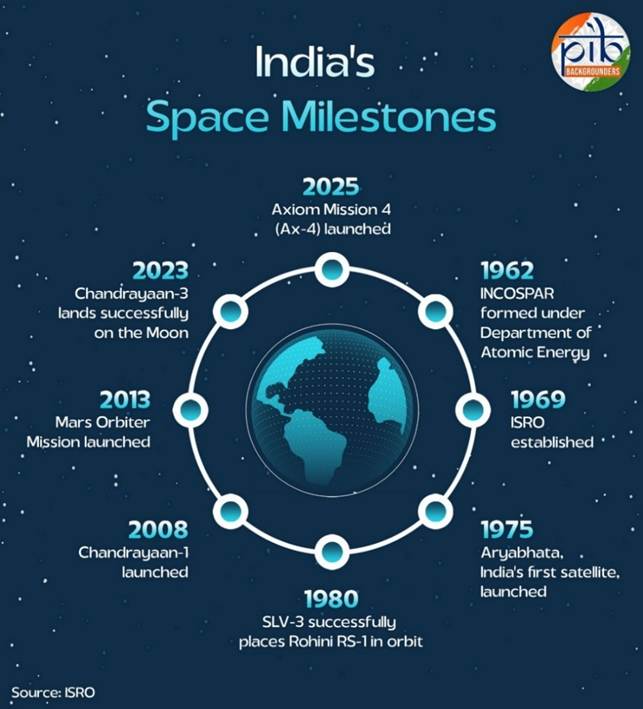
Source: DD India — India's space programme soars to new heights with bold missions ... · ddindia.co.in
Mission confusion: Don't mix up Chandrayaan-2 (partial success) with Chandrayaan-3 (full success)
First vs early: India was first to Mars in first attempt, but not first to Mars overall
ASTROSAT uniqueness: It's India's first astronomy satellite, but not the world's first