Which of the following pairs is/are correctly matched?
Contents18
Which of the following pairs is/are correctly matched?
| Spacecraft | Purpose | |
|---|---|---|
| 1. | Cassini-Huygens | Orbiting the Venus and transmitting data to the Earth |
| 2. | Messenger | Mapping and investigating the Mercury |
| 3. | Voyager 1 and 2 | Exploring the outer solar system |
Select the correct answer using the code given below.
- A1 only
- B2 and 3 only
- C1 and 3 only
- D1, 2 and 3
Show answer
Answer: (B) 2 and 3 only
Pair 1 — WRONG:
Cassini-Huygens was sent to SATURN (not Venus).
It orbited Saturn from 2004 to 2017, and the Huygens probe landed on Saturn's moon Titan.
Venus missions include Venera (Soviet) and Magellan (NASA).
Pair 2 — CORRECT:
MESSENGER (MErcury Surface, Space ENvironment, GEochemistry, and Ranging) was NASA's mission to map and investigate Mercury.
It orbited Mercury from 2011 to 2015.
Pair 3 — CORRECT:
Voyager 1 and 2 (launched 1977) explored the outer solar system — Jupiter, Saturn, Uranus, Neptune — and are now in interstellar space.
Voyager 1 is the farthest human-made object from Earth.
Memory aid:
Cassini = Saturn (both have 'a' as second letter).
Cassini-Huygens spent 13 years at Saturn (2004-2017) and was one of the most successful planetary missions, making it a frequently tested topic.
The question tests whether students can distinguish between different planetary destinations - a common UPSC trap is mixing up which spacecraft went to which planet.
Students should memorize spacecraft-planet pairs using mnemonics like 'Cassini-Saturn both have A as second letter' rather than trying to remember mission details.
Cassini-Huygens Saturn Mission
Science And Technology Cassini-Huygens Venus
Cassini-Huygens Mission: Saturn Explorer (Not Venus)
Cassini-Huygens explored Saturn from 2004-2017, not Venus
Huygens probe landed on Saturn's moon Titan in 2005
Joint mission between NASA, ESA, and Italian Space Agency
Discovered water geysers on Saturn's moon Enceladus
Mission Overview
Cassini-Huygens was one of the most successful planetary missions, spending 13 years studying Saturn and its moons. The spacecraft had two parts: Cassini (orbiter) and Huygens (lander probe).
Mission Components
Component | Role | Achievement | Duration |
|---|---|---|---|
Cassini (Orbiter) | Study Saturn system | 294 orbits, mapped rings | 2004-2017 |
Huygens (Probe) | Land on Titan | First landing on outer solar system moon | Jan 2005 |
Saturn System
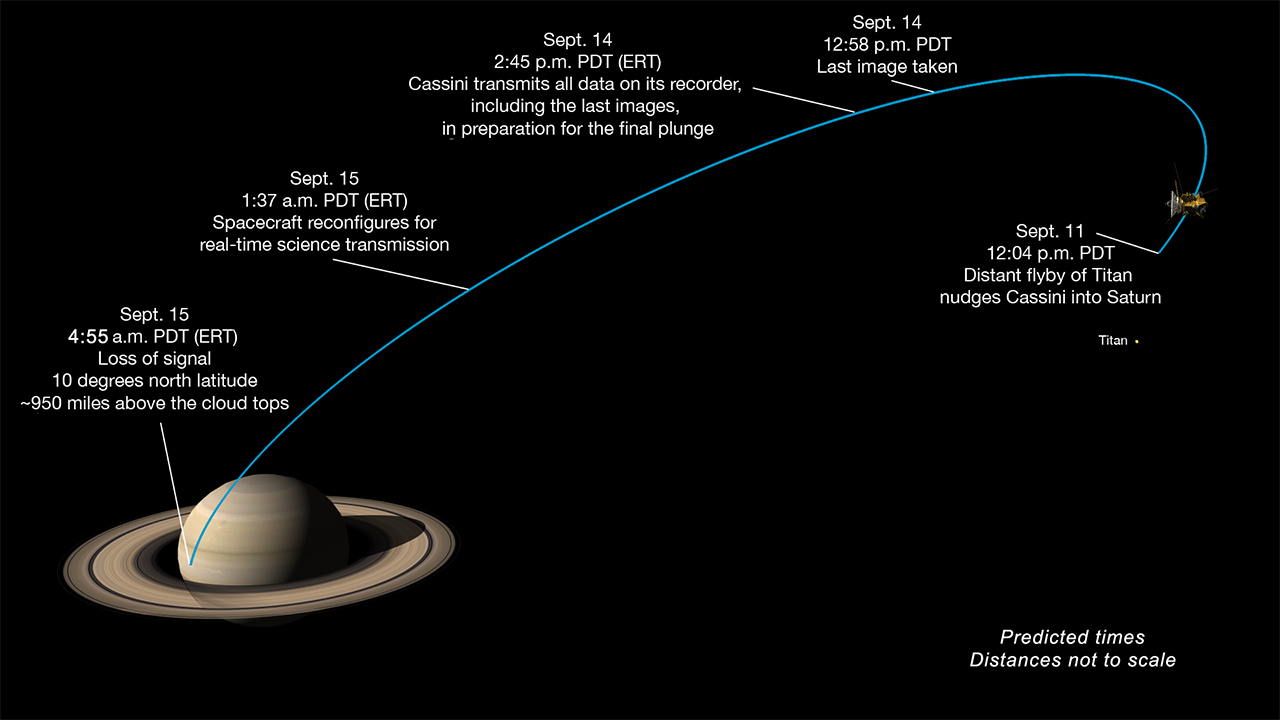
Source: Design World — Cassini Spacecraft Makes Its Final Approach to Saturn · www.designworldonline.com
Trap: UPSC paired Cassini with Venus - remember Cassini = Saturn
Memory aid: Cassini and Saturn both have 'a' as second letter
Venus missions were Venera (Soviet) and Magellan (NASA), not Cassini
MESSENGER Mercury Mission
Science And Technology Messenger Mercury
MESSENGER: Mercury Mapping Mission (2011-2015)
MESSENGER mapped and investigated Mercury from 2011-2015
Full form: MErcury Surface, Space ENvironment, GEochemistry, and Ranging
First spacecraft to orbit Mercury (previous was flyby only)
Discovered water ice at Mercury's poles
Mission Significance
MESSENGER was NASA's first mission to orbit Mercury, the innermost planet. Previous missions like Mariner 10 only did flybys. Mercury is extremely challenging to study due to its proximity to the Sun.
Key Discoveries
Water ice deposits at Mercury's north and south poles despite extreme heat
Volcanic plains covering 40% of Mercury's surface
Magnetic field generated by liquid iron core
Hollows - mysterious bright depressions on Mercury's surface
Planet is shrinking due to cooling core
Mercury Mission Comparison
Mission | Type | Year | Achievement |
|---|---|---|---|
Mariner 10 | Flyby | 1974-75 | First close-up images |
MESSENGER | Orbiter | 2011-15 | Complete mapping, water ice discovery |
BepiColombo | Orbiter | 2025 arrival | Joint ESA-JAXA mission (ongoing) |
Statement 2 was correctly matched - MESSENGER did map Mercury
Don't confuse with Mariner 10 which only did Mercury flybys
Mercury is the innermost planet, not Venus
Voyager 1 & 2 Missions
Science And Technology Voyager 1 and 2 outer solar system
Voyager 1 & 2: Grand Tour of Outer Solar System
Voyager 1 & 2 launched in 1977 to explore outer solar system
Both spacecraft are now in interstellar space
Voyager 1 is the farthest human-made object from Earth
Used gravitational assists from planets to reach outer system
The Grand Tour
The Voyager missions took advantage of a rare planetary alignment that occurs every 175 years. This allowed both spacecraft to visit multiple outer planets using gravitational slingshot techniques.
Voyager Planetary Encounters
Spacecraft | Planets Visited | Key Discoveries | Current Status |
|---|---|---|---|
Voyager 1 | Jupiter (1979), Saturn (1980) | Active volcanoes on Io, Saturn's rings structure | Interstellar space since 2012 |
Voyager 2 | Jupiter (1979), Saturn (1981), Uranus (1986), Neptune (1989) | Only spacecraft to visit Uranus & Neptune | Interstellar space since 2018 |
Journey Timeline
%%{init: {"flowchart": {"wrappingWidth": 460}}}%%
flowchart TD
  s1["`**1977**
Both Voyagers launched from Earth`"]
  s2["`**1979-1981**
Jupiter and Saturn encounters`"]
  s3["`**1986-1989**
Voyager 2 visits Uranus and Neptune`"]
  s4["`**2012**
Voyager 1 enters interstellar space`"]
  s5["`**2018**
Voyager 2 enters interstellar space`"]
  s6["`**Present**
Both continue transmitting data`"]
  s1 --> s2
  s2 --> s3
  s3 --> s4
  s4 --> s5
  s5 --> s6
Voyager Trajectories
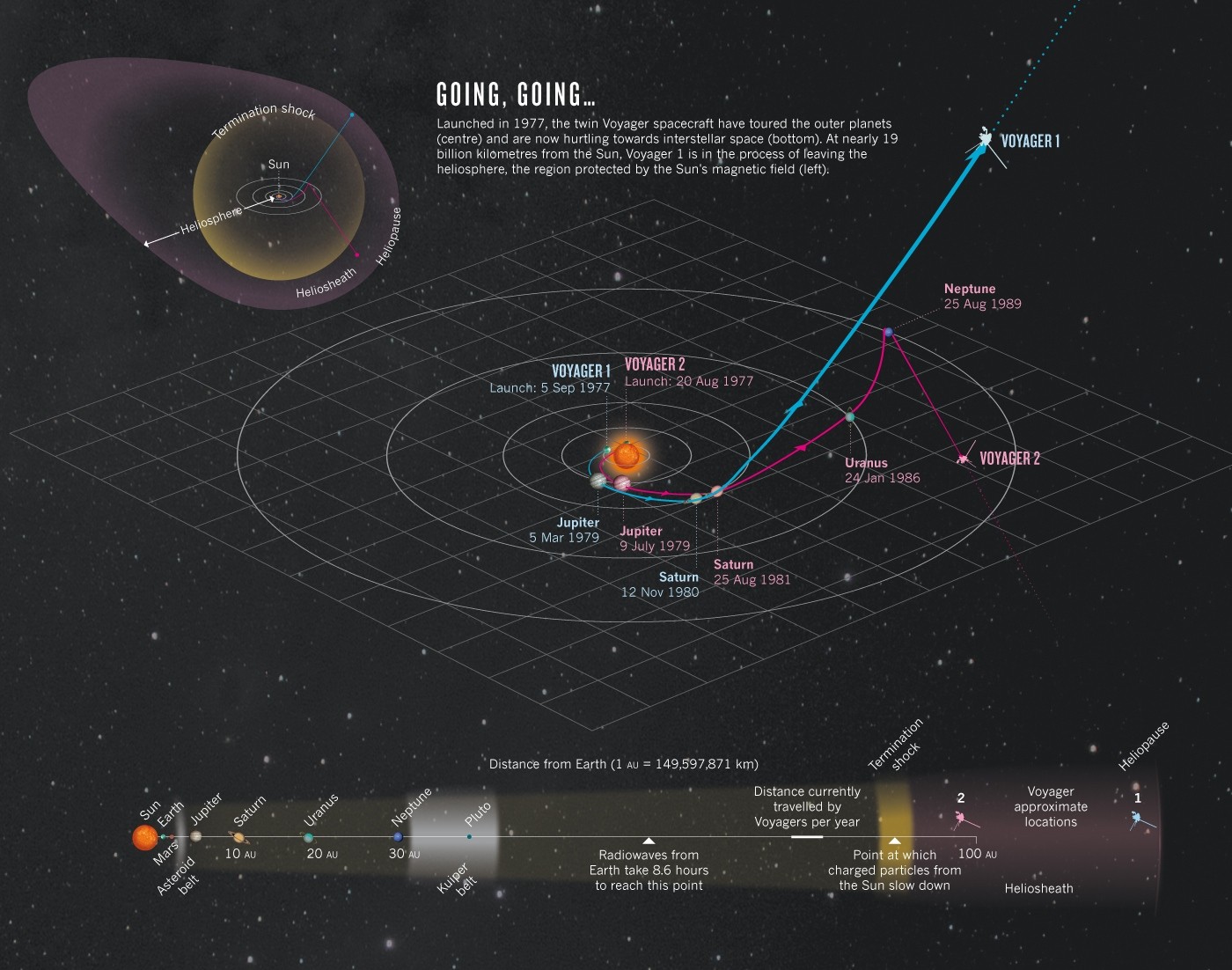
Source: Nature — Voyager: Outward bound | Nature · www.nature.com
Major Discoveries
Io's active volcanoes - first discovered extraterrestrial volcanic activity
Complex ring systems around all gas giants, not just Saturn
Great Dark Spot on Neptune and extreme winds
Magnetic field reversals and unusual orientations
Heliopause boundary where solar wind meets interstellar medium
Statement 3 was correctly matched - Voyagers did explore outer solar system
Voyager 2 is the only spacecraft to visit Uranus and Neptune
Both are still operational and sending data after 45+ years
Venus Exploration Missions
Science And Technology Venus
Venus Missions: Venera & Magellan (Not Cassini)
Venera program (Soviet) first successful Venus missions
Magellan (NASA) mapped Venus surface with radar
Cassini-Huygens went to Saturn, not Venus
Venus has extremely hostile environment with 900°F temperatures
Venus Challenge
Venus is one of the most challenging planets to explore due to crushing atmospheric pressure (90 times Earth's) and sulfuric acid clouds. Surface temperatures reach 462°C - hot enough to melt lead.
Major Venus Missions
Mission | Country | Year | Achievement |
|---|---|---|---|
Venera 7 | Soviet Union | 1970 | First successful Venus landing |
Venera 9 | Soviet Union | 1975 | First Venus surface images |
Magellan | USA | 1989-94 | Radar mapping of 98% of surface |
Venus Express | Europe | 2006-14 | Atmospheric studies |
Akatsuki | Japan | 2015-present | Climate and weather monitoring |
Venus Surface

Source: Rare Historical Photos — Captured by Venera 13 in 1982: The Only Photos Humanity Has of ... · rarehistoricalphotos.com
Major trap: UPSC wrongly paired Cassini with Venus - Cassini went to Saturn
Venera and Magellan are the famous Venus missions, not Cassini
Venus missions are much rarer than Mars missions due to hostile conditions