Consider the following statements: The Mangalyaan launched by ISRO 1. is also called the Mars Orbiter Mission 2. made India the second country to have a spacecraft orbit the Mars after USA 3. made India the only country to be successful in making its spacecraft orbit the Mars in its very first attempt Which of the statements given above is/are correct?
Contents14
- A1 only
- B2 and 3 only
- C1 and 3 only
- D1, 2 and 3
Show answer
Answer: (C) 1 and 3 only
Answer: (c) 1 and 3 only
Statement 1 (✓ CORRECT):
Mangalyaan is also called the Mars Orbiter Mission (MOM).
Both names refer to the same ISRO spacecraft launched November 5, 2013, reaching Mars orbit on September 24, 2014.
Statement 2 (✗ WRONG):
India was NOT the second country after USA.
Multiple entities reached Mars before India:
- NASA (USA) since 1965,
- Soviet Union (Mars 3, 1971),
- ESA (Mars Express, 2003),
- ISRO (2014).
India was the FOURTH entity.
Statement 3 (✓ CORRECT):
India IS the only country to successfully orbit Mars on its very first attempt.
USA, Russia, and ESA all had failures before succeeding.
Other proud facts:
- Most economical interplanetary mission at Rs.450 crore (less than the budget of the movie 'Gravity');
- first Asian country to reach Mars orbit.
Trick: Statement 2 is the trap - 'second country' sounds right but is factually wrong because of Soviet Union and ESA.
Mangalyaan made India the fourth entity to reach Mars orbit, after USA, Soviet Union, and European Space Agency.
India became the only country to succeed in orbiting Mars on its very first attempt, unlike USA, Russia, and ESA who had multiple failures before success.
The question tests whether students know the chronological order of Mars missions by different space agencies, not just India's achievement.
Mangalyaan (Mars Orbiter Mission)
Science And Technology Mangalyaan Mars Orbiter Mission ISRO
Mangalyaan: India's Mars Orbiter Mission & Key Facts
Mangalyaan = Mars Orbiter Mission (MOM) — same spacecraft, two names
Launched November 5, 2013, reached Mars orbit September 24, 2014
India became 4th entity to reach Mars (after USA, USSR, ESA)
Only country to succeed in Mars orbit on first attempt
Most economical Mars mission at ₹450 crore
Mission Overview
Mangalyaan is India's first interplanetary mission, demonstrating the country's capability for cost-effective deep space exploration. The mission serves as a technology demonstrator while conducting scientific studies of Mars' surface and atmosphere.
Key Mission Details
Parameter | Details |
|---|---|
Official Name | Mars Orbiter Mission (MOM) |
Popular Name | Mangalyaan (Mars Craft) |
Launch Date | November 5, 2013 |
Launch Vehicle | PSLV-C25 |
Mars Orbit Insertion | September 24, 2014 |
Mission Cost | ₹450 crore (~$74 million) |
Mission Duration | 6 months planned, exceeded expectations |
Orbit Type | Elliptical orbit around Mars |
Historic Achievements
First Asian country to reach Mars orbit successfully
Most cost-effective interplanetary mission globally — cheaper than Hollywood movie 'Gravity' (₹670 crore budget)
Technology demonstrator for India's deep space exploration capabilities
Carried 5 scientific instruments to study Mars' surface, atmosphere, and mineralogy
Extended operational life beyond planned 6-month duration
Mission Trajectory
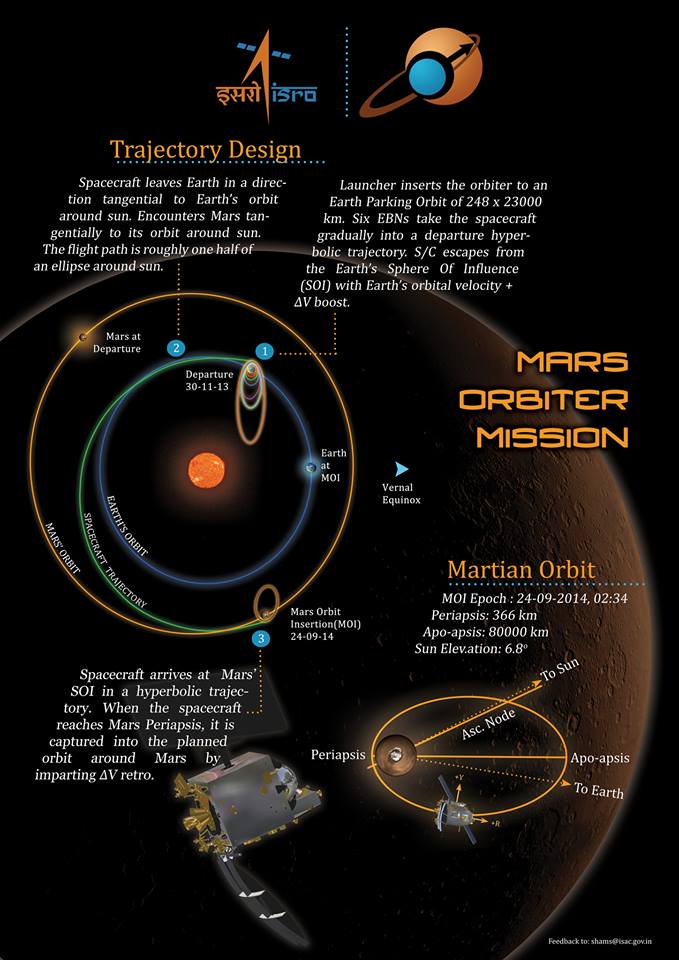
Source: AmericaSpace — India's Mars Mission Back On Track as Spacecraft Apogee Exceeds ... · www.americaspace.com
Question Connection
This question tests knowledge of India's Mars mission facts. Statement 2 is the classic trap — many assume India was second after USA, forgetting that Soviet Union (1971) and ESA (2003) reached Mars before India (2014).
Trap: India was the second country to reach Mars after USA — Wrong! USSR and ESA reached first
Trap: Confusing first attempt success with first to reach — India was 4th to reach but 1st to succeed on first try
Trap: Mixing up MOM and Mangalyaan as different missions — they are the same spacecraft
Trap: Assuming expensive mission due to interplanetary distance — actually most economical Mars mission ever
Global Mars Exploration Timeline
Science And Technology Mars spacecraft
Countries & Agencies That Reached Mars: Complete Timeline
USA (NASA) — first successful Mars missions starting 1965
Soviet Union — Mars 3 successful landing in 1971
European Space Agency (ESA) — Mars Express orbiter in 2003
India (ISRO) — Mangalyaan orbiter in 2014, first-attempt success
Mars Mission Milestones by Country
Country/Agency | First Success | Mission Name | Type | Key Achievement |
|---|---|---|---|---|
USA (NASA) | 1965 | Mariner 4 | Flyby | First close-up Mars photos |
Soviet Union | 1971 | Mars 3 | Lander | First soft landing on Mars |
European Space Agency | 2003 | Mars Express | Orbiter | Still operational after 20+ years |
India (ISRO) | 2014 | Mangalyaan/MOM | Orbiter | First-attempt success, most economical |
China (CNSA) | 2021 | Tianwen-1 | Orbiter + Rover | Zhurong rover successful landing |
Success vs Failure Patterns
Mars missions have ~50% failure rate — technical challenges of interplanetary travel
USA had multiple failures before Mariner 4 success (Mariner 1, 3 failed)
Soviet Union lost many missions — Mars 1, 2 failed before Mars 3 succeeded
ESA's Beagle 2 lander failed in 2003, though Mars Express orbiter succeeded
Only India achieved orbit on first attempt — unique achievement in Mars exploration
Current Mars Missions
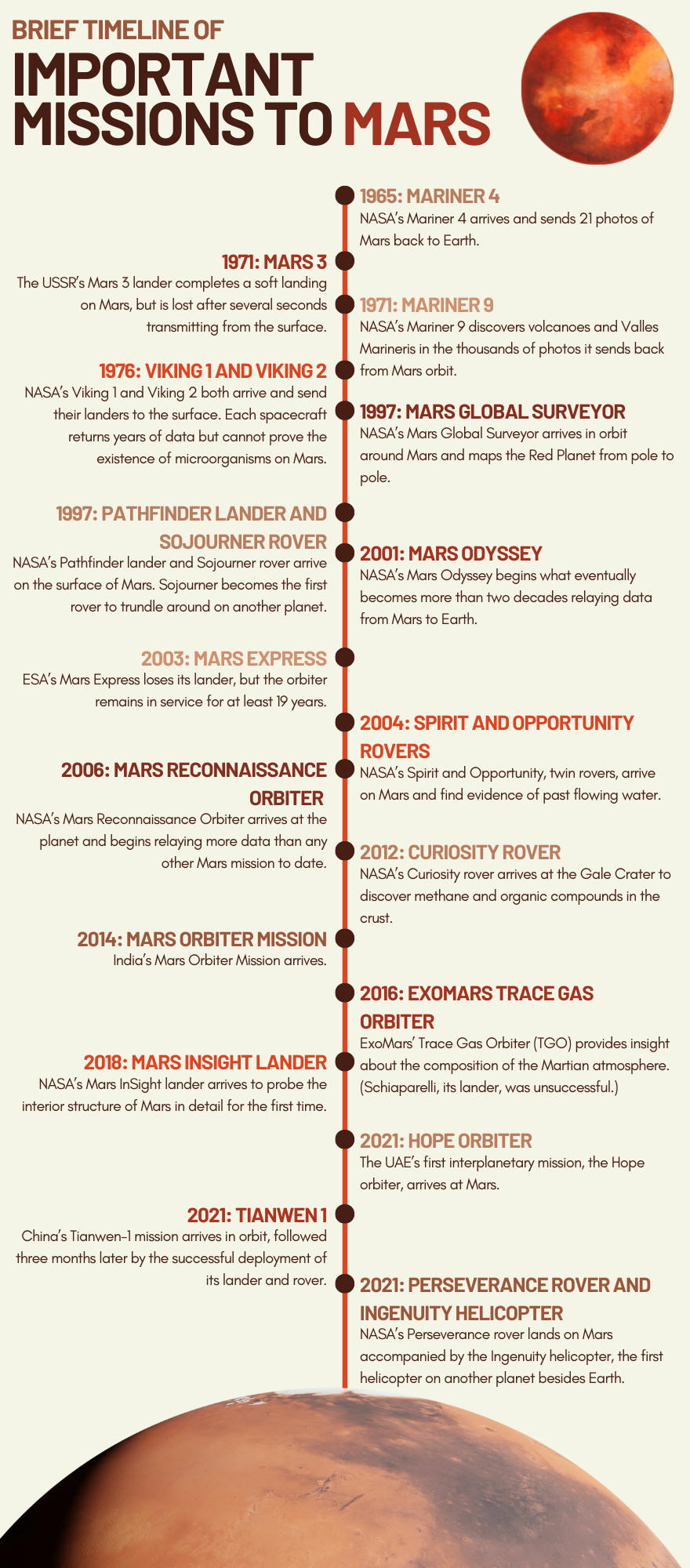
Source: Space — Mars missions: A brief history | Space · www.space.com
Trap: Assuming India was 2nd after USA — USSR and ESA came before India chronologically
Trap: Confusing first successful mission with first attempt success — different concepts
Trap: Forgetting ESA as a separate entity from individual European countries
Trap: Mixing up Mars flyby, orbiter, lander, and rover missions — different complexity levels
ISRO Major Space Achievements
Science And Technology ISRO
ISRO's Landmark Missions & Global Recognition
Chandrayaan-1 — India's first moon mission, discovered water on Moon
Mangalyaan — first Mars mission, most economical interplanetary mission
104 satellites in single launch — world record (PSLV-C37, 2017)
PSLV workhorse — 50+ successful launches, commercial satellite services
ISRO Milestone Missions
Mission | Year | Achievement | Global Recognition |
|---|---|---|---|
Aryabhata | 1975 | First Indian satellite | Space program foundation |
SLV-3 | 1980 | First indigenous launch vehicle | Launch capability demonstration |
Chandrayaan-1 | 2008 | Moon orbiter, water discovery | Lunar exploration success |
Mangalyaan/MOM | 2013-14 | Mars orbiter, first attempt | Most economical Mars mission |
PSLV-C37 | 2017 | 104 satellites in single launch | World record for multi-satellite launch |
Chandrayaan-2 | 2019 | Moon orbiter + lander attempt | Advanced lunar exploration |
Chandrayaan-3 | 2023 | Successful Moon south pole landing | 4th country to land on Moon |
ISRO's Unique Strengths
Cost-effective missions — Mangalyaan cheaper than most Hollywood space movies
Reliable PSLV launcher — preferred vehicle for international commercial launches
Indigenous technology development — minimal foreign dependence in critical components
Commercial satellite services — earning foreign exchange through Antrix Corporation
Frugal engineering approach — maximum results with minimal resources
ISRO Mission Categories
# ISRO Missions
## Earth Observation
- IRS series
- Cartosat
- RISAT
- Oceansat
## Communication
- INSAT series
- GSAT series
- IRNSS/NavIC
## Scientific
- Chandrayaan
- Mangalyaan
- Astrosat
- Aditya-L1
## Launch Vehicles
- PSLV
- GSLV
- GSLV Mk III
- Future RLVTrap: Confusing Chandrayaan (Moon) with Mangalyaan (Mars) mission names
Trap: Assuming ISRO missions are expensive — actually known for frugal engineering
Trap: Mixing up PSLV (Polar) with GSLV (Geosynchronous) launch vehicles
Trap: Forgetting ISRO's commercial success — not just scientific achievements