With reference to ‘LiFi’, recently in the news, which of the following statements is/are correct? 1. It uses light as the medium for high-speed data transmission. 2. It is a wireless technology and is several times faster than ‘WiFi’. Select the correct answer using the code given below.
Contents16
- A1 only
- B2 only
- CBoth 1 and 2
- DNeither 1 nor 2
Show answer
Answer: (C) Both 1 and 2
Answer: (c) Both 1 and 2
Statement 1 (✓ CORRECT):
Li-Fi (Light Fidelity) uses VISIBLE LIGHT for high-speed data transmission by flickering LED lights at extremely high speeds (invisible to the eye).
Statement 2 (✓ CORRECT):
Li-Fi IS wireless (uses light waves, not wires) and is SEVERAL TIMES FASTER than Wi-Fi.
Li-Fi can theoretically reach up to 224 Gbps versus Wi-Fi's few Gbps.
Comparison:
- Li-Fi uses visible light while Wi-Fi uses radio waves;
- Li-Fi is faster but has a limited range (room-level);
- Li-Fi is more secure since light cannot pass through walls;
- Li-Fi has no radio frequency interference.
Advantages of Li-Fi:
- Works where Wi-Fi cannot (aircraft cabins, hospitals, hazardous areas);
- Light spectrum is 10,000 times larger than radio spectrum.
Limitation:
Requires line of sight - if there is a wall between you and the light source, connection is lost.
LiFi uses visible light spectrum which is 10,000 times larger than the radio spectrum used by WiFi, enabling theoretical speeds up to 224 Gbps.
LiFi was prominently in news around 2015-2016 when several countries including India began testing this technology for potential commercial deployment.
The question tests understanding of both the technical mechanism (light vs radio waves) and the practical advantages of this emerging wireless technology.
Li-Fi (Light Fidelity) Technology
Science And Technology LiFi light high-speed data transmission wireless technology
Li-Fi Technology: Light-Based Wireless Communication
Li-Fi uses visible light from LED bulbs for high-speed data transmission
Li-Fi is wireless and theoretically 224 Gbps vs Wi-Fi's few Gbps
Requires line of sight - light cannot pass through walls
Works in RF-sensitive areas like aircraft cabins and hospitals
Li-Fi (Light Fidelity) transmits data by rapidly flickering LED lights at frequencies invisible to human eyes. Unlike Wi-Fi's radio waves, Li-Fi uses the visible light spectrum for wireless communication.
Li-Fi vs Wi-Fi Comparison
Parameter | Li-Fi | Wi-Fi |
|---|---|---|
Medium | Visible light (LED) | Radio waves |
Speed | Up to 224 Gbps (theoretical) | Few Gbps |
Range | Room-level (line of sight) | Building-wide |
Security | More secure (light doesn't penetrate walls) | Less secure |
Interference | No RF interference | RF interference possible |
Penetration | Cannot pass through walls | Can pass through walls |
Key Advantages
Light spectrum is 10,000 times larger than radio spectrum - more bandwidth available
Works in RF-sensitive environments like aircraft cabins, hospitals, and hazardous industrial areas
Enhanced security since light signals cannot penetrate walls or solid objects
No electromagnetic interference with existing radio-based systems
How Li-Fi Works
%%{init: {"flowchart": {"wrappingWidth": 460}}}%%
flowchart TD
  s1["`**Data Input**
Digital data fed to LED driver circuit`"]
  s2["`**Light Modulation**
LED flickers at high frequency (invisible to eyes)`"]
  s3["`**Light Transmission**
Modulated light carries data across room`"]
  s4["`**Photodetector Reception**
Receiver detects light variations`"]
  s5["`**Data Recovery**
Light signals converted back to digital data`"]
  s1 --> s2
  s2 --> s3
  s3 --> s4
s4 --> s5Trap: Li-Fi is wireless - many assume 'light-based' means wired connection
Trap: Li-Fi is several times faster than Wi-Fi, not just 'comparable speed'
Trap: Li-Fi uses visible light, not infrared or laser light
Common confusion: Li-Fi's main limitation is line of sight requirement, not speed
Wireless Communication Technologies
Science And Technology WiFi wireless technology faster
Wireless Communication: Radio vs Light Spectrum
Wi-Fi uses 2.4 GHz and 5 GHz radio frequency bands
Visible light spectrum offers much larger bandwidth than radio waves
Bluetooth operates in 2.4 GHz band with shorter range
Major Wireless Technologies
Technology | Frequency/Medium | Typical Speed | Range | Key Use |
|---|---|---|---|---|
Wi-Fi | 2.4/5 GHz radio | 150 Mbps - 1 Gbps | 100m indoor | Internet access |
Bluetooth | 2.4 GHz radio | 1-24 Mbps | 10m | Device pairing |
Li-Fi | Visible light | Up to 224 Gbps | Room-level | High-speed data |
Cellular (4G/5G) | Various radio bands | 100 Mbps - 10 Gbps | Cell tower coverage | Mobile communication |
Infrared | Infrared light | Up to 4 Mbps | 1-2m | Remote controls |
Electromagnetic Spectrum for Communication
# Electromagnetic Spectrum
## Radio Waves
- Wi-Fi (2.4/5 GHz)
- Bluetooth
- Cellular
- Satellite
## Infrared
- Remote controls
- Short-range data
- Night vision
## Visible Light
- Li-Fi
- Optical fiber
- Laser communication
## Higher Frequencies
- UV
- X-rays
- Gamma rays
Spectrum Utilization Challenges
Radio spectrum congestion - limited bandwidth shared by multiple technologies
Licensing requirements for radio frequencies vs unlicensed visible light spectrum
Interference issues in radio bands, especially in crowded urban areas
Light spectrum is 10,000 times larger than radio spectrum but requires line of sight
Optical Communication Systems
Science And Technology light data transmission
Optical Communication: Fiber vs Li-Fi vs Laser
Fiber optic cables use infrared light through glass fibers for wired communication
Li-Fi uses visible light LEDs for wireless communication within rooms
Free Space Optics uses laser beams for point-to-point wireless links
Optical Communication Types
Type | Light Source | Medium | Range | Speed | Application |
|---|---|---|---|---|---|
Fiber Optic | Infrared laser/LED | Glass fiber cable | Thousands of km | Up to 100 Tbps | Internet backbone |
Li-Fi | Visible LED | Air (visible light) | Room-level | Up to 224 Gbps | Indoor wireless |
Free Space Optics | Infrared laser | Air (laser beam) | Up to 5 km | Up to 10 Gbps | Building-to-building |
Underwater Optical | Blue-green laser | Water | Hundreds of meters | Mbps range | Submarine communication |
Advantages of Optical Communication
High bandwidth - light can carry much more information than radio waves
Security - optical signals difficult to intercept without physical access
No electromagnetic interference - immune to radio frequency interference
Energy efficiency - LEDs consume less power than radio transmitters for equivalent data rates
Optical Communication Spectrum
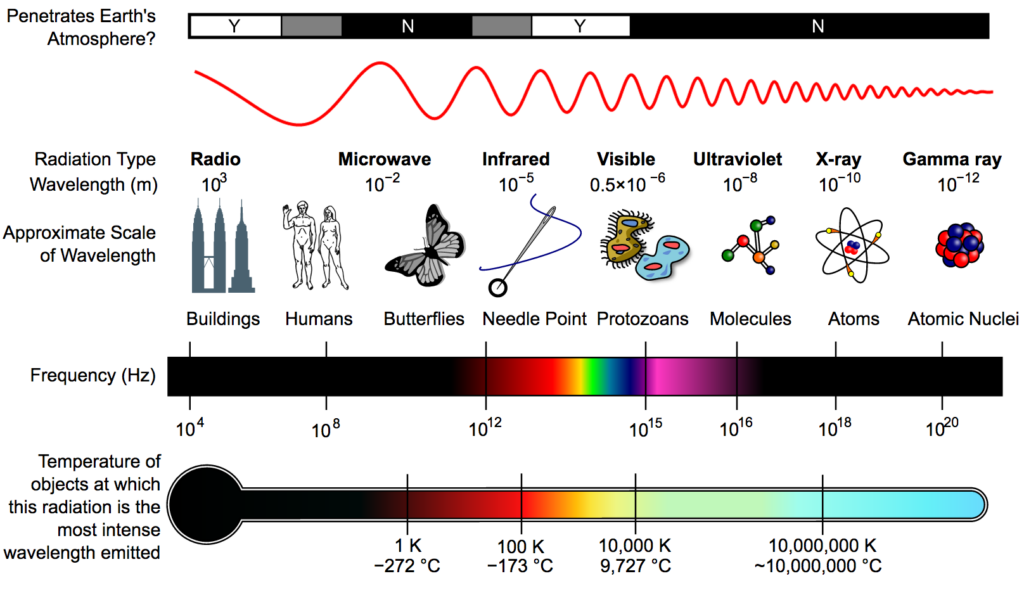
Source: FindLight — Electromagnetic Spectrum: From XUV to Microwaves · www.findlight.net
Trap: Fiber optic is wired, Li-Fi is wireless - both use light but different delivery methods
Trap: Li-Fi uses visible light, fiber optics typically use infrared light
Don't confuse Free Space Optics (laser beams) with Li-Fi (LED visible light)
Emerging Communication Technologies in India
Science And Technology
India's Advanced Communication Technology Initiatives
Digital India promotes adoption of emerging communication technologies
5G rollout in India focuses on industrial IoT and rural connectivity
Indian companies are researching Li-Fi applications for smart cities
India is exploring Li-Fi technology for applications in hospitals, aircraft, and smart buildings where traditional Wi-Fi faces limitations. Several Indian startups and research institutions are developing Li-Fi solutions.
Indian Li-Fi & Advanced Wireless Initiatives
IIT Madras and other institutions researching visible light communication applications
Smart Cities Mission exploring Li-Fi for intelligent street lighting with data transmission
Healthcare applications - Li-Fi being tested in hospitals to avoid RF interference with medical equipment
Aviation sector - Indian airlines exploring Li-Fi for in-flight internet services
India's Communication Technology Priorities
Technology | Government Initiative | Key Application Areas | Implementation Status |
|---|---|---|---|
5G Networks | National 5G Mission | Smart cities, IoT, rural broadband | Commercial rollout ongoing |
Li-Fi | Research in IITs/IISc | Hospitals, aircraft cabins, secure areas | Research & pilot phase |
Satellite Internet | BharatNet, ISRO programs | Remote areas, disaster management | Expanding coverage |
Fiber Optics | BharatNet Phase II | Rural connectivity, digital backbone | Implementation ongoing |
Strategic Importance for India
RF spectrum scarcity makes Li-Fi attractive for high-density urban areas
Security applications - Li-Fi suitable for defense and sensitive government facilities
Rural connectivity - Combination of 5G, satellite, and optical technologies for comprehensive coverage