India is an important member of the 'International Thermonuclear Experimental Reactor'. If this experiment succeeds, what is the immediate advantage for India?
Contents14
- AIt can use thorium in place of uranium for power generation
- BIt attain a global role in satellite-navigation
- CIt can drastically improve the efficiency of its fission reactors in power generation
- DIt can build fusion reactors for power generation
Show answer
Answer: (D) It can build fusion reactors for power generation
Answer: (d) It can build fusion reactors for power generation
ITER = International Thermonuclear Experimental Reactor.
The key word is 'thermonuclear' which means FUSION (not fission).
Fusion vs Fission:
- Fission = splitting heavy atoms (like uranium) - this is what current nuclear plants do
- Fusion = joining light atoms (like hydrogen) - this is what the Sun does, much more powerful and cleaner
If ITER succeeds, India can build fusion reactors.
That is the direct, immediate advantage.
Why not the other options?
- (a) Thorium use relates to India's 3-stage nuclear programme (fission-based), not fusion.
- (b) Satellite navigation is completely unrelated to nuclear energy.
- (c) ITER is about fusion, not improving existing fission technology.
Memory aid: ITER = Fusion = joining atoms = future clean energy.
ITER is the world's largest fusion energy experiment, designed to prove that fusion can generate more energy than it consumes - potentially solving humanity's clean energy needs.
India joined ITER in 2005 and contributes both funding and technology, making it crucial for India's future energy security as fossil fuels decline.
The question tests whether students understand the difference between fusion (joining light atoms like hydrogen) and fission (splitting heavy atoms like uranium) that current nuclear plants use.
ITER (International Thermonuclear Experimental Reactor)
Science And Technology International Thermonuclear Experimental Reactor ITER thermonuclear
ITER: World's Largest Fusion Experiment & India's Role
ITER is the world's largest nuclear fusion experiment, not fission
India is a key member contributing 9% of project costs
Success means India can build fusion reactors for clean energy
Located in Cadarache, France with 35 nations participating
What is ITER
ITER stands for International Thermonuclear Experimental Reactor — the world's largest fusion experiment. The key word 'thermonuclear' means fusion, not fission. It aims to prove that fusion can produce 10 times more energy than it consumes.
ITER Key Facts
Aspect | Details |
|---|---|
Location | Cadarache, France |
Members | 35 nations including India, EU, US, Russia, China, Japan |
India's Share | 9% of total project costs |
Project Cost | Over $20 billion |
Timeline | First plasma expected 2025-2030 |
Goal | Achieve 500 MW output from 50 MW input |
India's ITER Benefits
# India's ITER Advantages
## Technology Transfer
- Fusion reactor design
- Plasma physics
- Superconducting magnets
- Advanced materials
## Energy Security
- Clean unlimited energy
- No radioactive waste
- Fuel from seawater
- No meltdown risk
## Industrial Gains
- High-tech manufacturing
- Export opportunities
- Skilled workforce
- R&D partnerships
Question Connection
The question asks about ITER's immediate advantage for India. Since ITER is a fusion experiment (thermonuclear = fusion), success means India can build fusion reactors. Options about thorium, satellites, or fission improvements are unrelated to fusion technology.
Trap: 'Thermonuclear' sounds like fission but means fusion — joining atoms, not splitting
Trap: Thorium relates to India's 3-stage fission programme, not ITER fusion
Trap: ITER won't improve existing fission reactors — it's developing fusion technology
Confusion: Nuclear = both fission AND fusion — ITER specifically does fusion
Nuclear Fusion vs Fission
Science And Technology fusion fission thermonuclear
Fusion vs Fission: Core Differences & UPSC Traps
Fission splits heavy atoms (uranium); fusion joins light atoms (hydrogen)
Current nuclear plants use fission; Sun uses fusion
Fusion produces 4x more energy per unit mass than fission
Fusion creates no long-term radioactive waste
Fusion vs Fission Comparison
Aspect | Nuclear Fission | Nuclear Fusion |
|---|---|---|
Process | Splits heavy atoms | Joins light atoms |
Fuel | Uranium-235, Plutonium | Hydrogen isotopes (deuterium, tritium) |
Temperature | Normal reactor conditions | 100+ million°C |
Radioactive Waste | Long-term (thousands of years) | Minimal short-term |
Safety Risk | Meltdown possible | Reaction stops if containment fails |
Current Status | Commercial power plants | Experimental stage |
Examples | Indian nuclear plants | Sun, ITER experiment |
Energy Output | High | 4x higher per unit mass |
Fusion Process
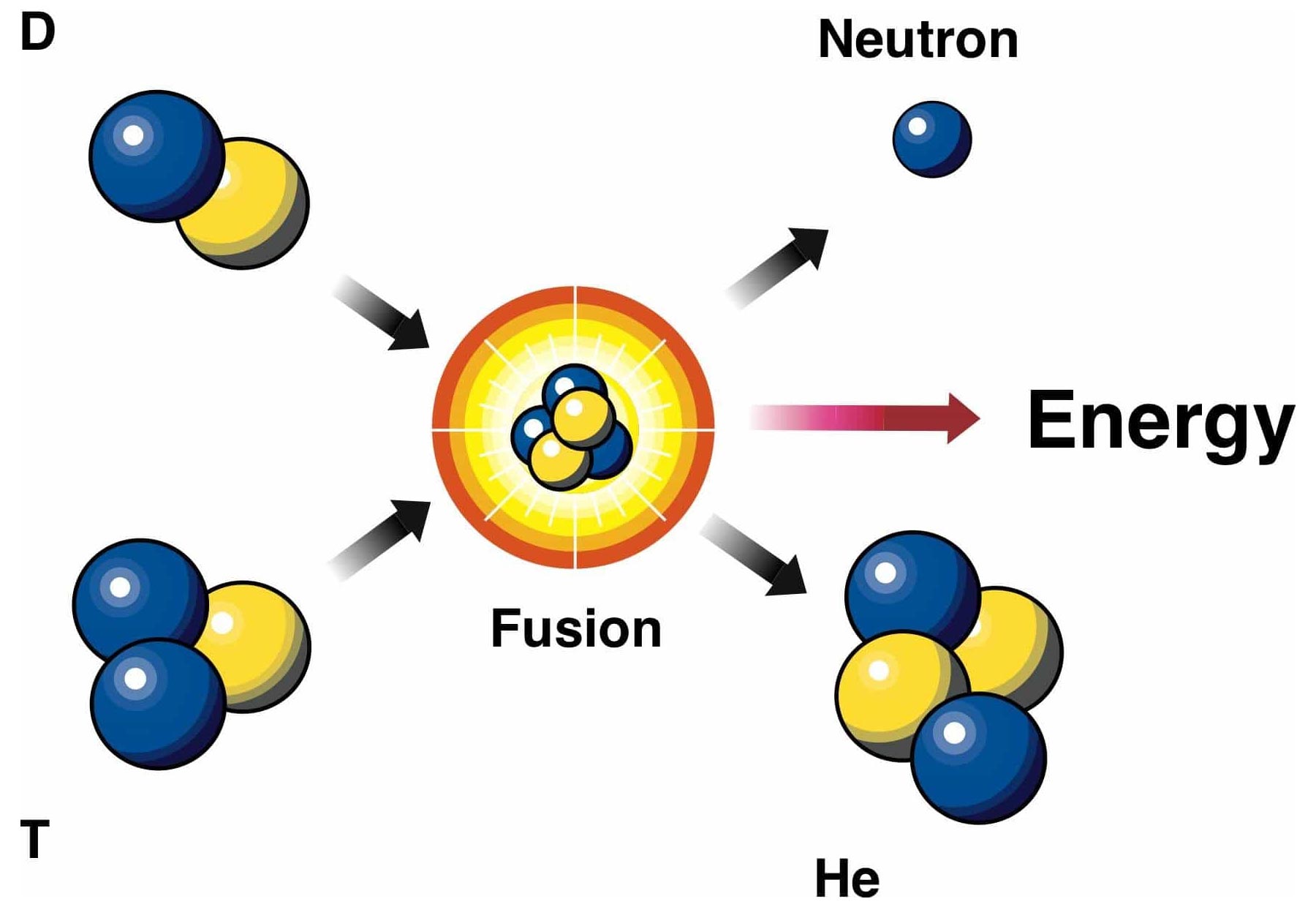
Source: SciTechDaily — Science Made Simple: What Are Nuclear Fusion Reactions? · scitechdaily.com
Why Fusion is Better
Fuel abundance: Hydrogen can be extracted from seawater — virtually unlimited supply
Clean energy: No carbon emissions, no long-term radioactive waste storage problems
Inherently safe: Reaction requires precise conditions — any disruption stops the process immediately
Higher efficiency: Gram for gram, fusion releases much more energy than fission or fossil fuels
Trap: 'Nuclear' doesn't specify fission or fusion — context matters
Memory: Fission = Fissure = Split; Fusion = Fuse = Join
Trap: Thermonuclear = Fusion (high temperature nuclear reaction)
Confusion: Both release energy, but fusion joins light atoms, fission splits heavy atoms
India's Three-Stage Nuclear Programme
Science And Technology thorium uranium
India's 3-Stage Nuclear Programme: Thorium Strategy
Stage 1: Natural uranium in Pressurized Heavy Water Reactors (PHWRs)
Stage 2: Plutonium from Stage 1 in Fast Breeder Reactors (FBRs)
Stage 3: Thorium-Uranium-233 cycle for long-term energy security
India has 25% of world's thorium reserves
Why This Programme
India designed this programme because it has limited uranium but abundant thorium reserves. The strategy converts thorium (not directly fissile) into Uranium-233 (fissile) through a multi-stage process.
Three Stages Explained
%%{init: {"flowchart": {"wrappingWidth": 460}}}%%
flowchart TD
  s1["`**Stage 1: Natural Uranium Reactors**
**PHWRs** use natural uranium, produce **plutonium-239** as byproduct`"]
  s2["`**Stage 2: Fast Breeder Reactors**
Use **plutonium** from Stage 1, breed more plutonium, produce **Uranium-233** from thorium`"]
  s3["`**Stage 3: Thorium Reactors**
Use **Uranium-233** to sustain **thorium fuel cycle** — long-term energy security`"]
  s1 --> s2
  s2 --> s3
India's Nuclear Reactor Status
Stage | Reactor Type | Fuel | Status | Key Example |
|---|---|---|---|---|
1 | PHWR | Natural uranium | Operational | Tarapur, Kudankulam |
2 | FBR | Plutonium + uranium | Under development | Prototype FBR at Kalpakkam |
3 | AHWR | Thorium + U-233 | R&D stage | Advanced Heavy Water Reactor |
ITER vs Thorium Distinction
Important: India's thorium programme is fission-based (splitting atoms). ITER is fusion-based (joining atoms). These are completely different nuclear technologies — thorium use has nothing to do with fusion reactor success.
Trap: Thorium programme ≠ ITER — thorium is fission, ITER is fusion
Memory: 3 stages = 3 different fuels — natural uranium → plutonium → thorium-U233
Confusion: India has thorium reserves but cannot directly use thorium without the 3-stage process
Trap: Stage 2 Fast Breeder Reactors are still under development, not fully operational