With reference to street-lighting, how do sodium lamps differ from LED lamps? 1. Sodium lamps produce light in 360 degrees but it is not so in the case of LED lamps. 2. As street-lights, sodium lamps have longer life span than LED lamps. 3. The spectrum of visible light from sodium lamps is almost monochromatic while LED lamps offer significant colour advantages in street-lighting. Select the correct answer using the code given below.
Contents18
- A3 only
- B2 only
- C1 and 3 only
- D1, 2 and 3
Show answer
Answer: (C) 1 and 3 only
Statement 1 is correct:
Sodium lamps emit light in all 360 degrees (omnidirectional),
meaning at least half the light goes the wrong way and must be reflected.
LEDs emit directionally (about 180 degrees),
so most light goes where needed.
Statement 2 is wrong:
LEDs actually last much longer — over 100,000 hours,
more than 4 times sodium lamps.
LEDs have far lower maintenance costs.
Statement 3 is correct:
Sodium lamps produce narrow-spectrum yellow-orange light (monochromatic),
making other colors appear grey.
LEDs offer broad-spectrum light with CRI of 65-95,
showing colors much more accurately.
Statements 1 and 3 are correct.
Answer: (c).
LEDs last over 100,000 hours compared to sodium lamps at about 24,000 hours, making LED street lighting far more cost-effective for municipalities.
Around 2020-21, many Indian cities accelerated LED street light replacement under SLNP and other programs, making this comparison highly relevant for current affairs.
The question tests practical knowledge of lighting technology differences that affect urban infrastructure decisions.
Sodium Street Lamps
Science And Technology sodium lamps
Sodium Street Lamps: Technology & Characteristics
Sodium lamps emit omnidirectional light (360 degrees) requiring reflectors
Produce monochromatic yellow-orange light (narrow spectrum)
Lifespan is 20,000-24,000 hours (shorter than LEDs)
Two types: High Pressure Sodium (HPS) and Low Pressure Sodium (LPS)
Basic Technology
Sodium lamps contain sodium vapor that produces light when electricity passes through it. The characteristic yellow-orange glow comes from sodium atoms emitting light at specific wavelengths around 589 nanometers.
Types of Sodium Lamps
Type | Light Color | Efficiency | Common Use |
|---|---|---|---|
Low Pressure Sodium (LPS) | Pure yellow (monochromatic) | Very high | Highways, industrial areas |
High Pressure Sodium (HPS) | Yellow-orange (broader) | High | Street lighting, parking lots |
Key Characteristics
Omnidirectional emission: Light spreads in all 360 degrees, requiring reflectors to direct light downward
Warm-up time: Takes 1-4 minutes to reach full brightness after switching on
Poor color rendering: Makes other colors appear grey or washed out
High luminous efficacy: Produces more lumens per watt than incandescent bulbs
Heat generation: Operates at high temperatures, requires proper ventilation
Trap: Statement 2 claims sodium lamps last longer than LEDs - actually LEDs last 4x longer
Confusion: Both sodium lamps are efficient, but LPS is more efficient than HPS
Remember: Monochromatic = narrow spectrum, not single wavelength
LED Street Lamps
Science And Technology LED lamps
LED Street Lamps: Technology & Advantages
LEDs emit directional light (180 degrees) with minimal light wastage
Provide broad spectrum light with excellent color rendering
Lifespan exceeds 100,000 hours (4x longer than sodium lamps)
CRI of 65-95 shows colors accurately compared to sodium's poor CRI
LED Technology
Light Emitting Diodes (LEDs) use semiconductors that emit light when electric current passes through them. Unlike sodium lamps, they produce white light by combining different wavelengths or using phosphor coatings.
LED vs Sodium Comparison
Parameter | LED Lamps | Sodium Lamps |
|---|---|---|
Light Direction | Directional (180°) | Omnidirectional (360°) |
Light Spectrum | Broad spectrum white | Narrow yellow-orange |
Lifespan | 100,000+ hours | 20,000-24,000 hours |
Color Rendering | CRI 65-95 | Poor CRI (<25) |
Warm-up Time | Instant on | 1-4 minutes |
Maintenance | Very low | Higher due to shorter life |
LED Advantages
Directional lighting: Most light goes where needed, reducing light pollution
Instant illumination: No warm-up time, reaches full brightness immediately
Superior color rendering: Objects appear in natural colors, improving safety
Lower heat generation: Cooler operation reduces fire risk and energy waste
Dimming capability: Can be easily controlled for smart lighting systems
Light Distribution Patterns
Side-by-side diagram showing omnidirectional light pattern from sodium lamp (360 degrees) versus directional LED light pattern (180 degrees focused downward)
LEDs waste less light by emitting directionally, unlike sodium lamps that scatter light in all directions
Trap: Don't assume all directional lighting means narrow beam - LEDs still cover wide areas
Remember: CRI = Color Rendering Index measures how accurately colors appear
Key distinction: Broad spectrum ≠ full spectrum - LEDs offer better color than sodium, not perfect color
Street Lighting Technology Evolution
Science And Technology street-lighting street-lights
Street Lighting Technology: Evolution & Current Trends
Evolution: Incandescent → Sodium → LED represents increasing efficiency
LED adoption growing rapidly due to 4x longer life and better light quality
Modern focus on smart lighting with dimming and remote control
Street Lighting Evolution
Technology | Era | Efficiency | Key Limitation |
|---|---|---|---|
Incandescent | Early 1900s-1960s | Low | High energy consumption, short life |
Mercury Vapor | 1940s-1990s | Medium | Contains toxic mercury |
Sodium (HPS/LPS) | 1970s-2010s | High | Poor color rendering, omnidirectional |
LED | 2000s-present | Very High | Higher initial cost (decreasing) |
Smart LED | 2010s-present | Adaptive | Requires infrastructure investment |
Current Trends
Smart city integration: LEDs with sensors for traffic, weather, and security monitoring
Adaptive lighting: Brightness adjusts based on traffic, time, and ambient conditions
Reduced light pollution: Directional LEDs minimize sky glow and glare
Energy savings: LED street lighting reduces municipal electricity bills by 50-70%
Question Context
This UPSC question tests understanding of fundamental differences between sodium and LED technology - specifically light distribution patterns, lifespan, and color rendering. The trap was statement 2 reversing the actual lifespan comparison.
Common reversal trap: LEDs last longer than sodium lamps, not the other way around
Don't confuse luminous efficacy (lumens/watt) with lifespan (operating hours)
Omnidirectional means 360°, directional means focused (usually 180° or less)
Color Rendering & Light Spectrum
Science And Technology spectrum visible light monochromatic colour advantages
Color Rendering & Light Spectrum in Street Lighting
Monochromatic light contains narrow wavelength range (like sodium's yellow)
Color Rendering Index (CRI) measures how accurately colors appear under a light source
Broad spectrum light shows colors more naturally than narrow spectrum
CRI scale: 0-100, with 100 being perfect (like sunlight)
Light Spectrum Basics
Light spectrum refers to the range of wavelengths a light source emits. Monochromatic light contains wavelengths in a very narrow band, while broad spectrum covers a wide range of visible wavelengths (400-700 nanometers).
Spectrum Comparison
Light Source | Spectrum Type | CRI Value | Color Appearance |
|---|---|---|---|
Sunlight | Full spectrum | 100 | All colors appear natural |
LED (white) | Broad spectrum | 65-95 | Good color rendering |
High Pressure Sodium | Limited spectrum | 20-25 | Colors appear yellowish |
Low Pressure Sodium | Monochromatic | <10 | Everything appears yellow-grey |
Why Spectrum Matters
Safety: Better color rendering helps identify objects, people, and hazards accurately
Security: CCTV cameras capture clearer images under broad spectrum light
Aesthetics: Buildings, landscapes, and signage appear more attractive
Psychology: Broad spectrum light feels more comfortable and natural to humans
Spectrum Visualization
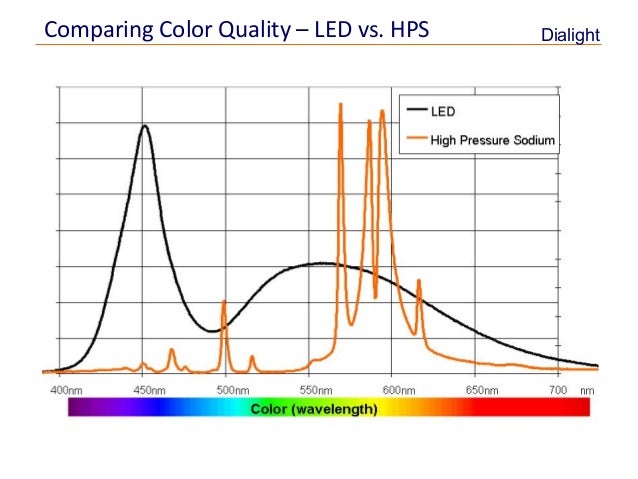
Source: Reddit — Comparison on the effect of light pollution after the city of ... · www.reddit.com
Monochromatic ≠ single wavelength - it means very narrow spectrum range
Higher CRI is better: LED CRI 65-95 > Sodium CRI <25
Don't confuse light spectrum with electromagnetic spectrum (includes radio, X-ray, etc.)