An artificial satellite orbiting around the Earth does not fall down. This is so because the attraction of Earth.
Contents12
- ADoes not exist at such distance
- BIs neutralized by the attraction of the moon
- CProvides the necessary speed for its steady motion
- DProvides the necessary acceleration for its motion
Show answer
Answer: (D) Provides the necessary acceleration for its motion
A satellite doesn't fall to Earth even though gravity pulls it,
because gravity provides the centripetal acceleration needed to keep it moving in a circular orbit.
Think of it like swinging a ball on a string — the string (gravity) constantly pulls the ball inward,
but the ball's forward speed keeps it moving in a circle instead of falling straight down.
Option (a) is wrong — gravity absolutely exists at satellite altitudes (it's only about 10% weaker at ISS height).
Option (b) is wrong — the Moon's gravity is far too weak to cancel Earth's pull at those distances.
Option (c) is tricky but wrong — gravity doesn't provide SPEED; the satellite already has forward speed from its launch.
Gravity provides ACCELERATION (change in direction), bending the straight-line path into a curve.
Key physics:
- Gravity = centripetal force → provides acceleration → curves the path into an orbit.
Satellites stay in orbit because Earth's gravity provides the centripetal acceleration that curves their straight-line motion into a circular path.
The question tests the difference between speed (which satellites get from launch) and acceleration (which gravity provides to bend the path) — a fundamental physics concept UPSC uses to check if students truly understand orbital mechanics.
Orbital Mechanics & Gravity
Science And Technology artificial satellite orbiting attraction of Earth fall down
Orbital Mechanics: Why Satellites Don't Fall to Earth
Satellites orbit because gravity provides centripetal acceleration, not speed
Gravity curves the satellite's straight-line path into a circular orbit
Gravity exists at satellite altitudes — only 10% weaker at ISS height
Moon's gravity is too weak to neutralize Earth's pull on satellites
The Physics
A satellite doesn't fall to Earth because gravity acts as centripetal force. The satellite has forward speed from its launch, and gravity constantly pulls it toward Earth's center. This creates circular motion — like a ball on a string being swung in a circle.
Forward speed tries to make the satellite fly straight
Gravity pulls it inward
Result: curved path = orbit
How Orbits Work
%%{init: {"flowchart": {"wrappingWidth": 460}}}%%
flowchart TD
  s1["`**Launch**
Rocket gives satellite **horizontal speed** (about 7.8 km/s for low Earth orbit)`"]
  s2["`**Gravity Acts**
Earth's gravity pulls satellite **downward** with constant acceleration`"]
  s3["`**Path Curves**
Forward motion + downward pull = **curved trajectory**`"]
  s4["`**Stable Orbit**
Satellite 'falls' around Earth in a continuous circle`"]
  s1 --> s2
  s2 --> s3
  s3 --> s4
Key Physics Concepts
Concept | Role in Orbit | Common Mistake |
|---|---|---|
Speed | Launch provides horizontal velocity | Thinking gravity provides speed |
Acceleration | Gravity changes direction (not speed) | Confusing speed with acceleration |
Centripetal Force | Gravity = inward force keeping circular path | Thinking satellites escape gravity |
Free Fall | Satellite is always falling toward Earth | Thinking 'no gravity' in space |
Orbital Motion Diagram

Source: Science Ready — HSC Physics: Orbital Velocity Explained – Science Ready · scienceready.com.au
Trap: Option C says gravity 'provides speed' — gravity provides acceleration (direction change)
Trap: 'No gravity in space' — gravity exists but gets weaker with distance (inverse square law)
Trap: Moon cancels Earth's gravity — Moon's pull is negligible compared to Earth at satellite distances
Confusion: Acceleration vs Speed — satellites have constant speed but changing direction
Gravity Variation with Altitude
Science And Technology distance attraction of Earth
How Earth's Gravity Changes with Altitude
Gravity follows inverse square law — weakens with distance but never disappears
At ISS altitude (400 km), gravity is still 90% of surface strength
Geostationary orbit (36,000 km): gravity is about 3% of surface value
The Math
Inverse Square Law: Gravity = GM/r²
As distance (r) from Earth's center increases, gravitational force decreases rapidly. But it never becomes zero — even at the Moon's distance, Earth's gravity is measurable.
Gravity at Different Altitudes
Location | Altitude | Gravity (% of surface) | Examples |
|---|---|---|---|
Earth Surface | 0 km | 100% | 9.8 m/s² |
Commercial Aircraft | 10 km | 99.7% | Negligible change |
ISS Orbit | 400 km | 90% | Still strong enough for orbit |
GPS Satellites | 20,000 km | 6% | Much weaker but present |
Geostationary Orbit | 36,000 km | 3% | Still provides orbital force |
Moon's Distance | 384,000 km | 0.0003% | Creates tides on Earth |
Trap: 'Gravity doesn't exist at satellite distance' — gravity always exists, just gets weaker
Trap: Confusing weightlessness with no gravity — astronauts feel weightless but gravity is 90% of surface value
Remember: If gravity truly disappeared, satellites would fly off in straight lines into space
Centripetal Force in Circular Motion
Science And Technology acceleration steady motion
Centripetal Force: The Physics of Circular Motion
Centripetal force always points toward center of circular path
In orbits, gravity = centripetal force
Acceleration can change direction without changing speed
Formula: F = mv²/r (force depends on mass, speed, radius)
Key Concept
Centripetal means 'center-seeking'. Any object moving in a circle needs an inward force to constantly change its direction. Without this force, the object would fly off in a straight line (Newton's First Law).
Examples of Centripetal Force
System | What Provides Centripetal Force | Direction | Result |
|---|---|---|---|
Satellite Orbit | Earth's gravity | Toward Earth's center | Circular/elliptical orbit |
Ball on String | Tension in string | Toward your hand | Circular path around you |
Car on Curve | Friction between tires & road | Toward center of curve | Car follows curved road |
Electron in Atom | Electric attraction to nucleus | Toward nucleus | Electron orbital motion |
Centripetal Force Examples
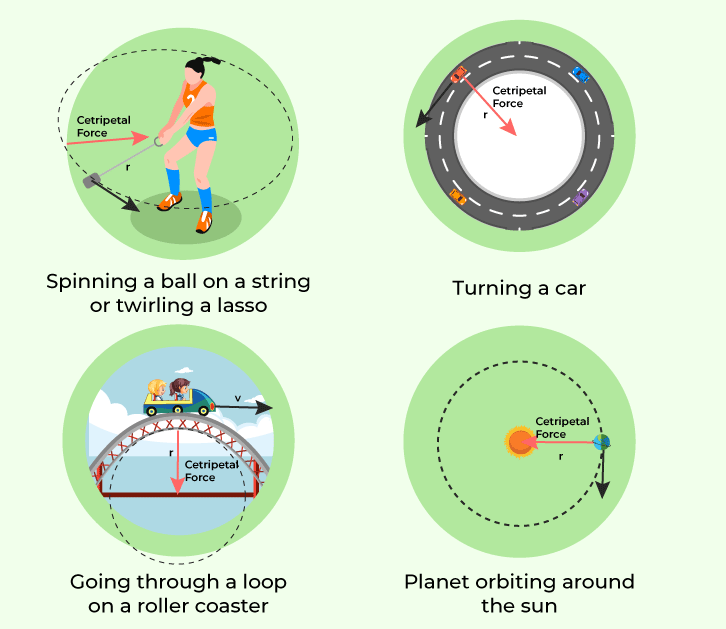
Source: GeeksforGeeks — Centripetal and Centrifugal Force - GeeksforGeeks · www.geeksforgeeks.org
Trap: Thinking acceleration only increases speed — it can change direction while keeping speed constant
Key Distinction: Speed vs Velocity — speed is magnitude, velocity includes direction
Remember: In uniform circular motion, speed is constant but velocity keeps changing (direction changes)