Water can dissolve more substances than any other liquid because
Contents11
- Ait is dipolar in nature
- Bit is a good conductor of heat
- Cit has high value of specific heat
- Dit is an oxide of hydrogen
Show answer
Answer: (A) it is dipolar in nature
Water is the 'universal solvent' because of its dipolar (polar) nature.
A water molecule has a bent shape: the oxygen end carries a slight negative charge, and the hydrogen end carries a slight positive charge.
This allows water to attract and surround ions and polar molecules, pulling them apart.
For example, when salt (NaCl) is added to water, positive hydrogen ends attract Cl- ions while negative oxygen ends attract Na+ ions, dissolving the salt.
Options (b), (c), and (d) describe other water properties but do not explain its dissolving ability.
Answer: (a).
Water's dipolar nature makes it the universal solvent, dissolving more substances than any other liquid by attracting both positive and negative ions.
The question tests understanding of molecular structure versus bulk properties - dipolar nature is about molecular geometry, while heat conduction and specific heat are bulk thermal properties.
Water Polarity & Molecular Structure
Science And Technology dipolar water molecule polar
Water's Dipolar Nature: Why H₂O is Polar
Water is dipolar - oxygen end is slightly negative (δ-), hydrogen ends are slightly positive (δ+)
Bent molecular shape (104.5°) creates unequal charge distribution
Oxygen is more electronegative than hydrogen, pulling electrons toward itself
Why Water is Dipolar
Water's dipolar nature comes from its molecular structure. The H₂O molecule has a bent shape rather than being linear, creating an uneven distribution of electrical charge.
How Water Becomes Polar
%%{init: {"flowchart": {"wrappingWidth": 460}}}%%
flowchart TD
  s1["`**Oxygen attracts electrons**
Oxygen is more **electronegative** than hydrogen`"]
  s2["`**Electrons spend more time near oxygen**
Creates **partial negative charge** on oxygen (δ-)`"]
  s3["`**Hydrogen atoms become electron-poor**
Creates **partial positive charge** on hydrogens (δ+)`"]
  s4["`**Bent shape amplifies polarity**
**104.5° bond angle** prevents charges from canceling out`"]
  s1 --> s2
  s2 --> s3
  s3 --> s4
Water Molecule Structure
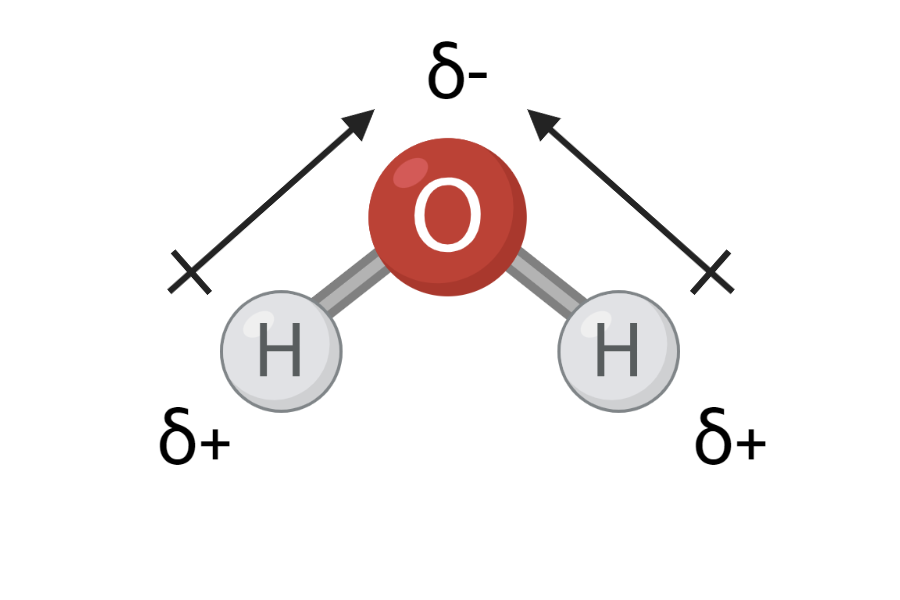
Source: Biotech Academy — Polarity - Biotech Academy · www.biotechacademy.dk
Trap: Linear vs bent - if water were linear, positive and negative charges would cancel out
Trap: Don't confuse dipolar with ionic - water has partial charges, not full charges
Trap: Electronegativity creates polarity, not just the presence of different atoms
Universal Solvent Mechanism
Science And Technology dissolve more substances universal solvent
How Water Dissolves Substances: The Universal Solvent
Water dissolves ionic compounds by surrounding and separating ions
Polar molecules dissolve because water can align with their charges
Follows 'like dissolves like' principle - polar dissolves polar
Nonpolar substances (oil, wax) do not dissolve in water
Why Water Dissolves So Much
Water is called the 'universal solvent' because its dipolar nature allows it to dissolve more substances than any other liquid. The partial positive and negative charges can interact with both ionic and polar substances.
Salt Dissolution Process
%%{init: {"flowchart": {"wrappingWidth": 460}}}%%
flowchart TD
  s1["`**Salt crystal in water**
**NaCl** has Na+ and Cl- ions in crystal lattice`"]
  s2["`**Water molecules orient**
**Oxygen ends** point toward Na+, **hydrogen ends** toward Cl-`"]
  s3["`**Electrostatic attraction**
Water's partial charges attract the ions`"]
  s4["`**Ions separate**
Water molecules **surround and isolate** each ion`"]
  s5["`**Complete dissolution**
Ions become **hydrated** and disperse in solution`"]
  s1 --> s2
  s2 --> s3
  s3 --> s4
  s4 --> s5
What Water Can & Cannot Dissolve
Type of Substance | Dissolves in Water? | Reason | Examples |
|---|---|---|---|
Ionic compounds | Yes | Water separates positive and negative ions | Salt (NaCl), sugar |
Polar molecules | Yes | Water aligns with partial charges | Alcohol, ammonia |
Nonpolar molecules | No | No charge interaction possible | Oil, benzene, wax |
Large molecules | Depends | Size and polarity both matter | Proteins (some yes, some no) |
Trap: Water dissolves most substances, not all - oils and fats don't dissolve
Trap: Dissolving ≠ conducting - pure water is a poor electrical conductor
Trap: Specific heat and thermal conductivity don't explain dissolving ability
Water Properties Comparison
Science And Technology conductor of heat specific heat oxide of hydrogen
Water's Physical & Chemical Properties: Beyond Polarity
Water has high specific heat (4.18 J/g°C) - absorbs much energy to heat up
Water is chemically H₂O - an oxide of hydrogen, not just physical description
Pure water is a poor heat conductor compared to metals
Water Properties & Their Functions
Property | Value/Description | Function | Explains Dissolving? |
|---|---|---|---|
Dipolar nature | δ+ hydrogen, δ- oxygen | Attracts ions and polar molecules | Yes ✓ |
Specific heat | 4.18 J/g°C (very high) | Temperature regulation, climate moderation | No ✗ |
Heat conduction | Poor conductor (0.6 W/mK) | Thermal insulation in organisms | No ✗ |
Chemical nature | H₂O - oxide of hydrogen | Chemical classification | No ✗ |
Why Other Options are Wrong
Options (B), (C), and (D) describe real properties of water but don't explain its dissolving ability:
Heat conduction: Water is actually a poor heat conductor
Specific heat: High specific heat helps with temperature regulation, not dissolving
Oxide of hydrogen: This is just water's chemical formula (H₂O), not a functional property
Trap: High specific heat is important for climate but irrelevant to dissolving power
Trap: 'Oxide of hydrogen' sounds scientific but doesn't explain any mechanism
Trap: Water conducts heat poorly compared to metals - don't confuse with electrical conduction