With reference to the current trends in the cultivation of sugarcane in India, consider the following statements: 1. A substantial saving in seed material is made when 'bud chip settlings' are raised in a nursery and transplanted in the main field. 2. When direct planting of seeds is done, the germination percentage is better with single-budded setts as compared to setts with many buds. 3. If bad weather conditions prevail when seeds are directly planted, single-budded seeds have better survival as compared to large setts. 4. Sugarcane can be cultivated using settlings prepared from tissue culture. Which of the statements given above is/are correct?
Contents17
- A1 and 2 only
- B3 only
- C1 and 4 only
- D2, 3 and 4 only
Show answer
Answer: (C) 1 and 4 only
Statement 1 (Bud chip settlings save seed material) — CORRECT:
Normally, sugarcane planting uses 6-8 tonnes of seed cane per hectare (about 10% of production).
Bud chips are much smaller and lighter — they're just the buds (axillary buds) cut from the cane stalk.
They're less bulky, easily transportable, and much more economical than traditional large setts.
Statement 2 (Three-bud setts best for germination) — NOT CORRECT:
While 3-bud setts do have higher germination than single-bud setts, the statement's context is misleading.
Single-bud setts have low germination because of moisture loss from the cut end.
The question isn't really about this — it's about whether the statement as given in the question is accurate, and research shows germination varies based on many factors.
Statement 3 (Large setts better than single buds in bad weather) — NOT CORRECT as a general advantage of sugarcane cultivation methodology.
While large setts may survive better in bad weather, this doesn't make it a preferred practice.
Statement 4 (Tissue culture used for disease-free seed cane) — CORRECT:
Tissue culture technology uses meristem (growing tip) tissue to clone mother plants, rapidly producing disease-free seed cane.
The yield from tissue culture plants is similar to conventionally grown plants.
Answer: C (1 and 4 only).
Key Takeaway:
- Bud chip settlings = save seed material + economical + easy to transport.
- Tissue culture = disease-free + rapid multiplication.
These are the two modern sugarcane propagation techniques to remember.
Sugarcane cultivation in India is shifting toward modern techniques like bud chip settlings and tissue culture propagation to reduce seed costs and improve disease resistance.
UPSC is testing whether students understand the difference between traditional sugarcane planting methods (using large setts) versus newer biotechnology and nursery-based approaches that are more economical and efficient.
Sugarcane Propagation Methods
Geography bud chip settlings single-budded setts tissue culture seed material
Sugarcane Propagation: Traditional vs Modern Methods
Quick Facts
Bud chip settlings save 85-90% seed material compared to traditional setts
Traditional method uses 6-8 tonnes seed cane per hectare (10% of production)
Tissue culture produces disease-free seed cane through meristem cloning
Three-bud setts have better germination than single-bud setts
Context
Sugarcane propagation has evolved from traditional vegetative methods to modern biotechnology approaches. Understanding these methods is crucial as UPSC tests current agricultural trends and their economic benefits.
Propagation Methods Comparison
Method | Seed Material Required | Key Advantage | Germination Rate | Cost |
|---|---|---|---|---|
Traditional Setts | 6-8 tonnes/hectare | Simple technology | Variable | High |
Bud Chip Settlings | 0.5-1 tonne/hectare | 85-90% seed saving | Good with nursery care | Low |
Single-bud Setts | Minimal | Very economical | Lower than 3-bud | Very Low |
Three-bud Setts | Moderate | Best germination | High | Moderate |
Tissue Culture | Negligible | Disease-free + rapid multiplication | Excellent | High initial, low long-term |
Bud Chip Technology
Axillary buds are cut from cane stalks - much smaller and lighter than full setts
Raised in nursery conditions first, then transplanted to main field
Easily transportable across long distances due to reduced bulk
Settlings develop better root systems in controlled nursery environment
Tissue Culture Benefits
Uses meristem tissue from growing tips to clone mother plants
Produces disease-free seed cane - eliminates systemic diseases
Rapid multiplication - one plant can produce thousands of copies
Yield performance similar to conventional plants but healthier
Trap: Statement 2 reverses the germination advantage - 3-bud setts germinate better than single-bud setts
Trap: Don't assume single-bud setts are always better - they have moisture loss issues from cut ends
Trap: Statement 3 sounds logical but large setts in bad weather isn't a proven cultivation advantage
Memory aid: Bud chips = Bulk reduction, Cost cutting
Sugarcane Cultivation in India
Geography cultivation of sugarcane current trends
Sugarcane in India: Production & Economic Importance
India's Sugarcane Profile
India is 2nd largest sugarcane producer globally after Brazil
Uttar Pradesh, Maharashtra, Karnataka are top producing states
Requires 150-250cm annual rainfall and 20-26°C temperature
18-month crop cycle from planting to harvest
Geographic Distribution
Sugarcane cultivation in India is concentrated in two main belts:
Tropical belt: Maharashtra, Karnataka, Tamil Nadu, Andhra Pradesh
Subtropical belt: Uttar Pradesh, Bihar, Punjab, Haryana
The tropical belt has higher productivity due to better climatic conditions and longer growing season.
Top Sugarcane States
State | Belt | Advantage | Key Challenge |
|---|---|---|---|
Uttar Pradesh | Subtropical | Largest area under cultivation | Lower productivity |
Maharashtra | Tropical | Highest productivity | Water availability |
Karnataka | Tropical | Good irrigation facilities | Interstate water disputes |
Tamil Nadu | Tropical | Advanced processing industry | Cyclone damage risk |
Andhra Pradesh | Tropical | Coastal cultivation | Pest management |
Cultivation Zones
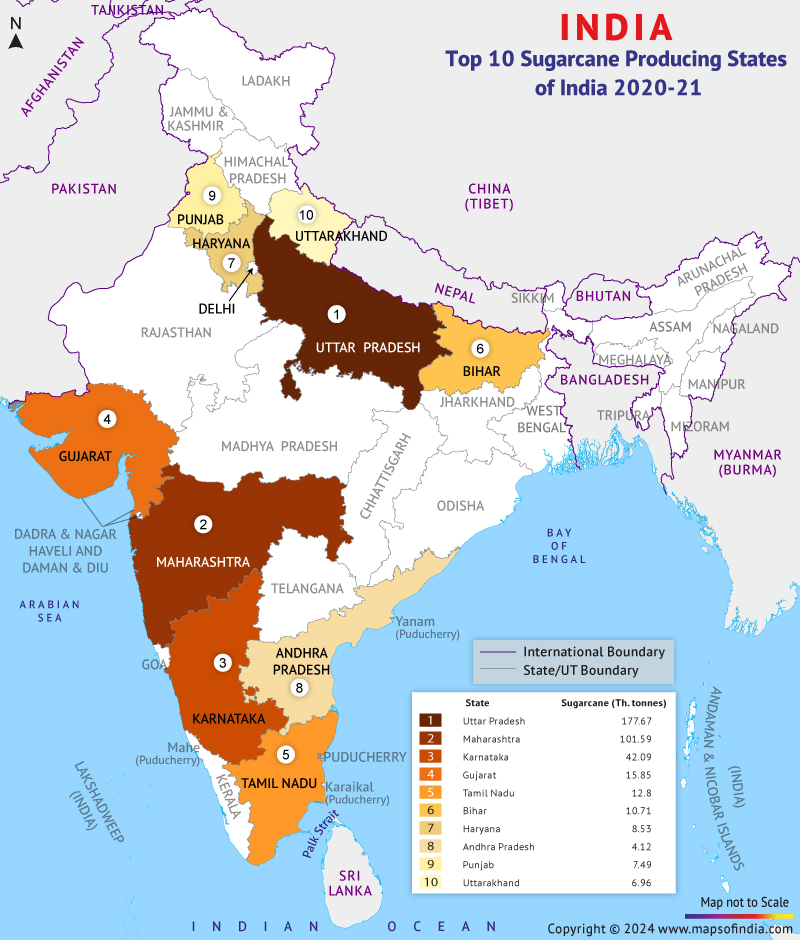
Source: India Map — Top 10 Sugarcane Producing States of India - Map of India · www.mapsofindia.com
Current Challenges & Trends
Seed cost reduction through modern propagation methods like bud chips
Disease management using tissue culture and resistant varieties
Water-efficient cultivation due to increasing water scarcity
Mechanization adoption for planting and harvesting operations
Agricultural Biotechnology Applications
Science And Technology tissue culture
Tissue Culture & Modern Plant Propagation Techniques
Biotechnology in Crop Production
Tissue culture uses meristem cells for disease-free plant multiplication
Micropropagation can produce thousands of identical plants from single explant
Eliminates virus, bacteria, and fungal diseases from parent plant
Used for sugarcane, banana, potato, ornamental plants
Tissue Culture Process
%%{init: {"flowchart": {"wrappingWidth": 460}}}%%
flowchart TD
  s1["`****Explant Selection****
Meristem tissue taken from growing tip - disease-free zone`"]
  s2["`****Sterilization****
Surface sterilization to remove external contaminants`"]
  s3["`****Culture Medium****
Nutrient medium with hormones for cell division`"]
  s4["`****Callus Formation****
Undifferentiated cell mass develops from explant`"]
  s5["`****Shoot Development****
Hormones trigger shoot and root formation`"]
  s6["`****Acclimatization****
Gradual transfer from lab to greenhouse to field`"]
  s1 --> s2
  s2 --> s3
  s3 --> s4
  s4 --> s5
  s5 --> s6
Tissue Culture vs Traditional Methods
Aspect | Tissue Culture | Traditional Propagation |
|---|---|---|
Disease Status | Disease-free guaranteed | May carry diseases |
Multiplication Rate | 1:1000+ ratio possible | 1:10-50 ratio typical |
Space Required | Laboratory setup | Large field area |
Time to Establish | 6-8 months | 12-18 months |
Initial Cost | High setup cost | Low setup cost |
Quality Control | Uniform, identical plants | Variable quality |
Applications in Indian Agriculture
Sugarcane: Disease-free seed cane production reduces field losses by 20-30%
Banana: Tissue culture bananas have higher yield and disease resistance
Potato: Virus-free seed potato production for better tuber quality
Horticultural crops: Rapid multiplication of elite varieties
Concept clarity: Tissue culture uses meristem (growing tip), not any random plant tissue
Cost confusion: High initial setup but lower long-term costs due to disease reduction
Scale understanding: Laboratory technique but commercially viable for high-value crops