Many transplanted seedlings do not grow because
Contents15
- Athe new soil does not contain favourable minerals
- Bmost of the root hairs grip the new soil too hard
- Cmost of the root hairs are lost during transplantation
- Dleaves get damaged during transplantation
Show answer
Answer: (C) most of the root hairs are lost during transplantation
When a seedling is transplanted, it experiences transplant shock.
The main cause is the loss of fine root hairs during the process.
Here's why this matters:
- The thickest roots are nearest to the root ball,
- but the most important roots — the tiny feeder roots and root hairs that actually absorb water and nutrients — are located farthest from the plant.
These delicate root hairs are easily destroyed during transplantation, either by being cut (to keep the root ball manageable), by drying out (they can die in just 3-4 minutes of air exposure), or by being jarred and jostled during the move.
Once these root hairs are lost, the plant cannot draw enough moisture to support its top growth, creating an imbalance that manifests as transplant shock — wilting, leaf drop, and sometimes death.
Options (a), (b), and (d) are not the primary causes.
Root hairs are microscopic extensions that dramatically increase a plant's surface area for water and nutrient absorption - their loss during transplantation cuts off the plant's primary feeding mechanism.
The question tests understanding of plant physiology fundamentals rather than advanced biotechnology, checking if students know the difference between structural roots and functional absorptive structures.
Root Hairs: Structure & Function
Science And Technology root hairs
Root Hairs: The Plant's Water & Nutrient Absorption System
Root hairs are microscopic extensions of root cells that dramatically increase surface area for absorption
Located on feeder roots farthest from the main stem, not on thick primary roots
Extremely fragile - can die in 3-4 minutes of air exposure during transplantation
Loss of root hairs creates water-nutrient imbalance causing transplant shock
What Are Root Hairs
Root hairs are tiny, tube-like extensions of individual root cells that project into the soil. They are the plant's primary absorption mechanism - not the thick roots you can see, but microscopic structures that do the actual work of drawing water and nutrients from soil particles.
Root System Components
Root Type | Location | Primary Function | Durability |
|---|---|---|---|
Primary roots | Near root ball/stem | Structural support, transport | Thick, durable |
Feeder roots | Outer edges of root zone | Anchor smaller roots | Moderately fragile |
Root hairs | Tips of feeder roots | Water & nutrient absorption | Extremely fragile |
Why Root Hairs Matter
Surface area multiplication: A single plant may have billions of root hairs, increasing absorption surface area by 15-20 times
Direct soil contact: Root hairs grow into tiny soil spaces where water and dissolved minerals collect
Selective absorption: They actively transport specific nutrients the plant needs while filtering out harmful substances
Water balance maintenance: Root hairs must absorb enough water to support all above-ground plant tissues
Connection to Question
This question tests understanding of transplant shock - the wilting and poor growth seen in newly transplanted seedlings. The correct answer (C) identifies root hair loss as the primary cause, not soil minerals, root grip strength, or leaf damage.
Trap: Students think thick, visible roots do the absorption work - actually it's microscopic root hairs
Trap: Option B suggests roots grip 'too hard' - root hairs are for absorption, not gripping
Trap: Soil minerals (Option A) sound plausible but aren't the main transplant problem
Trap: Leaf damage (Option D) is a symptom of transplant shock, not the root cause
Transplant Shock in Plants
Science And Technology transplanted seedlings transplantation
Transplant Shock: Why Seedlings Struggle After Moving
Transplant shock occurs when root hair loss creates water-nutrient imbalance in moved plants
Root hairs die from air exposure, cutting, or physical damage during transplantation
Symptoms include wilting, leaf drop, stunted growth despite adequate soil conditions
Recovery requires new root hair regeneration which takes 1-2 weeks
The Transplant Process Problem
When seedlings are moved from one location to another, the most crucial parts of their root system - the root hairs - are inevitably damaged or destroyed. These microscopic structures cannot survive the digging, moving, and replanting process.
How Transplant Shock Develops
%%{init: {"flowchart": {"wrappingWidth": 460}}}%%
flowchart TD
  s1["`**Root Hair Damage**
Digging destroys delicate root hairs through cutting, air exposure, or physical trauma`"]
  s2["`**Absorption Capacity Lost**
Plant suddenly cannot absorb enough water and nutrients to support existing foliage`"]
  s3["`**Water-Nutrient Imbalance**
Above-ground tissues demand more resources than damaged roots can supply`"]
  s4["`**Visible Symptoms**
Wilting, leaf drop, stunted growth as plant struggles to maintain itself`"]
  s5["`**Recovery or Death**
Plant either regenerates new root hairs and recovers, or dies from sustained stress`"]
  s1 --> s2
  s2 --> s3
  s3 --> s4
  s4 --> s5
Transplant Shock vs Other Plant Problems
Issue | Primary Cause | Timing | Recovery |
|---|---|---|---|
Transplant shock | Root hair loss | Immediate after moving | 1-2 weeks if successful |
Poor soil | Nutrient deficiency | Gradual over weeks | Quick with fertilization |
Overwatering | Root rot from excess water | Few days to weeks | Difficult, often fatal |
Physical damage | Broken stems/leaves | Immediate | Quick for minor damage |
Prevention Strategies
Minimize root disturbance: Keep as much original soil around roots as possible during transplanting
Timing matters: Transplant during cooler parts of the day or overcast weather to reduce stress
Watering technique: Water immediately after transplanting but avoid waterlogging
Gradual acclimatization: Introduce plants slowly to new environmental conditions
Trap: Confusing transplant shock with soil quality issues - shock happens even in perfect soil
Trap: Thinking visible root damage is the problem - the real issue is microscopic root hair loss
Trap: Assuming leaf damage causes transplant problems - leaf symptoms are the result, not the cause
Plant Water Transport System
Science And Technology
How Plants Transport Water: From Root Hairs to Leaves
Root hairs absorb water → Xylem transports upward → Stomata release water vapor
Transpiration creates negative pressure that pulls water up through the plant
Disruption at any stage can cause plant stress and wilting
The Water Highway
Plants operate a sophisticated water transport system that moves water from soil to atmosphere. This system depends on every component working properly - when root hairs are damaged during transplantation, the entire system becomes unbalanced.
Water Movement in Plants
%%{init: {"flowchart": {"wrappingWidth": 460}}}%%
flowchart TD
  s1["`**Soil Water Absorption**
Root hairs absorb water and dissolved minerals from soil particles`"]
  s2["`**Root Transport**
Water moves through root tissues toward the central vascular system`"]
  s3["`**Xylem Uptake**
Water enters xylem vessels - the plant's 'water pipes'`"]
  s4["`**Upward Transport**
Transpiration pull draws water up through xylem to stems and leaves`"]
  s5["`**Leaf Distribution**
Water reaches leaf cells and exits through stomata as water vapor`"]
  s1 --> s2
  s2 --> s3
  s3 --> s4
  s4 --> s5
Plant Transport Systems
# Plant Vascular System
## Xylem
- Transports water upward
- Dead cells form tubes
- Driven by transpiration
## Phloem
- Transports sugars
- Living cells
- Bidirectional flow
## Root System
- Root hairs absorb
- Feeder roots collect
- Primary roots transport
## Leaf System
- Stomata regulate
- Transpiration drives flow
- Photosynthesis occurs
Plant Water Transport
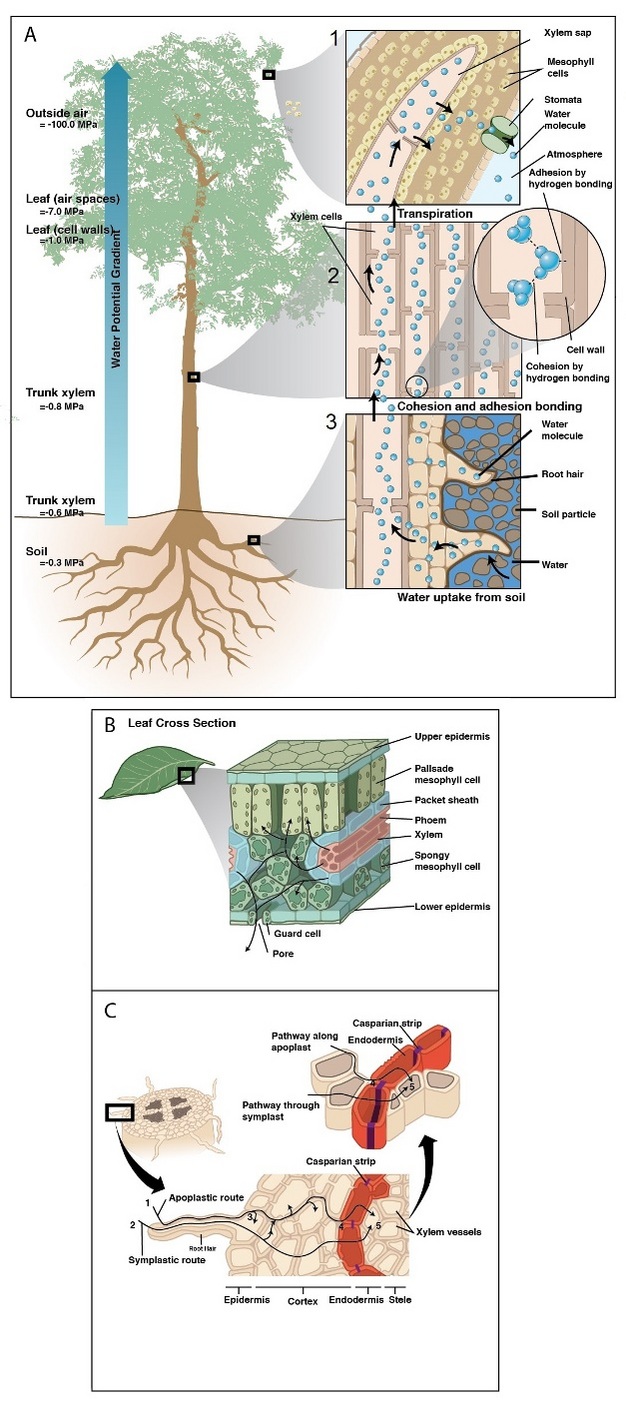
Source: Nature — Water Uptake and Transport in Vascular Plants | Learn ... · www.nature.com
Trap: Focusing on xylem and phloem while ignoring root hairs - absorption is the critical first step
Trap: Thinking water transport is simple 'sucking' - it's actually transpiration pull creating negative pressure
Trap: Confusing water transport (xylem) with food transport (phloem) - they're separate systems