‘Net metering’ is sometimes seen in the news in the context of promoting the
Contents19
- Aproduction and use of solar energy by the households/consumers
- Buse of piped natural gas in the kitchens of houeholds
- Cinstallation of CNG kits in motor-cars
- Dinstallation of water meters in urban households
Show answer
Answer: (A) production and use of solar energy by the households/consumers
Answer: (a) Production and use of solar energy by households/consumers
Net metering is a billing mechanism for rooftop solar users.
When your solar panels produce more electricity than you consume, excess goes to the grid and your meter runs BACKWARD.
You pay only for NET consumption (used minus exported).
Example:
- Consumed 300 units,
- exported 100 units = Pay for only 200 units.
This incentivizes households to adopt solar because their electricity bills decrease and they 'earn' from surplus power.
Why not others?
- (b) Piped gas,
- (c) CNG kits,
- (d) Water meters - Net metering is specifically an electricity billing concept for solar energy.
Net metering allows households with rooftop solar to run their electricity meter backward when they export excess power to the grid, paying only for net consumption.
India's renewable energy push and rooftop solar policies made net metering a key policy tool around 2015-2016 to incentivize household solar adoption.
The question tests whether students know net metering is specifically about solar electricity billing, not about measuring gas, water, or other utilities.
Net Metering Mechanism
Environment Net metering
Net Metering: Solar Billing Mechanism & UPSC Facts
Net metering allows solar users to export excess electricity to grid and get credited
Meter runs backward when solar panels produce more than household consumes
Users pay only for net consumption (used minus exported electricity)
Primarily incentivizes rooftop solar adoption by households
Net metering is a billing arrangement that makes rooftop solar financially attractive for households. When your solar panels generate more electricity than you use, the surplus flows into the electricity grid and you receive credit for it.
How Net Metering Works
%%{init: {"flowchart": {"wrappingWidth": 460}}}%%
flowchart TD
  s1["`**Solar panels generate electricity**
Rooftop panels produce power during daylight hours`"]
  s2["`**Household consumes part of generated power**
Direct use reduces grid dependency`"]
  s3["`**Excess power flows to grid**
Surplus electricity exported through same connection`"]
  s4["`**Meter runs backward**
Bi-directional meter records export as negative consumption`"]
  s5["`**Monthly bill = Used - Exported**
Pay only for net consumption, get credit for surplus`"]
  s1 --> s2
  s2 --> s3
  s3 --> s4
  s4 --> s5
Net Metering Example Calculation
Month | Consumed (units) | Exported (units) | Net Bill (units) | Financial Impact |
|---|---|---|---|---|
January | 300 | 100 | 200 | Pay for 200 units only |
February | 250 | 150 | 100 | Pay for 100 units only |
March | 200 | 250 | 0 | No payment, 50 unit credit |
Key Benefits & Features
Reduces electricity bills by offsetting grid consumption with solar generation
No separate infrastructure needed - uses existing grid connection and meter
Encourages distributed generation - reduces load on central power plants
Grid stability improves as local generation reduces transmission losses
Works best in areas with reliable grid connectivity and supportive policies
Question Connection
This question tests knowledge of solar energy promotion mechanisms. Net metering specifically incentivizes households to install rooftop solar by making it financially viable - they can 'sell' excess power back to the grid.
Trap: Don't confuse with gross metering where all solar power is sold to grid at fixed rate
Trap: Net metering is electricity-specific - not related to gas meters or water meters
Trap: Focus is on household/consumer level solar, not large solar farms
Trap: The meter runs backward during export, not forward - this is the key mechanism
Rooftop Solar Systems
Environment solar energy households/consumers
Rooftop Solar Systems: Technology & Policy Framework
Rooftop solar converts sunlight to electricity using photovoltaic panels on building roofs
Can be grid-connected (with net metering) or off-grid (with battery storage)
Distributed generation reduces transmission losses and grid dependence
India targets 40 GW rooftop solar by 2022 under National Solar Mission
Types of Rooftop Solar Systems
Type | Connection | Storage | Key Feature | Best For |
|---|---|---|---|---|
Grid-tied | Connected to grid | No battery | Net metering possible | Urban areas with reliable grid |
Off-grid | Standalone | Battery storage | Complete independence | Rural/remote areas |
Hybrid | Grid + battery | Battery backup | Grid stability + backup | Areas with unstable grid supply |
Advantages for Households
Reduced electricity bills through self-consumption and net metering credits
Energy independence reduces dependence on grid power and price fluctuations
Low maintenance - solar panels have 25+ year lifespan with minimal upkeep
Environmental benefit - clean energy reduces carbon footprint
Property value increase - solar installation adds to real estate value
India's Rooftop Solar Ecosystem
# Rooftop Solar in India
## Policy Support
- Net Metering Regulations
- Subsidies & Incentives
- Accelerated Depreciation
- Priority Sector Lending
## Key Players
- SECI (Solar Energy Corporation)
- State Electricity Boards
- Private Installers
- Equipment Manufacturers
## Challenges
- High Initial Cost
- Grid Integration Issues
- Policy Variations Across States
- Awareness Gap
Rooftop Solar Installation
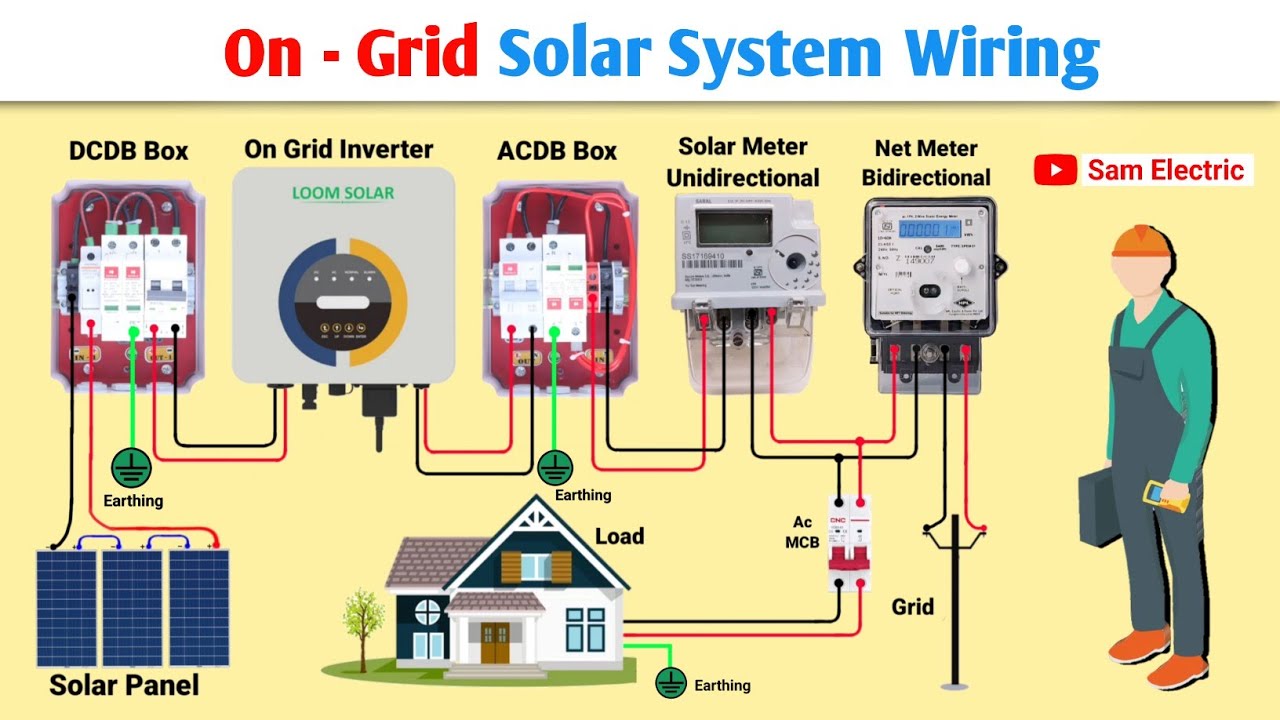
Source: YouTube — On Grid Solar System Wiring l Solar system complete installation l Sam Electric · www.youtube.com
Solar Energy Policies in India
Environment
India's Solar Energy Policies & Targets
National Solar Mission (2010) aims for 100 GW solar capacity by 2022
Target split: 60 GW utility-scale + 40 GW rooftop solar
Grid-connected solar gets priority with net metering and feed-in tariffs
Solar parks and rooftop schemes are two main implementation routes
Key Solar Policies & Schemes
Policy/Scheme | Launch Year | Target/Focus | Key Mechanism |
|---|---|---|---|
Jawaharlal Nehru National Solar Mission | 2010 | 100 GW by 2022 | Utility + rooftop solar |
Solar Park Scheme | 2014 | 25 solar parks, 500 MW each | Large-scale solar farms |
Grid Connected Rooftop Programme | 2014 | 40 GW rooftop capacity | Net metering + subsidies |
KUSUM Scheme | 2019 | Solar pumps for farmers | Decentralized solar + agriculture |
Policy Support Mechanisms
Net metering regulations by state electricity boards enable rooftop solar adoption
Capital subsidies up to 40% for residential rooftop installations under 10 kW
Accelerated depreciation allows businesses to claim 80% depreciation in first year
Solar obligation mandates discoms to purchase certain percentage from solar
Green bonds and priority sector lending provide cheaper financing
Solar Mission Implementation
%%{init: {"flowchart": {"wrappingWidth": 460}}}%%
flowchart TD
  s1["`**Phase 1 (2010-2013)**
1 GW capacity, technology development, manufacturing base`"]
  s2["`**Phase 2 (2013-2017)**
10 GW capacity, cost reduction, grid integration`"]
  s3["`**Phase 3 (2017-2022)**
100 GW target, grid parity, energy security`"]
  s1 --> s2
  s2 --> s3
Current Status & Challenges
India has achieved over 60 GW solar capacity by 2023, making it the 4th largest solar market globally. However, rooftop solar lags at around 10 GW due to policy implementation gaps, high costs, and limited awareness about net metering benefits.
Energy Metering & Billing Systems
Environment piped natural gas CNG kits water meters
Energy & Utility Metering Systems: Beyond Net Metering
Piped Natural Gas (PNG) uses volume-based metering, not net metering
CNG kits in vehicles use fuel dispensing meters, unrelated to electricity billing
Water meters measure consumption flow, cannot run backward like electricity meters
Net metering is unique to electricity because power can flow bidirectionally
Comparison of Utility Metering Systems
Utility | Meter Type | Billing Basis | Bidirectional Flow | Net Metering Possible |
|---|---|---|---|---|
Electricity | Energy meter (kWh) | Net consumption | Yes (grid-tied solar) | Yes |
Piped Natural Gas | Volume meter (SCM) | Total consumption | No | No |
CNG for vehicles | Fuel dispenser | Quantity dispensed | No | No |
Water supply | Flow meter | Volume consumed | No | No |
Why Net Metering Works Only for Electricity
Electricity flows both ways - consumers can become producers with solar/wind generation
Grid acts as virtual storage - excess power exported during day, imported at night
Instantaneous consumption - electricity cannot be stored in the grid like gas in pipelines
Standardized quality - electrical energy is homogeneous unlike different gas pressures
Real-time balancing required between generation and consumption in electrical grids
Smart Metering Evolution
Smart meters for electricity enable real-time monitoring and time-of-use pricing. Unlike basic net metering, advanced smart meters can track generation and consumption separately, enabling more sophisticated billing models for renewable energy integration.
Trap: Net metering ≠ smart metering - net metering is about bidirectional flow, smart metering is about digital monitoring
Trap: Don't assume other utilities can have 'net metering' - only electricity allows reverse flow
Trap: CNG meters measure fuel dispensed to vehicles, not household consumption like PNG meters
Trap: Water meters measure inflow only - there's no concept of 'exporting' water back to mains