Recently, our scientists have discovered a new and distinct species of banana plant which attains a height of about 11 metres and has orange-coloured fruit pulp. In which part of India has it been discovered?
Contents17
- AAndaman Islands
- BAnaimalai Forests
- CMaikala Hills
- DTropical rain forests of northeast
Show answer
Answer: (A) Andaman Islands
Answer: (a) Andaman Islands
Scientists at the Botanical Survey of India discovered this new banana species in the tropical rain forests of Little Andaman Islands.
It is about 11 metres tall (usual bananas are 3-4 metres) with unique orange-coloured fruit pulp.
Why Andaman?
These islands are a biodiversity hotspot with dense, largely unexplored tropical rain forests where new species are regularly discovered.
Why not others?
- (b) Anaimalai Forests (Western Ghats)
- (c) Maikala Hills (central India)
- (d) NE tropical forests
This particular species was found in Andaman.
The Andaman and Nicobar Islands are a biodiversity hotspot where new species are regularly discovered due to their isolated location and unexplored tropical rainforests.
This specific banana species discovery by the Botanical Survey of India was likely a current affairs topic around 2015-16, making it relevant for that year's exam.
UPSC is testing knowledge of India's biodiversity hotspots and which regions are most likely to yield new species discoveries.
Andaman & Nicobar Biodiversity
Environment Andaman Islands Little Andaman
Andaman & Nicobar Islands: Biodiversity Hotspot & Endemic Species
Andaman & Nicobar Islands are a biodiversity hotspot with high endemism
Little Andaman specifically discovered the 11-meter tall banana with orange pulp
Islands have largely unexplored tropical rainforests ideal for new species discovery
Botanical Survey of India (BSI) conducts species discovery research here
Why Andaman for Discovery
The Andaman & Nicobar Islands are a biodiversity hotspot with dense, largely unexplored tropical rainforests. Geographic isolation has created unique evolutionary conditions perfect for endemic species development.
• High endemism: Many species found nowhere else on Earth
• Unexplored forests: Remote areas still yield new discoveries
• Island biogeography: Isolation drives unique evolution
Key Biodiversity Facts
Aspect | Details | Significance |
|---|---|---|
Location | Bay of Bengal, 572 islands | Geographic isolation drives endemism |
Forest Cover | 86% of total area | Highest in India |
Endemic Species | Narcondam Hornbill, Andaman Wild Pig | Unique evolutionary laboratory |
New Discoveries | Regular species discovery by BSI | 11m banana plant (2016) example |
Protection Status | Many areas are Reserved Forests | Critical for conservation research |
Endemic Species Categories
# Andaman & Nicobar Endemic Species
## Flora
- Andaman Redwood
- 11m Banana Plant
- Andaman Padauk
- Endemic Orchids
## Fauna - Birds
- Narcondam Hornbill
- Andaman Crake
- Andaman Woodpecker
## Fauna - Mammals
- Andaman Wild Pig
- Andaman Shrew
- Long-tailed Macaque
## Marine Life
- Saltwater Crocodile
- Dugong
- Coral Species
Geographic Context

Source: Andaman Nicobar Environment Team | — The Islands | Andaman Nicobar Environment Team · anetindia.org
Don't confuse: Andaman discovery vs Northeast rainforests - this specific banana was found in Little Andaman
Island advantage: Geographic isolation = higher endemism than mainland forests
BSI role: Botanical Survey of India discovers plant species, not Zoological Survey
Banana Species & Diversity
Environment banana plant orange-coloured fruit 11 metres
Banana Species Diversity: Wild vs Cultivated Varieties
Wild bananas can reach 11 meters vs 3-4 meters for cultivated varieties
Fruit pulp colors vary: yellow, orange, red, purple in wild species
Musa genus has ~70 species, mostly wild and inedible
India is part of Southeast Asian origin center for bananas
Wild vs Cultivated
Most people know only cultivated bananas (3-4 meters, yellow fruit), but wild Musa species show remarkable diversity in height, fruit color, and seed content. The Andaman discovery represents this hidden wild diversity.
Banana Variety Comparison
Type | Height | Fruit Color | Seeds | Edibility | Example |
|---|---|---|---|---|---|
Cultivated | 3-4 meters | Yellow | Seedless | Sweet, edible | Cavendish, Robusta |
Wild Species | Up to 11+ meters | Orange, red, purple | Large seeds | Often inedible | Andaman discovery |
Ornamental | 2-6 meters | Various | Small seeds | Decorative | Musa ornata |
Fiber Types | 4-8 meters | Small fruit | Seeded | Fiber extraction | Abaca (Manila hemp) |
India's Banana Heritage
Northeast India is part of the Southeast Asian gene center for bananas
Kerala leads commercial cultivation with Robusta and Nendran varieties
Tamil Nadu, Maharashtra are other major producing states
Wild species preservation critical for genetic diversity of commercial crops
Height confusion: Wild bananas (11m) ≠ commercial bananas (3-4m)
Seed presence: Wild bananas have large seeds, cultivated ones are seedless
Edibility assumption: Wild species often inedible despite being 'bananas'
Botanical Survey of India (BSI)
Environment scientists discovered
Botanical Survey of India: Plant Species Discovery & Documentation
BSI is India's apex body for plant taxonomic research and species discovery
Headquarters in Kolkata, regional offices across India
Maintains National Herbarium with 2.5+ million specimens
Discovered the 11m Andaman banana among many new species annually
BSI's Role
BSI conducts systematic surveys to discover, identify, and document India's plant diversity. Their work is crucial for biodiversity conservation and understanding India's rich flora.
BSI Structure & Functions
Aspect | Details | Purpose |
|---|---|---|
Establishment | 1890, reorganized 1954 | Plant taxonomy research |
Ministry | Environment, Forest & Climate Change | Government coordination |
Headquarters | Kolkata (Indian Botanic Garden) | Central herbarium location |
Regional Centers | Pune, Coimbatore, Dehradun, etc. | Geographic coverage |
Key Activity | Species discovery & documentation | Biodiversity cataloguing |
Publications | Flora of India series | Scientific documentation |
Species Discovery Process
%%{init: {"flowchart": {"wrappingWidth": 460}}}%%
flowchart TD
  s1["`**Field Survey**
BSI teams explore remote forests, islands, mountains`"]
  s2["`**Specimen Collection**
Collect plant samples with GPS coordinates, habitat notes`"]
  s3["`**Laboratory Analysis**
Morphological study, DNA analysis if needed`"]
  s4["`**Literature Review**
Compare with existing species descriptions`"]
  s5["`**New Species Confirmation**
If distinct, prepare scientific description`"]
  s6["`**Publication**
Publish in peer-reviewed journals with type specimen`"]
  s1 --> s2
  s2 --> s3
  s3 --> s4
  s4 --> s5
s5 --> s6BSI vs ZSI: Botanical Survey studies plants, Zoological Survey studies animals
Not ICMR: BSI does plant taxonomy, not medical research
Herbarium importance: Dried specimens are the 'libraries' of plant diversity
India's Major Biodiversity Hotspots
Environment Anaimalai Forests Maikala Hills northeast
India's Biodiversity Hotspots: Comparison & Key Features
Western Ghats and Northeast India are global biodiversity hotspots
Anaimalai Hills are part of Western Ghats hotspot in Tamil Nadu-Kerala
Maikala Hills in Chhattisgarh have Central Indian flora, not hotspot status
Each region has distinct endemic species and forest types
Major Biodiversity Regions Comparison
Region | Hotspot Status | Key Features | Endemic Examples | States/UTs |
|---|---|---|---|---|
Western Ghats | Global Hotspot | High endemism, wet forests | Lion-tailed Macaque, Nilgiri Tahr | Kerala, Tamil Nadu, Karnataka, Maharashtra, Goa, Gujarat |
Northeast India | Global Hotspot | High species richness | Hoolock Gibbon, Red Panda | 7 Sister States + Sikkim |
Andaman & Nicobar | High Endemism | Island biogeography | Narcondam Hornbill, 11m Banana | Andaman & Nicobar Islands |
Eastern Ghats | Regional Importance | Dry deciduous forests | Jerdon's Courser | Odisha, Andhra Pradesh, Tamil Nadu |
Central India | Tiger Landscapes | Sal, teak forests | Barasingha, Indian Bison | Madhya Pradesh, Chhattisgarh, Maharashtra |
Anaimalai Forest Specifics
Anaimalai Hills are part of the Western Ghats in Tamil Nadu-Kerala border
Home to Indira Gandhi Wildlife Sanctuary and Anamalai Tiger Reserve
Known for elephant corridors and high mammal diversity
Cardamom Hills ecosystem with spice plantations and rainforest patches
Hotspots Distribution
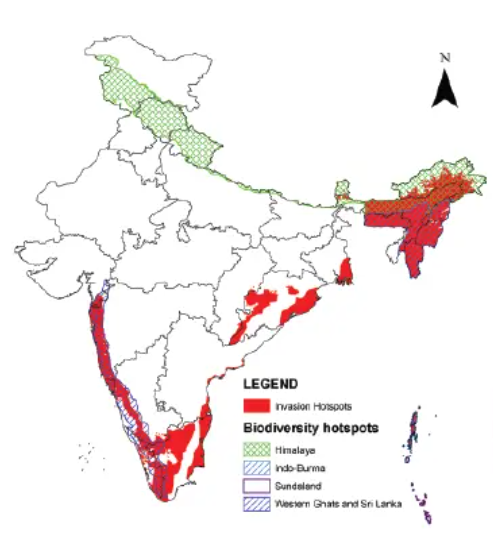
Source: StudyIQ — Biodiversity Hotspots in India, and Threats to Hotspot in India · www.studyiq.com
Hotspot confusion: Only Western Ghats and Northeast are global hotspots, not Eastern Ghats
Anaimalai location: Part of Western Ghats, not a separate hotspot
Maikala Hills: Central India forests, important but not hotspot-level endemism