Which of the following is not a member of ‘Gulf Cooperation Council’?
Contents12
- AIran
- BSaudi Arabia
- COman
- DKuwait
Show answer
Answer: (A) Iran
Answer: (a) Iran
Iran is NOT a member of the Gulf Cooperation Council (GCC).
The GCC (also known as the Cooperation Council for the Arab States of the Gulf) has 6 member states — all ARAB states of the Persian Gulf:
- Saudi Arabia
- Kuwait
- Bahrain
- Qatar
- United Arab Emirates (UAE)
- Oman
Why Iran is NOT a member:
• Iran is a Persian (not Arab) state — GCC is specifically for ARAB states of the Gulf
• Iran has historically had tensions with several GCC members, especially Saudi Arabia
• The GCC was actually formed in 1981 partly as a response to the Iranian Revolution of 1979
Note: Iraq is also a Gulf state but is NOT a GCC member, even though it is an Arab country.
Easy way to remember GCC members: "SaKBaQUO" — Saudi Arabia, Kuwait, Bahrain, Qatar, UAE, Oman (all 6 are Arab monarchies on the Arabian Peninsula side of the Persian Gulf).
The correct answer is (a) Iran.
The GCC has only 6 members, all Arab monarchies on the Arabian Peninsula side of the Persian Gulf - Saudi Arabia, Kuwait, Bahrain, Qatar, UAE, and Oman.
Iran, despite being a major Gulf power, is excluded because it is Persian (not Arab) and has been in rivalry with GCC states since the 1979 Iranian Revolution.
UPSC tests whether students can distinguish between geographic proximity and actual membership in regional organizations.
Gulf Cooperation Council (GCC)
World Affairs (International Relations) Gulf Cooperation Council Iran Saudi Arabia Oman Kuwait
Gulf Cooperation Council: Members, Purpose & UPSC Traps
GCC has 6 members — all Arab monarchies on Arabian Peninsula
Iran is NOT a member — Persian state, not Arab
Mnemonic: SaKBaQUO — Saudi, Kuwait, Bahrain, Qatar, UAE, Oman
Formed in 1981 partly as response to Iranian Revolution
What is GCC
The Gulf Cooperation Council (officially called Cooperation Council for the Arab States of the Gulf) is a regional organization of 6 Arab monarchies located on the Arabian Peninsula side of the Persian Gulf. Formed in 1981, it focuses on economic cooperation, political coordination, and collective security.
GCC Member States
Country | Capital | Ruling System | Key Feature |
|---|---|---|---|
Saudi Arabia | Riyadh | Absolute Monarchy | Largest GCC economy, oil giant |
Kuwait | Kuwait City | Constitutional Monarchy | First Gulf state to discover oil |
Bahrain | Manama | Constitutional Monarchy | Island nation, banking hub |
Qatar | Doha | Absolute Monarchy | Highest GDP per capita, natural gas |
UAE | Abu Dhabi | Federal Monarchy | 7 emirates, Dubai financial center |
Oman | Muscat | Absolute Monarchy | Strategic location, Strait of Hormuz |
GCC Geography
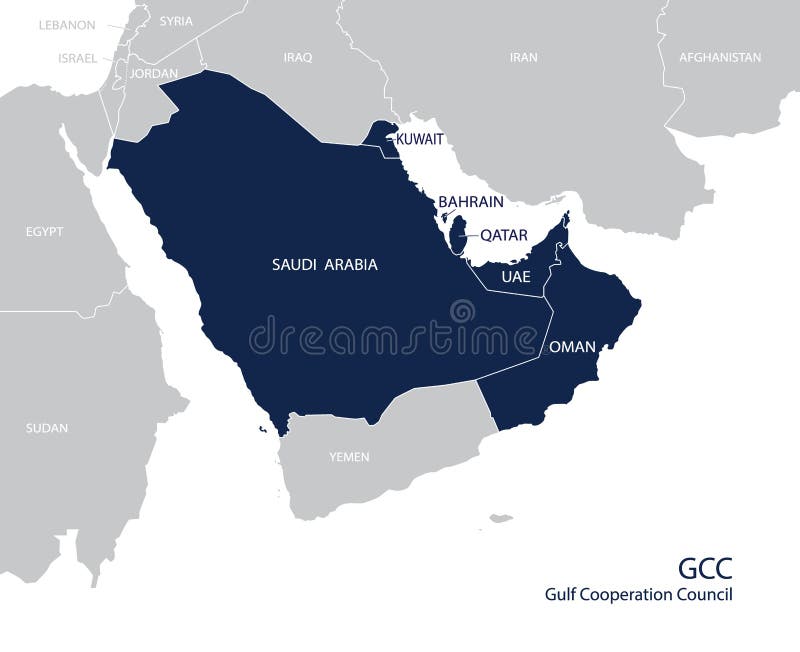
Source: Dreamstime.com — Gcc Map Stock Illustrations – 132 Gcc Map Stock Illustrations ... · www.dreamstime.com
Why Iran is NOT a Member
Ethnic difference: Iran is Persian, GCC is exclusively for Arab states
Religious divide: Iran is Shia-majority, most GCC states are Sunni-majority
Political rivalry: Iran and Saudi Arabia compete for regional influence
Historical context: GCC formed in 1981 partly as response to Iranian Revolution of 1979
Geographic position: Iran is on the northern/eastern side of Persian Gulf
Question Connection
This question tests knowledge of regional organizations in West Asia. The trap is that Iran is a major Gulf state with significant influence, making students think it must be in the Gulf Cooperation Council. However, the 'Arab States' in GCC's official name is the key — Iran is Persian, not Arab.
Trap: Iran is a major Gulf power but NOT in GCC — ethnic difference matters
Trap: Iraq is Arab but also NOT in GCC — don't assume all Gulf Arabs are members
Trap: All GCC states are monarchies — no republics allowed
Memory aid: SaKBaQUO covers all 6 members — if it's not in this list, it's not GCC
Iran's Regional Position
World Affairs (International Relations) Iran
Iran: Persian Power Outside Arab Organizations
Persian ethnicity — not Arab, hence excluded from Arab organizations
Shia-majority nation in predominantly Sunni Arab region
Regional rival to Saudi Arabia for Middle East influence
Iran's Identity
Iran is the largest Persian-majority nation in West Asia, with Shia Islam as its dominant religion. This makes it ethnically and religiously distinct from its Arab Sunni neighbors, creating natural barriers to joining Arab regional organizations like the GCC or Arab League.
Key Distinctions
Language: Farsi (Persian), not Arabic
Religion: 83% Shia Muslim vs Arab states that are mostly Sunni
Government: Islamic Republic since 1979 vs Arab monarchies in GCC
Geopolitics: Often opposes US-allied Arab states like Saudi Arabia
Regional role: Supports Shia groups across Middle East (Hezbollah, Assad regime)
Don't confuse: Iran is in West Asia but NOT Arab — ethnicity matters for regional groups
Geographic trap: Being on Persian Gulf ≠ automatic GCC membership
Arab League vs GCC Comparison
World Affairs (International Relations)
Major Arab Regional Organizations: Scope & Membership
Arab League: 22 Arab states across Middle East & North Africa
GCC: 6 Gulf Arab monarchies only — subset of Arab League
Both exclude non-Arab states like Iran, Turkey, Israel
Arab Organizations Compared
Organization | Members | Geographic Scope | Criteria | Founded |
|---|---|---|---|---|
Arab League | 22 states | Middle East + North Africa | Arab ethnicity | 1945 |
GCC | 6 states | Persian Gulf only | Arab + Gulf location + Monarchy | 1981 |
Arab Maghreb Union | 5 states | North Africa | Arab + Maghreb region | 1989 |
Membership Logic
Arab League: Broadest — any Arab state can join (includes republics & monarchies)
GCC: Most restrictive — must be Arab + Gulf location + monarchy
Key exclusions: Iran (Persian), Turkey (Turkish), Israel (Jewish state), Iraq (Arab but not monarchy, security concerns)
Iraq paradox: Arab state but NOT in GCC — political instability & republican system
Don't assume: Major regional power = automatic membership in regional organizations