Which of the following are the reasons/factors for exposure to benzene pollution? 1. Automobile exhaust 2. Tobacco smoke 3. Wood burning 4. Using varnished wooden furniture 5. Using products made of polyurethane Select the correct answer using the code given below:
Contents17
- A1, 2 and 3 only
- B2 and 4 only
- C1, 3 and 4 only
- D1, 2, 3, 4 and 5
Show answer
Answer: (D) 1, 2, 3, 4 and 5
Benzene is a harmful chemical that can cause cancer and blood disorders.
This question asks about sources of benzene exposure.
Automobile exhaust — YES: Petrol/gasoline contains benzene, so car exhaust is the single largest source of benzene in the environment.
Tobacco smoke — YES: Cigarette smoke (both active and passive smoking) contains benzene.
Wood burning — YES: When wood burns, it releases benzene among other chemicals. Forest fires are a natural source of benzene.
Varnished wooden furniture — YES: Wood finishes and varnishes can contain and emit benzene and related chemicals.
Polyurethane products — YES: When polyurethane foam burns or degrades, it produces benzene along with other toxic gases like carbon monoxide and toluene.
All five are sources of benzene exposure, so the answer is D.
Key Takeaway: Benzene is everywhere — car exhaust, cigarettes, burning wood, furniture varnish, and polyurethane products.
Remember: if it burns or contains petroleum products, it likely releases benzene.
Benzene is a known carcinogen found in petroleum products, making automobile exhaust the largest environmental source of benzene exposure.
The question tests whether students understand that benzene comes from both obvious sources like car exhaust and cigarettes, and less obvious indoor sources like furniture varnish and polyurethane products.
Benzene Pollution Sources
Environment benzene automobile exhaust tobacco smoke wood burning varnished wooden furniture polyurethane
Benzene Pollution: Major Sources & Health Risks
Quick Revision
Benzene is a carcinogenic chemical found in petrol, cigarettes, and burning materials
Automobile exhaust is the single largest source of environmental benzene
All combustion processes (tobacco, wood burning) release benzene
Causes cancer and blood disorders with prolonged exposure
Indoor sources include varnished furniture and polyurethane products
What is Benzene
Benzene is a colorless, sweet-smelling chemical that occurs naturally in crude oil and is widely used in industry. It's classified as a Group 1 carcinogen by WHO — meaning it definitely causes cancer in humans. Even low-level exposure over time can cause blood disorders and leukemia.
Major Benzene Sources
Source | How Benzene is Released | Exposure Level | Key Point |
|---|---|---|---|
Automobile exhaust | Petrol contains benzene; incomplete combustion | Highest | Single largest environmental source |
Tobacco smoke | Burning tobacco releases benzene | High | Both active & passive smoking |
Wood burning | Natural component released during combustion | Medium | Includes forest fires & fireplaces |
Varnished furniture | Wood finishes & varnishes emit benzene vapors | Low | Indoor air quality concern |
Polyurethane products | Degradation & burning releases benzene | Low-Medium | Foam, adhesives, coatings |
Health Impact
Short-term exposure: Drowsiness, dizziness, headaches, skin irritation
Long-term exposure: Leukemia, aplastic anemia, immune system damage
WHO limit: 10 μg/m³ annual average in ambient air
No safe level: Even low concentrations pose cancer risk over time
Question Connection
This 2020 UPSC question tested all five major benzene sources. The trap was thinking indoor sources like furniture varnish or polyurethane don't matter — but benzene exposure happens both outdoors (cars, fires) and indoors (furniture, products).
Trap: Thinking only outdoor combustion sources matter — indoor sources like varnished furniture also emit benzene
Trap: Assuming polyurethane is safe — it releases benzene when degrading or burning
Trap: Forgetting passive smoking — tobacco smoke affects non-smokers too
Confusion: Benzene vs toluene — both are in petrol, both toxic, but benzene is more carcinogenic
Volatile Organic Compounds (VOCs)
Environment
Volatile Organic Compounds: Classification & Sources
Quick Facts
VOCs are carbon-based chemicals that evaporate easily at room temperature
Include benzene, toluene, formaldehyde, xylene — all harmful to health
Major sources: vehicle emissions, paints, solvents, furniture
Contribute to ground-level ozone formation and smog
VOC Definition
Volatile Organic Compounds (VOCs) are carbon-containing chemicals that easily become vapors or gases at room temperature. They're called 'volatile' because they evaporate quickly into the air we breathe.
Common VOCs & Their Sources
VOC | Main Sources | Health Effects | Regulation Status |
|---|---|---|---|
Benzene | Petrol, cigarettes, varnishes | Carcinogenic, blood disorders | WHO Group 1 carcinogen |
Toluene | Paints, adhesives, gasoline | Nervous system damage | Regulated in workplace |
Formaldehyde | Plywood, carpets, cosmetics | Carcinogenic, respiratory issues | WHO Group 1 carcinogen |
Xylene | Printing inks, rubber, leather | Headaches, dizziness | Occupational limits set |
VOC Source Categories
# VOC Sources
## Transportation
- Vehicle exhaust
- Fuel evaporation
- Aircraft emissions
## Industrial
- Chemical manufacturing
- Petroleum refining
- Dry cleaning
## Residential
- Paints & varnishes
- Furniture
- Cleaning products
- Cigarettes
## Natural
- Forest fires
- Plant emissions
- Volcanic activityTrap: All organic compounds are VOCs — NO, only those that evaporate easily
Confusion: VOCs vs particulate matter — VOCs are gases, PM is solid particles
Trap: Only industrial sources matter — household products are major VOC emitters too
Indoor Air Pollution
Environment varnished wooden furniture polyurethane
Indoor Air Pollution: Sources & Health Impacts in India
Key Points
Indoor air can be 2-5 times more polluted than outdoor air
Major sources: cooking fuels, furniture, tobacco, cleaning products
Disproportionately affects women and children in developing countries
4.3 million deaths annually from household air pollution globally
The Hidden Problem
Indoor air pollution is often worse than outdoor pollution because pollutants get trapped in enclosed spaces. In India, household air pollution from cooking and heating kills more people than outdoor air pollution.
Indoor vs Outdoor Pollution Sources
Pollution Type | Major Sources | Key Pollutants | Health Impact |
|---|---|---|---|
Combustion | Cooking stoves, cigarettes, candles | CO, PM2.5, benzene | Respiratory diseases, cancer |
Building Materials | Furniture, carpets, paints | Formaldehyde, benzene, VOCs | Sick building syndrome |
Biological | Mold, dust mites, bacteria | Allergens, toxins | Asthma, allergies |
Consumer Products | Cleaners, air fresheners, cosmetics | VOCs, ammonia | Eye/throat irritation |
India-Specific Issues
Solid fuel use: 44% of Indian households still use wood, dung, or crop residue for cooking
Chulah emissions: Traditional stoves emit high levels of PM2.5 and carbon monoxide
LPG transition: Pradhan Mantri Ujjwala Yojana aims to provide clean cooking fuel
Urban apartments: Poor ventilation traps pollutants from furniture and electronics
Household Pollution Sources
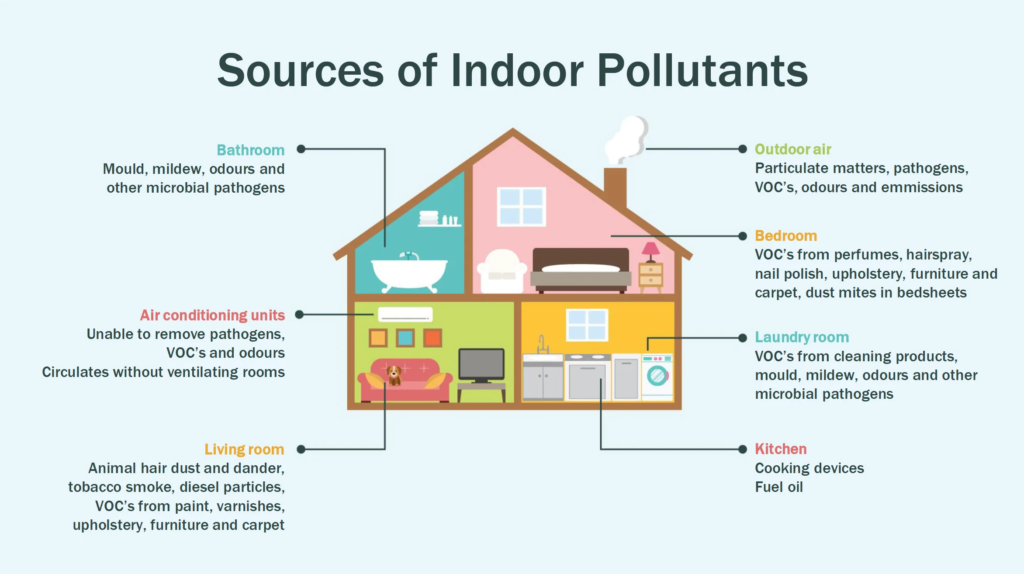
Source: Energy Tracker Asia — Indoor Air Pollution - What a Household Can Do? · energytracker.asia
Trap: Only cooking smoke matters in indoor pollution — furniture and products are major sources too
Confusion: PM2.5 vs VOCs — both cause indoor pollution but through different mechanisms
India angle: Rural vs urban sources differ — rural has more biomass, urban has more chemical pollutants