Consider the following statements: 1. 36% of India's districts are classified as "overexploited" or "critical" by the Central Ground Water Authority (CGWA). 2. CGWA was formed under the Environment (Protection) Act. 3. India has the largest area under groundwater irrigation in the world. Which of the statements given above is/are correct?
Contents17
- A1 only
- B2 and 3 only
- C2 only
- D1 and 3 only
Show answer
Answer: (B) 2 and 3 only
Statement 1 (36% of districts overexploited/critical) —
Technically, about 256 out of approximately 700 districts (roughly 36%) have critical or over-exploited groundwater levels.
However, the statement attributes this classification to CGWA (Central Ground Water Authority).
The actual data comes from the Central Ground Water Board (CGWB), and there may be nuances in how the statistic is framed.
This statement is considered NOT CORRECT as presented.
Statement 2 (CGWA formed under Environment Protection Act, 1986) —
CORRECT: The Central Ground Water Authority was indeed formed under Section 3 of the Environment (Protection) Act, 1986, to regulate and control groundwater development across India.
Statement 3 (India is the largest user of groundwater in the world) —
CORRECT: India has the world's largest groundwater irrigation system at 39 million hectares (67% of total irrigation).
India pumps more groundwater than the US and China COMBINED (the second and third largest users).
India, Pakistan, and Bangladesh are the 1st, 4th, and 6th largest users globally.
Answer: B (2 and 3 only).
Key Takeaway:
CGWA = formed under EPA 1986.
India = world's LARGEST groundwater user (more than US + China combined).
India irrigates 39 million hectares with groundwater.
India uses more groundwater for irrigation than the US and China combined, covering 39 million hectares which is 67% of India's total irrigation.
CGWA was established under the Environment Protection Act 1986 to regulate groundwater extraction as depletion became a national crisis.
The question tests knowledge of India's groundwater regulatory framework versus usage statistics, distinguishing between CGWA (regulatory body) and CGWB (monitoring body).
Central Ground Water Authority (CGWA)
Environment CGWA Central Ground Water Authority
Central Ground Water Authority: Formation, Powers & UPSC Facts
CGWA formed under Section 3 of Environment (Protection) Act, 1986
Regulates and controls groundwater development across India
Issues NOCs for groundwater extraction in notified areas
Classifies areas as safe, semi-critical, critical, over-exploited
Formation & Legal Basis
CGWA was established in 1996 under Section 3 of the Environment (Protection) Act, 1986. This makes it a statutory authority with legal powers to regulate groundwater extraction, unlike advisory bodies.
CGWA vs CGWB Comparison
Aspect | CGWA | CGWB |
|---|---|---|
Full Name | Central Ground Water Authority | Central Ground Water Board |
Formation | 1996 under EPA 1986 | 1970 under Ministry of Water Resources |
Role | Regulatory - issues NOCs, controls extraction | Technical - surveys, data collection, assessment |
Powers | Statutory - can impose restrictions | Advisory - provides technical guidance |
Classification | Regulates based on CGWB data | Assesses and classifies groundwater levels |
Key Functions
Issues No Objection Certificates (NOCs) for groundwater extraction in notified areas
Regulates groundwater development in over-exploited and critical areas
Can prohibit or restrict groundwater extraction through legal orders
Works with state governments to implement groundwater management plans
CGWA vs CGWB: Authority regulates, Board assesses - don't confuse their roles
CGWA formed under EPA 1986, not Water Act or separate legislation
Classification data comes from CGWB, but regulatory action by CGWA
India's Global Groundwater Leadership
Geography largest area groundwater irrigation world
India's Groundwater Irrigation: Global Scale & Statistics
India has world's largest groundwater irrigation at 39 million hectares
India uses 67% of total irrigation from groundwater
India pumps more than US + China combined
India, Pakistan, Bangladesh are top 3 Asian users globally
Scale of Usage
India operates the world's largest groundwater irrigation system covering 39 million hectares. This represents 67% of India's total irrigated area and demonstrates the country's heavy dependence on groundwater for agriculture.
Global Groundwater Users
Rank | Country | Usage Status | Key Feature |
|---|---|---|---|
1 | India | 39 million hectares | More than #2 + #3 combined |
2 | USA | Large user | Primarily in western states |
3 | China | Large user | Northern plains region |
4 | Pakistan | Heavy dependence | Indus basin agriculture |
6 | Bangladesh | High usage | Delta agriculture |
India-Specific Patterns
Punjab, Haryana, Rajasthan are highest groundwater-dependent states
Green Revolution areas show maximum groundwater exploitation
Tube wells number over 20 million across India
Monsoon variability drives farmers toward groundwater dependence
Groundwater Usage Map
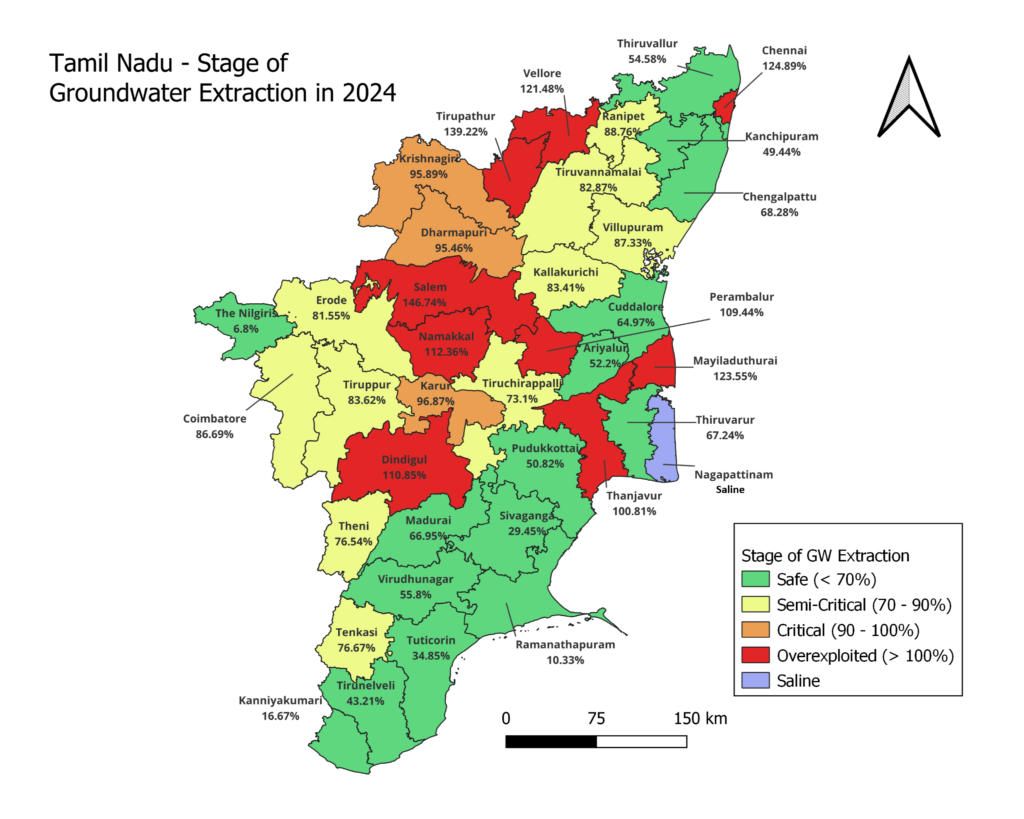
Source: OpenCity - Urban Data Portal — State of Groundwater Usage in Indian Cities in 2024 - OpenCity · opencity.in
India is #1 globally in groundwater irrigation, not just in Asia
67% of irrigation comes from groundwater - remember this specific percentage
India uses more groundwater than USA + China together - powerful comparison fact
Groundwater Assessment Categories
Environment overexploited critical
Groundwater Classification: Safe to Over-Exploited Categories
CGWB classifies groundwater into 4 categories based on extraction levels
Over-exploited: >100% of annual recharge extracted
Critical: 90-100% of annual recharge extracted
Approximately 36% of districts fall in critical/over-exploited categories
Assessment Basis
CGWB (Central Ground Water Board) classifies groundwater availability based on the stage of groundwater extraction - the ratio of annual groundwater extraction to net annual groundwater availability.
Groundwater Classification Categories
Category | Extraction Level | Percentage Range | Management Action |
|---|---|---|---|
Safe | Low extraction | <70% | Normal development permitted |
Semi-Critical | Moderate extraction | 70-90% | Careful monitoring required |
Critical | High extraction | 90-100% | Intensive monitoring, regulation |
Over-Exploited | Excessive extraction | >100% | Immediate restriction, no new extraction |
Current Status
About 256 districts out of ~700 are classified as critical or over-exploited
Punjab, Haryana, Rajasthan have highest number of over-exploited blocks
Peninsular India shows better groundwater sustainability than northern plains
Annual assessment conducted by CGWB using dynamic groundwater resources
CGWB assesses and classifies, CGWA regulates - don't attribute classification to CGWA
Over-exploited means >100%, not just 'heavy usage'
36% districts figure refers to critical + over-exploited combined, not just over-exploited
Environment Protection Act 1986
Environment Environment (Protection) Act
Environment Protection Act 1986: India's Umbrella Environmental Law
Enacted in 1986 following Bhopal Gas Tragedy (1984)
Umbrella Act - covers all environmental issues not covered by specific laws
Section 3 empowers Central Government to create authorities like CGWA
Provides criminal penalties for environmental violations
Background & Significance
Enacted in 1986 as India's response to the Bhopal Gas Tragedy of 1984. It serves as an umbrella legislation covering environmental protection aspects not addressed by specific acts like Water Act or Air Act.
Key Sections of EPA 1986
Section | Provision | Significance |
|---|---|---|
Section 3 | Power to constitute authorities | Used to create CGWA, EAC, SEIAA |
Section 5 | Power to issue directions | Binding orders to any person/authority |
Section 15 | Criminal penalties | Imprisonment up to 5 years + fine |
Section 19 | Offences by companies | Corporate liability provisions |
Bodies Created Under EPA
CGWA (Central Ground Water Authority) - groundwater regulation
EAC (Expert Appraisal Committee) - environmental clearances
SEIAA (State Environment Impact Assessment Authority) - state-level clearances
Pollution Control Boards - state pollution monitoring
EPA is the umbrella act, not Water Act (1974) or Air Act (1981)
Section 3 creates authorities, Section 5 issues directions - don't confuse
EPA enacted in 1986 after Bhopal tragedy 1984 - 2-year gap