R2 Code of Practices' constitutes a tool available for promoting the adoption of
Contents13
- Aenvironmentally responsible practices in electronics recycling industry
- Becological management of 'Wetlands of International Importance' under the Ramsar Convention
- Csustainable practices in the cultivation of agricultural crops in degraded lands.
- D'Environmental Impact Assessment' in the exploitation of natural resources
Show answer
Answer: (A) environmentally responsible practices in electronics recycling industry
R2 stands for 'Responsible Recycling.'
It is a standard specifically created for the electronics recycling industry by SERI (Sustainable Electronics Recycling International).
The R2 Standard provides guidelines and best practices for responsible recycling and refurbishment of electronics.
Stakeholders who contributed include:
- the US EPA
- state regulators
- electronics recyclers
- OEMs
- NGOs
It has nothing to do with wetlands (Ramsar Convention), agriculture, or Environmental Impact Assessment.
R2 (Responsible Recycling) is the main international standard that certifies electronics recyclers to handle e-waste safely and responsibly.
India's e-waste generation has been rapidly increasing, making electronics recycling standards like R2 increasingly relevant for environmental policy discussions.
UPSC is testing whether students can distinguish between different environmental certification systems rather than just knowing pollution treaties.
R2 Responsible Recycling Standard
Environment R2 Code of Practices electronics recycling
R2 Standard: Electronics Recycling Guidelines & Certification
R2 = Responsible Recycling — industry standard for electronics recycling and refurbishment
Developed by SERI (Sustainable Electronics Recycling International)
Supported by US EPA and state regulators for environmentally responsible practices
Covers data security, worker safety, and environmental protection in e-waste handling
The R2 Standard addresses the growing problem of electronic waste by providing certified guidelines for responsible recycling. It ensures that discarded electronics are processed safely without harming the environment or compromising data security.
R2 Standard Key Features
Aspect | R2 Requirements | Purpose |
|---|---|---|
Data Security | Complete data destruction protocols | Protect personal/corporate information |
Environmental Safety | No dumping in developing countries | Prevent pollution export |
Worker Protection | Health & safety standards for handlers | Minimize occupational hazards |
Material Recovery | Maximize reuse and recycling rates | Reduce landfill waste |
Chain of Custody | Track materials through entire process | Ensure responsible downstream handling |
SERI & Stakeholder Involvement
SERI (Sustainable Electronics Recycling International) developed R2 as a consensus-based standard
US EPA actively supported development and promotes R2 certification
State regulators recognize R2 for compliance with e-waste laws
Electronics manufacturers (OEMs) participate to ensure supply chain responsibility
NGOs contributed environmental and social justice perspectives
This question tests knowledge of specific environmental standards. The R2 Code of Practices is exclusively for electronics recycling — it has no connection to wetlands, agriculture, or EIA processes.
Trap: Ramsar Convention (Option B) deals with wetlands, not electronics — completely different environmental domain
Trap: Agricultural crops (Option C) might seem environmental, but R2 is technology-focused, not agriculture
Trap: EIA (Option D) is for project assessment, while R2 is for waste management — different stages of environmental protection
E-Waste Management in India
Environment
India's E-Waste Challenge & Regulatory Framework
India generates 3.2 million tonnes of e-waste annually — 5th largest globally
E-Waste Management Rules 2016 (amended 2018) govern electronic waste in India
Extended Producer Responsibility (EPR) makes manufacturers responsible for entire lifecycle
Large informal recycling sector creates environmental and health hazards
India faces a massive e-waste crisis due to rapid digitalization and short device lifecycles. Most e-waste ends up in informal recycling units that use crude methods, releasing toxic substances into the environment.
E-Waste Rules 2016 vs 2018 Amendment
Aspect | 2016 Rules | 2018 Amendment |
|---|---|---|
Scope | Only manufacturers covered | Producers, importers, refurbishers included |
EPR Targets | Fixed percentages | Phased increase: 10% (2017) to 70% (2023) |
Collection | Through authorized dismantlers | Producer responsibility organizations allowed |
Deposit Refund | Not specified | Mandatory for certain products |
Penalties | Basic environmental penalties | Specific EPR non-compliance penalties |
Formal E-Waste Management Process
%%{init: {"flowchart": {"wrappingWidth": 460}}}%%
flowchart TD
  s1["`**Collection**
Consumers return devices to authorized collection centers or producers`"]
  s2["`**Transportation**
Licensed transporters move e-waste to registered dismantling facilities`"]
  s3["`**Dismantling**
Authorized dismantlers separate materials under pollution control norms`"]
  s4["`**Recycling**
Precious metals, plastics recovered through environmentally sound processes`"]
  s5["`**Disposal**
Hazardous residues sent to authorized treatment facilities`"]
  s1 --> s2
  s2 --> s3
  s3 --> s4
s4 --> s5Trap: India does NOT follow R2 Standard — it has its own E-Waste Management Rules framework
Trap: CPCB (not SERI) regulates e-waste in India under Environment Ministry
Trap: EPR targets are percentage-based (70% by 2023), not absolute tonnage requirements
Ramsar Convention on Wetlands
Environment Ramsar Convention Wetlands of International Importance
Ramsar Convention: International Wetland Conservation Framework
Ramsar Convention (1971) — oldest modern global environmental agreement on wetlands
India has 75 Ramsar sites covering over 1.3 million hectares (as of 2023)
Wise use principle — sustainable utilization for human benefit while maintaining ecological character
Montreux Record lists Ramsar sites facing ecological threats
The Ramsar Convention requires countries to designate wetlands of international importance and maintain their ecological character. It promotes international cooperation for wetland conservation through the 'wise use' approach.
Ramsar Convention Key Pillars
Pillar | Obligation | Implementation Tool |
|---|---|---|
Site Designation | List wetlands of international importance | Ramsar site criteria (9 criteria covering ecology, species, biogeography) |
Wise Use | Maintain ecological character of all wetlands | National wetland policies and management plans |
International Cooperation | Cooperate on shared wetlands and species | Transboundary agreements and joint monitoring |
India's Major Ramsar Sites
Chilika Lake (Odisha) — largest brackish water lagoon, migratory bird habitat
Keoladeo National Park (Rajasthan) — UNESCO World Heritage Site, waterbird sanctuary
Wular Lake (Kashmir) — largest freshwater lake in India
Sundarbans (West Bengal) — mangrove ecosystem, Royal Bengal Tiger habitat
Kolleru Lake (Andhra Pradesh) — largest freshwater lake in AP, pelican breeding ground
India's Ramsar Sites Distribution
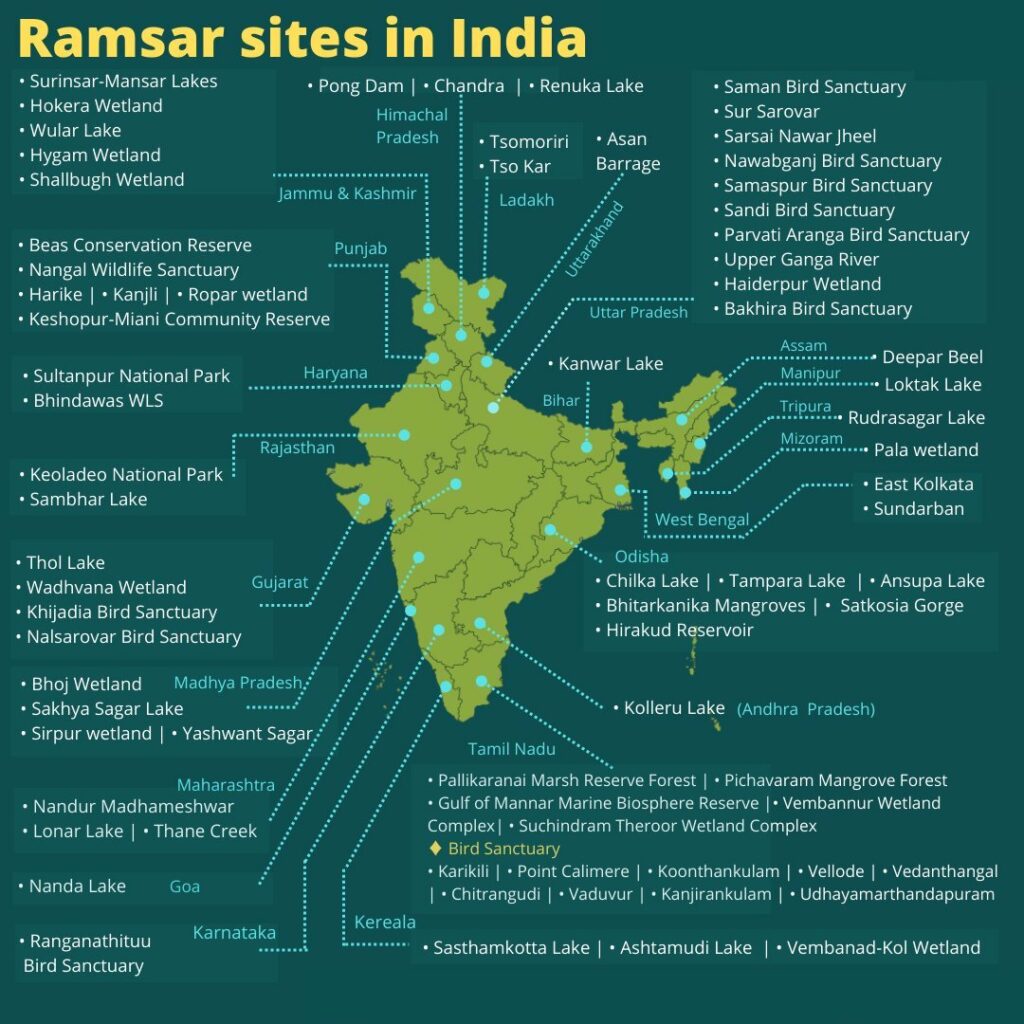
Source: LotusArise — Ramsar Sites in India with Map (Updated in 2026) | UPSC · lotusarise.com
Trap: Ramsar deals with wetland conservation, NOT electronics recycling — completely unrelated domains
Trap: Montreux Record is for threatened Ramsar sites, not a general wetland management tool
Trap: India has the most Ramsar sites but not the largest wetland area under Ramsar protection
Environmental Impact Assessment (EIA)
Environment Environmental Impact Assessment
EIA Process: Project Assessment & Environmental Clearance
EIA assesses environmental impact BEFORE project implementation — preventive tool
EIA Notification 2006 (amended 2020) governs EIA process in India
MoEFCC grants environmental clearance based on EIA reports
Public consultation mandatory for Category A projects, optional for Category B
Environmental Impact Assessment is a planning tool that evaluates potential environmental consequences of proposed projects. Unlike R2 (which handles waste after electronics are discarded), EIA operates at the project planning stage to prevent environmental damage.
EIA Process in India
%%{init: {"flowchart": {"wrappingWidth": 460}}}%%
flowchart TD
  s1["`**Screening**
Determine if project needs EIA (Category A/B classification)`"]
  s2["`**Scoping**
Define key environmental issues to be studied in detail`"]
  s3["`**Impact Assessment**
Prepare detailed EIA report covering all environmental aspects`"]
  s4["`**Public Consultation**
Stakeholder consultation (mandatory for Category A projects)`"]
  s5["`**Appraisal**
Expert Appraisal Committee evaluates EIA report and public inputs`"]
  s6["`**Decision Making**
MoEFCC grants/denies environmental clearance with conditions`"]
  s7["`**Monitoring**
Post-clearance compliance monitoring and periodic reports`"]
  s1 --> s2
  s2 --> s3
  s3 --> s4
  s4 --> s5
  s5 --> s6
  s6 --> s7
EIA Project Categories
Category | Project Scale | Clearance Authority | Public Consultation |
|---|---|---|---|
Category A | Large-scale, high impact | MoEFCC (Central) | Mandatory — 30 days notice |
Category B1 | Medium-scale, moderate impact | SEIAA (State) | Mandatory — case-by-case |
Category B2 | Smaller projects | SEIAA (State) | Not required |
Trap: EIA is for project planning, while R2 is for waste management — different stages of environmental protection
Trap: MoEFCC handles EIA clearances, not electronics recycling standards
Trap: EIA prevents environmental damage, R2 manages existing electronic waste