With reference to furnace oil, consider the following statements: 1. It is a product of oil refineries. 2. Some industries use it to generate power. 3. Its use causes sulphur emissions into environment. Which of the statements given above are correct?
Contents20
- A1 and 2 only
- B2 and 3 only
- C1 and 3 only
- D1, 2 and 3
Show answer
Answer: (D) 1, 2 and 3
Statement 1 is correct:
Furnace oil (also called heavy oil, marine fuel, or bunker fuel) is a fraction obtained from petroleum distillation in oil refineries.
Statement 2 is correct:
Some diesel-based power plants use furnace oil or heavy fuel oil to generate electricity.
For example, the Basin Bridge Diesel Generator Power Plant in Tamil Nadu used such fuel.
Statement 3 is correct:
Furnace oil contains sulfur.
During combustion, this fuel-bound sulfur gets oxidized to sulfur dioxide (SO2), with a small fraction (3-5%) further oxidizing to sulfur trioxide (SO3).
These are released into the environment as SOx emissions.
All three statements are correct.
Answer: (d).
Furnace oil is a heavy petroleum product from refineries that many industries use for power generation, making it a significant source of industrial emissions.
Around 2020-21, India was pushing cleaner fuel standards and emission controls for industries, making furnace oil's sulfur emissions a policy concern.
The question tests whether students understand the complete industrial fuel cycle from refinery production to environmental impact.
Furnace Oil (Heavy Fuel Oil)
Environment furnace oil
Furnace Oil: Production, Uses & Environmental Impact
Furnace oil is a heavy petroleum product from oil refineries
Used by diesel power plants and industries for electricity generation
Contains sulfur → releases SO2 and SO3 during combustion
Also called heavy fuel oil, marine fuel, or bunker fuel
What is Furnace Oil
Furnace oil is a heavy petroleum fraction obtained during crude oil refining. It sits at the heavier end of the distillation process, after lighter products like petrol, diesel, and kerosene are extracted.
Furnace Oil vs Other Petroleum Products
Product | Distillation Order | Density | Primary Use |
|---|---|---|---|
Petrol | Lightest | Low | Vehicle fuel |
Kerosene | Light | Medium | Aviation fuel, cooking |
Diesel | Medium | Medium-High | Vehicle fuel, generators |
Furnace Oil | Heaviest | High | Power plants, industrial heating |
Industrial Applications
Power generation: Diesel-based power plants use furnace oil as backup or primary fuel
Industrial heating: Steel, cement, and chemical industries use it in furnaces and boilers
Marine fuel: Ships use heavy fuel oil (same as furnace oil) for propulsion
Example: Basin Bridge Diesel Generator Power Plant in Tamil Nadu uses heavy fuel oil
Sulfur Emission Process
%%{init: {"flowchart": {"wrappingWidth": 460}}}%%
flowchart TD
  s1["`**Furnace oil contains sulfur**
Natural sulfur compounds present in heavy petroleum fractions`"]
  s2["`**Combustion occurs**
Oil burned in power plants or industrial furnaces`"]
  s3["`**Sulfur oxidizes**
Fuel-bound sulfur converts to sulfur dioxide (SO2)`"]
  s4["`**Further oxidation**
3-5% of SO2 converts to sulfur trioxide (SO3)`"]
  s5["`**SOx emissions released**
Both SO2 and SO3 released into atmosphere`"]
  s1 --> s2
  s2 --> s3
  s3 --> s4
s4 --> s5Trap: Don't confuse furnace oil with refined petroleum products like petrol - it's the heaviest fraction
Trap: Statement 2 might seem wrong if you think only coal plants generate power - diesel plants also exist
Trap: All fossil fuels contain sulfur and cause SOx emissions - not unique to coal
Name confusion: Furnace oil = Heavy fuel oil = Marine fuel = Bunker fuel (same product, different names)
Petroleum Refining & Products
Science And Technology oil refineries
Petroleum Refining: Fractional Distillation & Product Hierarchy
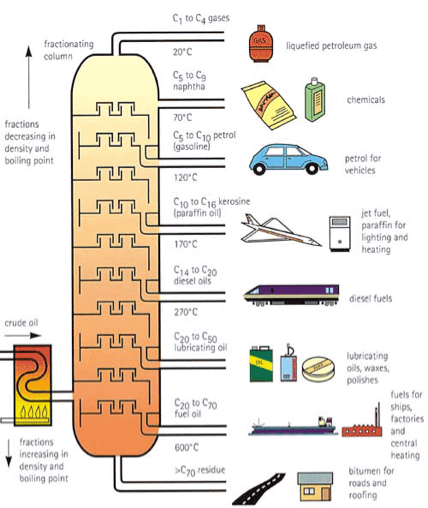
Crude oil separated into fractions by boiling point in refineries
Lighter fractions (petrol, kerosene) distill first, heavier ones (furnace oil) last
Each fraction has different density, viscosity, and industrial uses
Refining Process
Oil refineries use fractional distillation to separate crude oil into different products based on boiling points. Lighter hydrocarbons vaporize first, while heavier fractions like furnace oil remain liquid longer.
Distillation Sequence
%%{init: {"flowchart": {"wrappingWidth": 460}}}%%
flowchart TD
  s1["`**Crude oil heated**
Raw petroleum heated in distillation column`"]
  s2["`**Lightest fractions first**
Petrol, LPG vaporize at lowest temperatures`"]
  s3["`**Medium fractions**
Kerosene, diesel distill at moderate temperatures`"]
  s4["`**Heavy fractions last**
Furnace oil, lubricating oil remain at bottom`"]
  s5["`**Residue**
Bitumen and heavy residues collected`"]
  s1 --> s2
  s2 --> s3
  s3 --> s4
  s4 --> s5
Major Petroleum Products
Product | Boiling Range (°C) | Carbon Atoms | Main Uses |
|---|---|---|---|
LPG | Below 40 | C3-C4 | Cooking fuel, industrial |
Petrol | 40-200 | C5-C12 | Vehicle fuel |
Kerosene | 200-300 | C9-C16 | Aviation fuel, lamps |
Diesel | 300-370 | C10-C20 | Vehicle fuel, generators |
Furnace Oil | 370-600 | C20+ | Power plants, industries |
Refinery Distillation
Source: oilandgasinfo.ca — Fractional Distillation | oilandgasinfo.ca · oilandgasinfo.ca
Sulfur Emissions (SOx) from Fossil Fuels
Environment sulphur emissions
Sulfur Emissions: Chemistry, Sources & Environmental Impact
All fossil fuels contain sulfur → release SO2 and SO3 when burned
SO2 is primary emission, 3-5% further oxidizes to SO3
Major cause of acid rain and respiratory problems
Coal and heavy oil have highest sulfur content
Sulfur in Fossil Fuels
Fossil fuels naturally contain sulfur compounds formed during geological processes. When these fuels burn, the fuel-bound sulfur oxidizes and releases sulfur oxides (SOx) into the atmosphere.
SOx Formation Process
%%{init: {"flowchart": {"wrappingWidth": 460}}}%%
flowchart TD
  s1["`**Fossil fuel combustion**
Coal, oil, gas burned in power plants or industries`"]
  s2["`**Sulfur oxidation**
S + O2 → SO2 (sulfur dioxide)`"]
  s3["`**Secondary oxidation**
2SO2 + O2 → 2SO3 (3-5% of SO2 converts)`"]
  s4["`**Atmospheric reactions**
SO2 + H2O → H2SO3 (sulfurous acid)`"]
  s5["`**Acid rain formation**
SO3 + H2O → H2SO4 (sulfuric acid)`"]
  s1 --> s2
  s2 --> s3
  s3 --> s4
  s4 --> s5
Sulfur Content by Fuel Type
Fuel | Sulfur Content (%) | SOx Emission Level | Primary Use |
|---|---|---|---|
Coal | 0.5-3.0 | Very High | Power plants, steel |
Furnace Oil | 1.0-4.0 | High | Diesel plants, industries |
Diesel | 0.05-0.5 | Medium | Vehicles, generators |
Natural Gas | <0.01 | Very Low | Power, cooking |
Environmental Impact
Acid rain: SO2 and SO3 form sulfuric acid in atmosphere, damaging crops and buildings
Respiratory problems: SO2 causes asthma, bronchitis, and lung irritation
Particulate matter: SOx contributes to PM2.5 formation in urban areas
Ecosystem damage: Acid deposition acidifies soil and water bodies
Trap: Don't think only coal causes sulfur emissions - all fossil fuels do, including furnace oil
Trap: Natural gas has the lowest sulfur content, not zero sulfur
Chemical confusion: SO2 is the primary emission, SO3 forms secondarily in smaller amounts
Percentage trap: Only 3-5% of SO2 converts to SO3, not the majority
Diesel Power Plants in India
Indian Economy industries generate power
Diesel Power Plants: Role, Examples & Fuel Usage in India
Diesel plants use furnace oil or heavy fuel oil for electricity generation
Mainly serve as backup power and peak load management
Basin Bridge plant in Tamil Nadu is a key example
Role in Power System
Diesel power plants serve as backup and peaking power sources in India's electricity grid. They can start quickly when coal or gas plants cannot meet sudden demand spikes.
Power Plant Types by Fuel
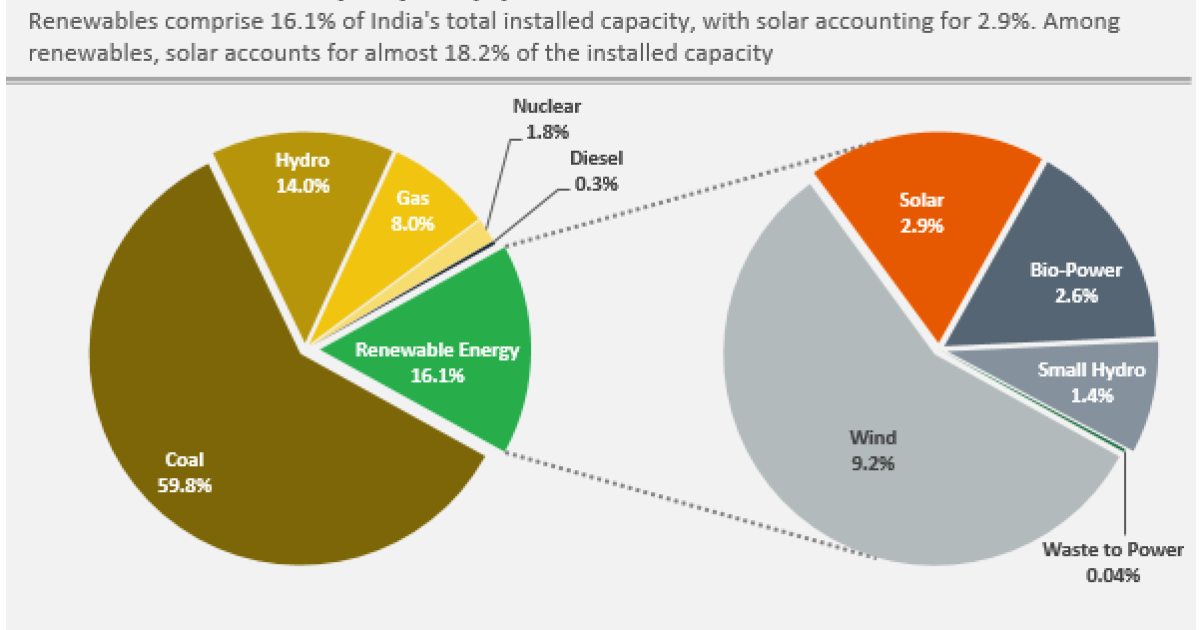
Plant Type | Primary Fuel | Capacity Share | Role |
|---|---|---|---|
Coal | Coal | ~70% | Base load |
Gas | Natural gas | ~25% | Peak load |
Diesel | Furnace oil/Heavy oil | <1% | Backup/Emergency |
Nuclear | Uranium | ~3% | Base load |
Hydro | Water | ~12% | Peak load |
Characteristics & Examples
Quick start: Diesel plants can reach full capacity within 15-30 minutes
High cost: Diesel/furnace oil is expensive compared to coal, so limited usage
Basin Bridge plant: 130 MW diesel generator plant in Chennai, Tamil Nadu
Island systems: Remote areas and islands often rely on diesel plants for primary power
India's Power Mix
Source: Asian Power — Renewable energy jumped to 16% of India's energy mix | Asian ... · asian-power.com
Capacity trap: Diesel plants have very low share in total capacity but still exist and operate
Fuel confusion: Diesel plants often use heavy fuel oil/furnace oil, not automotive diesel
Role misunderstanding: Primary role is backup/peaking, not continuous base load power