Why is there a concern about copper smelting plants? 1. They may release lethal quantities of carbon monoxide into environment. 2. The copper slag can cause the leaching of some heavy metals into environment. 3. They may release sulphur dioxide as a pollutant. Select the correct answer using the code given below.
Contents17
- A1 and 2 only
- B2 and 3 only
- C1 and 3 only
- D1, 2 and 3
Show answer
Answer: (B) 2 and 3 only
Statement 1 is wrong:
Copper smelting does not release lethal quantities of carbon monoxide.
The main pollutants from copper smelting are sulfur dioxide (SO2), suspended particles containing heavy metals like Lead, Cadmium, Nickel, and Arsenic — not CO in dangerous amounts.
Statement 2 is correct:
Copper slag contains heavy metals such as cobalt, zinc, arsenic, lead, cadmium, and barium.
Under natural weathering, these metals can leach into surrounding soil, surface water, and groundwater, causing environmental contamination.
Statement 3 is correct:
Copper smelting produces sulfur dioxide and other sulfur oxide emissions.
When SO2 combines with other pollutants in the atmosphere, it contributes to smog formation.
Statements 2 and 3 are correct.
Answer: (b).
Copper smelting releases sulfur dioxide and heavy metals like arsenic, lead, and cadmium through both air emissions and slag contamination.
The question tests whether students can distinguish between actual copper smelting pollutants (SO2, heavy metals) versus generic industrial pollutants like carbon monoxide.
Copper Smelting & Environmental Impact
Environment copper smelting plants sulphur dioxide carbon monoxide
Copper Smelting Plants: Pollution Sources & Environmental Concerns
Copper smelting releases SO₂ and heavy metal particles, not lethal CO
Main pollutants: sulfur dioxide, lead, cadmium, nickel, arsenic
Copper slag leaches heavy metals into soil and groundwater
SO₂ from smelting contributes to smog formation
What is Copper Smelting
Copper smelting extracts pure copper from sulfide ores by heating them at high temperatures. The process breaks down copper sulfide compounds, releasing the metal but also producing various pollutants as byproducts.
Major Pollutants from Copper Smelting
Pollutant Type | Specific Substances | Environmental Impact | Health Risk |
|---|---|---|---|
Gaseous Emissions | SO₂, sulfur oxides | Acid rain, smog formation | Respiratory problems |
Particulate Matter | Lead, Cadmium, Nickel, Arsenic | Air quality degradation | Carcinogenic, neurological damage |
Solid Waste (Slag) | Cobalt, Zinc, Arsenic, Barium | Soil & water contamination | Bioaccumulation in food chain |
Why CO is NOT a Major Concern
Carbon monoxide is not produced in lethal quantities during copper smelting
The chemical process primarily breaks down sulfide compounds, not carbon-based materials
Main concern is sulfur dioxide release, not carbon monoxide poisoning
Heavy Metal Leaching Process
%%{init: {"flowchart": {"wrappingWidth": 460}}}%%
flowchart TD
  s1["`**Copper Slag Generation**
Waste product containing heavy metals like cobalt, zinc, arsenic`"]
  s2["`**Natural Weathering**
Rain and atmospheric conditions break down slag particles`"]
  s3["`**Metal Leaching**
Heavy metals dissolve and migrate from slag`"]
  s4["`**Environmental Contamination**
Metals enter soil, surface water, and groundwater systems`"]
  s1 --> s2
  s2 --> s3
  s3 --> s4
Question Context
This question tested knowledge of specific pollutants from copper smelting. The trap was assuming CO is a major pollutant - but smelting sulfide ores primarily releases SO₂ and heavy metals, not carbon monoxide.
Trap: Statement 1 assumes carbon monoxide is a major smelting pollutant - it's not
Remember: Copper smelting = sulfide ore processing = SO₂ release, not CO
Don't confuse: Heavy metal particles (airborne) vs heavy metal leaching (from slag) - both are separate pollution sources
Heavy Metals & Environmental Leaching
Environment copper slag heavy metals leaching
Heavy Metal Contamination: Sources, Leaching & Environmental Impact
Heavy metals leach from industrial slag into soil and water
Common metals: lead, cadmium, arsenic, zinc, cobalt, barium
Contamination affects groundwater, surface water, and soil quality
Natural weathering accelerates metal migration from waste
What is Metal Leaching
Leaching occurs when heavy metals dissolve from solid waste (like copper slag) and migrate into surrounding environment. Natural processes like rain, temperature changes, and chemical weathering accelerate this contamination.
Major Heavy Metal Contaminants
Heavy Metal | Main Sources | Environmental Impact | Health Effects |
|---|---|---|---|
Lead (Pb) | Smelting, batteries, paints | Soil contamination, water pollution | Neurological damage, developmental issues |
Cadmium (Cd) | Industrial processes, fertilizers | Bioaccumulation in crops | Kidney damage, bone disease |
Arsenic (As) | Mining, smelting, pesticides | Groundwater contamination | Cancer, skin lesions |
Zinc (Zn) | Galvanizing, industrial waste | Aquatic ecosystem disruption | Digestive problems in excess |
Cobalt (Co) | Metal processing, batteries | Soil and water pollution | Respiratory and heart problems |
Environmental Pathways
# Heavy Metal Contamination
## Source
- Industrial Slag
- Mining Waste
- Smelting Byproducts
- Battery Disposal
## Transport
- Surface Runoff
- Groundwater Flow
- Wind Dispersion
- Weathering
## Impact
- Soil Degradation
- Water Pollution
- Crop Contamination
- Ecosystem Damage
Why Heavy Metals are Persistent
Non-biodegradable - heavy metals don't break down naturally like organic pollutants
Bioaccumulation - metals concentrate up the food chain, reaching toxic levels
Long residence time - metals persist in soil and sediments for decades
Multiple exposure routes - contamination through water, food, and direct contact
Don't assume all industrial pollution involves CO - many processes release different specific pollutants
Leaching vs Direct Release: Slag contamination happens gradually over time, not immediately
Remember: Heavy metals are elements (Pb, Cd, As) - they don't decompose like organic compounds
Sulfur Dioxide (SO₂) Pollution
Environment sulphur dioxide
Sulfur Dioxide: Industrial Sources, Formation & Environmental Impact
SO₂ is a major pollutant from burning sulfur-containing fuels and ores
Main sources: coal power plants, smelting, oil refineries
SO₂ causes acid rain and contributes to smog formation
Serious respiratory health impacts, especially for asthmatics
SO₂ Formation Process
Sulfur dioxide forms when sulfur-containing materials burn or are heated at high temperatures. In copper smelting, sulfide ores (like chalcopyrite) release SO₂ when copper is extracted.
Chemical reaction: Copper sulfide + Oxygen → Copper + Sulfur dioxide
Major SO₂ Sources & Emissions
Source Category | Specific Examples | % Contribution | Control Measures |
|---|---|---|---|
Power Generation | Coal-fired power plants | ~65% | Flue gas desulfurization |
Industrial Processes | Copper smelting, oil refining | ~20% | Cleaner production technology |
Transportation | Ships, diesel vehicles | ~10% | Low-sulfur fuels |
Residential | Coal heating, cooking | ~5% | Clean energy alternatives |
SO₂ Environmental Impact Chain
%%{init: {"flowchart": {"wrappingWidth": 460}}}%%
flowchart TD
  s1["`**SO₂ Emission**
Released from industrial sources like smelting plants`"]
  s2["`**Atmospheric Reaction**
SO₂ combines with water vapor and other pollutants`"]
  s3["`**Secondary Pollutant Formation**
Creates sulfuric acid particles and contributes to smog`"]
  s4["`**Environmental Deposition**
Falls as acid rain, affecting soil, water, and vegetation`"]
  s1 --> s2
  s2 --> s3
  s3 --> s4
Health & Environmental Effects
Respiratory irritation - causes coughing, throat irritation, breathing difficulty
Acid rain formation - SO₂ + water → sulfuric acid → damages buildings, forests, aquatic life
Smog component - reacts with other pollutants to form particulate matter
Visibility reduction - contributes to haze and poor air quality in industrial areas
SO₂ Pollution Cycle
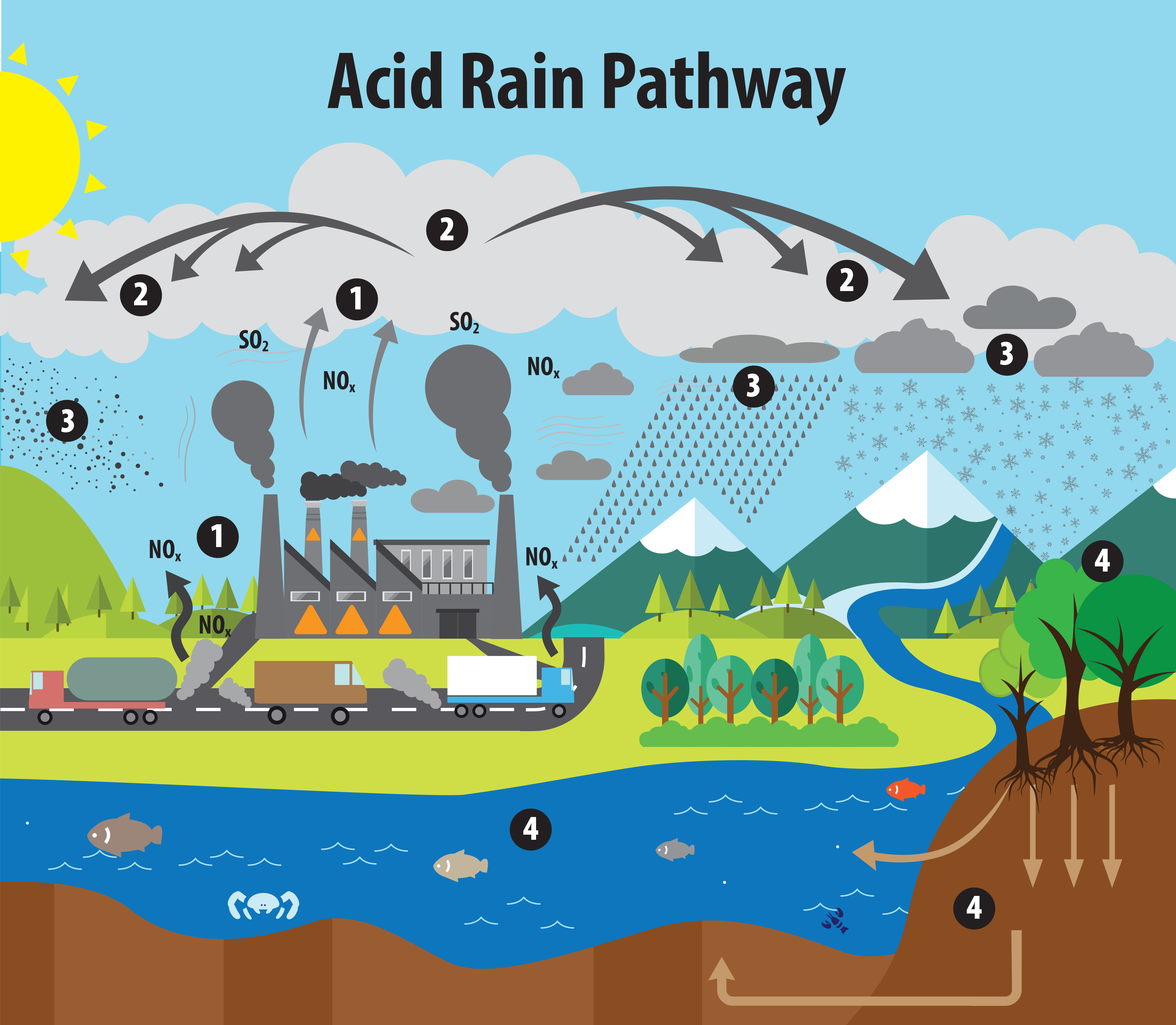
Source: EPA — What is Acid Rain? | US EPA · www.epa.gov
Remember: Sulfide ores (like copper sulfide) release SO₂ when smelted - it's chemistry, not coincidence
Don't confuse: SO₂ (sulfur dioxide) vs CO (carbon monoxide) - completely different sources and effects
Key distinction: SO₂ is a primary pollutant (directly emitted) that forms secondary pollutants (acid rain, smog)