Consider the following statements: Once the Central Government notifies an area as a 'Community Reserve' 1. the Chief Wildlife Warden of the State becomes the governing authority of such forest 2. hunting is not allowed in such area 3. people of such area are allowed to collect non-timber forest produce 4. people of such area are allowed traditional agricultural practices How many of the above statements are correct?
Contents10
- AOnly one
- BOnly two
- COnly three
- DAll four
Show answer
Answer: (C) Only three
Once an area is declared a Community Reserve under the Wildlife Protection Act (WLPA), 2002:
Statement 1 is correct — the Chief Wildlife Warden gets authority over the area.
Statement 2 is correct — hunting is not allowed.
Statement 3 is correct — agricultural practices are not permitted.
Statement 4 is wrong — people can still use the area for purposes consistent with the WLPA, but not for agriculture or hunting.
So only three are correct.
Answer is (c).
Community Reserves are one of three categories of protected areas under the Wildlife Protection Act 2002, allowing local communities to participate in conservation while maintaining some traditional rights.
The Forest Rights Act 2006 and various amendments to wildlife protection laws have made community-based conservation a policy priority, making this a relevant exam topic.
UPSC is testing whether students can distinguish between what communities can and cannot do in Community Reserves versus other protected area categories.
Community Reserves in India
Environment Community Reserve Chief Wildlife Warden
Community Reserves: Governance, Rules & UPSC Traps
Chief Wildlife Warden becomes governing authority of Community Reserves
Hunting prohibited in Community Reserves
Non-timber forest produce collection allowed by local communities
Traditional agricultural practices NOT allowed after notification
What are Community Reserves
Community Reserves are areas notified by the Central Government under the Wildlife Protection Act, 2002 to involve local communities in conservation while maintaining ecological integrity.
Key Provisions of Community Reserves
Aspect | Rule/Provision | Rationale |
|---|---|---|
Governing Authority | Chief Wildlife Warden of the State | Ensures scientific management and law enforcement |
Hunting | Completely prohibited | Wildlife protection is primary objective |
Non-timber Forest Produce | Collection allowed by locals | Supports community livelihoods sustainably |
Agricultural Practices | Not permitted after notification | Prevents habitat degradation and fragmentation |
Community Rights | Limited to conservation-compatible activities | Balances conservation with community needs |
Question Analysis
This question tested understanding of Statement 4 - the key trap. Many students assume traditional agriculture continues in Community Reserves, but the Wildlife Protection Act prohibits activities that could harm wildlife habitat, including farming.
Trap: Assuming agricultural practices are allowed because it's a 'Community' Reserve - they are NOT allowed
Confusion: Community Reserves vs Community Forest Resources under Forest Rights Act - different legal frameworks
Mix-up: Non-timber forest produce collection is allowed, but timber extraction is prohibited
Authority confusion: Chief Wildlife Warden (not District Collector or local panchayat) governs Community Reserves
Protected Areas Classification
Environment
India's Protected Area Categories: Rights & Restrictions
National Parks have strictest protection - no human activities allowed
Wildlife Sanctuaries allow some regulated activities with permission
Community Reserves involve local communities in conservation
Conservation Reserves are buffer zones between parks and human areas
Protected Area Categories Comparison
Category | Human Settlement | Grazing Rights | NTFP Collection | Hunting | Governing Authority |
|---|---|---|---|---|---|
National Park | Not allowed | Not allowed | Not allowed | Prohibited | Chief Wildlife Warden |
Wildlife Sanctuary | Existing allowed | With permission | With permission | Prohibited | Chief Wildlife Warden |
Community Reserve | Existing continues | Regulated | Allowed | Prohibited | Chief Wildlife Warden |
Conservation Reserve | Existing continues | Allowed | Allowed | Prohibited | Forest Department |
Tiger Reserve | Core: Not allowed, Buffer: Regulated | Buffer zone only | Buffer zone only | Prohibited | Field Director |
Protected Areas Framework
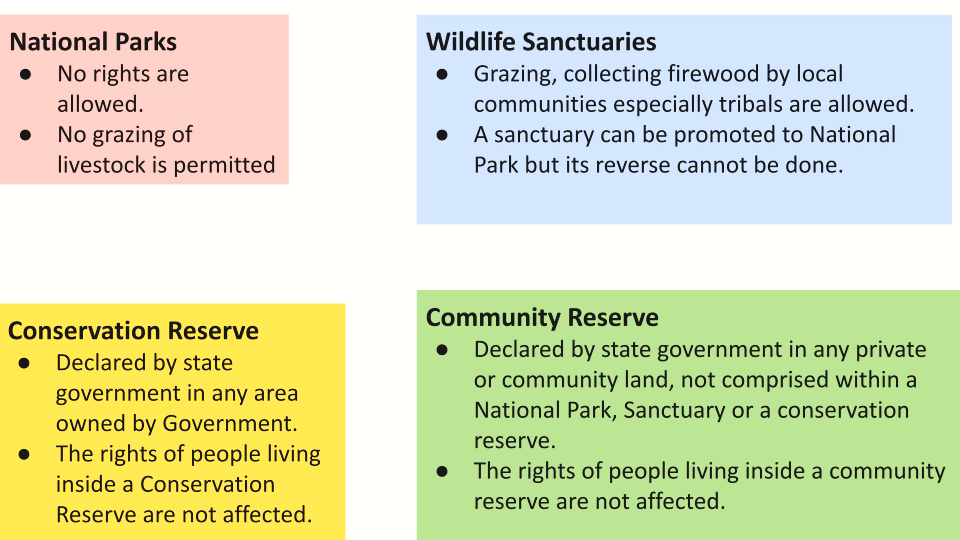
Source: PWOnlyIAS — Protected Areas In India 2026: Location, Management, Type ... · pwonlyias.com
Rights confusion: National Parks allow NO human activities, Sanctuaries allow some with permission
NTFP trap: Collection allowed in Community & Conservation Reserves but NOT in National Parks
Authority mix-up: Tiger Reserves have Field Director, others have Chief Wildlife Warden
Settlement rights: Only National Parks prohibit human settlements completely
Wildlife Protection Act 2002
Environment Wildlife Protection Act
Wildlife Protection Act 2002: Key Provisions & Amendments
WPA 2002 provides legal framework for wildlife conservation in India
Creates 6 categories of protected areas with different management regimes
Schedules I-VI classify species by protection level needed
2022 Amendment added Community Reserves and Conservation Reserves
WPA 2002 Structure
# Wildlife Protection Act 2002
## Protected Areas
- National Parks
- Wildlife Sanctuaries
- Community Reserves
- Conservation Reserves
- Tiger Reserves
- Biosphere Reserves
## Species Schedules
- Schedule I (Highest Protection)
- Schedule II-IV (Varying Protection)
- Schedule V (Vermin)
- Schedule VI (Plants)
## Authorities
- Chief Wildlife Warden
- Field Director
- Wildlife Advisory Board
- National Board for Wildlife
## Offences & Penalties
- Hunting Prohibition
- Trade Restrictions
- Habitat Destruction
- Penalty Structure
Recent Amendments & Updates
2022 Amendment strengthened penalties and added new categories of protected areas
Community participation emphasized through Community Reserves and Conservation Reserves
Digital monitoring and DNA profiling introduced for better enforcement
International trade regulations aligned with CITES provisions
Date confusion: It's Wildlife Protection Act 2002, not 1972 (that's the original act)
Authority levels: State governments notify most protected areas, Centre notifies only some
Schedule mix-up: Schedule I has highest protection, Schedule V are vermin species
Amendment awareness: 2022 changes often tested - know the recent updates