Consider the following statements: 1. Some microorganisms can grow in environments with temperature above the boiling point of water. 2. Some microorganisms can grow in environments with temperature below the freezing point of water. 3. Some microorganisms can grow in highly acidic environment with a pH below How many of the above statements are correct?
Contents20
- AOnly one
- BOnly two
- CAll three
- DNone
Show answer
Answer: (C) All three
All three are correct:
Some microorganisms (like Pyrolobus fumarii) thrive above 100°C at hydrothermal vents.
Psychrophiles can grow in extremely cold temperatures, down to -20°C.
Acidophiles thrive in highly acidic environments (pH below 3-5).
Answer is (c) All three.
Extremophiles are microorganisms that survive in conditions previously thought impossible for life, including temperatures above 100°C, below freezing, and in highly acidic environments with pH below 3.
Deep-sea hydrothermal vents, discovered in recent decades, host microorganisms that live above water's boiling point, revolutionizing our understanding of life's limits.
The question tests knowledge of the three main categories of extremophiles: thermophiles (high temperature), psychrophiles (low temperature), and acidophiles (acidic conditions).
Extremophile Microorganisms
Environment microorganisms temperature pH environments
Extremophile Microorganisms: Types & Extreme Survival
Extremophiles are microorganisms that thrive in extreme environments where most life cannot survive
Thermophiles grow above 100°C at hydrothermal vents and hot springs
Psychrophiles survive below 0°C, some down to -20°C in polar regions
Acidophiles thrive in pH below 3 environments like acid mine drainage
What Are Extremophiles
Extremophiles are microorganisms that not only survive but actively grow and reproduce in environmental conditions that would kill most other life forms. They have evolved unique biochemical adaptations that allow them to thrive where conventional life cannot exist.
Major Types of Extremophiles
Type | Extreme Condition | Temperature/pH Range | Examples & Habitats |
|---|---|---|---|
Thermophiles | High temperature | Above 100°C | Pyrolobus fumarii in hydrothermal vents, hot springs |
Psychrophiles | Low temperature | Below 0°C to -20°C | Antarctic ice, Arctic permafrost, deep ocean |
Acidophiles | High acidity | pH below 3 | Acid mine drainage, volcanic hot springs |
Alkaliphiles | High alkalinity | pH above 9 | Soda lakes, alkaline soils |
Halophiles | High salinity | 25-30% salt | Dead Sea, Great Salt Lake |
Barophiles | High pressure | >380 atm | Deep ocean trenches, oil wells |
Key Survival Mechanisms
Heat-shock proteins protect cellular structures at extreme temperatures
Antifreeze proteins prevent ice crystal formation in psychrophiles
Specialized enzymes maintain function at extreme pH levels
Modified cell membranes remain stable under extreme conditions
Unique metabolic pathways extract energy from harsh chemical environments
Question Connection
This question tested knowledge of all three major temperature and pH extremophiles. Statement 1 (above boiling point) refers to thermophiles, Statement 2 (below freezing) refers to psychrophiles, and Statement 3 (pH below 3) refers to acidophiles. All three statements are factually correct.
Trap: Assuming microorganisms cannot survive above 100°C - but thermophiles thrive at hydrothermal vents reaching 113°C
Trap: Thinking pH below 3 is impossible for life - acidophiles routinely survive in pH 1-2 environments
Trap: Confusing survival vs growth - extremophiles don't just survive, they actively grow and reproduce in extreme conditions
Confusion: Mixing up psychrophiles (cold-loving) with psychotrophs (cold-tolerant but prefer moderate temperatures)
Hydrothermal Vents Ecosystems
Environment boiling point temperature
Hydrothermal Vents: Deep Sea Extreme Ecosystems
Hydrothermal vents are underwater geysers reaching temperatures above 400°C near the seafloor
Support unique ecosystems based on chemosynthesis, not photosynthesis
Home to thermophile bacteria that thrive above 100°C
Located along mid-ocean ridges and volcanic zones
Formation & Environment
Hydrothermal vents form when seawater meets hot volcanic rock along mid-ocean ridges. The superheated water (reaching 350-400°C) dissolves minerals and creates unique chemical environments that support specialized life forms in complete darkness.
Chemosynthetic Food Chain
%%{init: {"flowchart": {"wrappingWidth": 460}}}%%
flowchart TD
  s1["`**Volcanic Heat**
Magma heats seawater to extreme temperatures`"]
  s2["`**Chemical Dissolution**
Hot water dissolves hydrogen sulfide, methane from rocks`"]
  s3["`**Chemosynthesis**
**Thermophile bacteria** convert chemicals into organic compounds`"]
  s4["`**Primary Consumers**
Tube worms, clams, mussels feed on bacteria`"]
  s5["`**Higher Consumers**
Crabs, fish, octopi complete the food web`"]
  s1 --> s2
  s2 --> s3
  s3 --> s4
  s4 --> s5
Unique Adaptations
Giant tube worms lack digestive systems - rely on symbiotic bacteria for nutrition
Pompeii worms withstand temperatures up to 80°C using heat-shock proteins
Vent crabs have specialized enzymes that function in high-pressure, high-temperature water
Chemosynthetic bacteria form the base of food webs without any sunlight
Many species are endemic - found nowhere else on Earth
Vent Ecosystem Structure
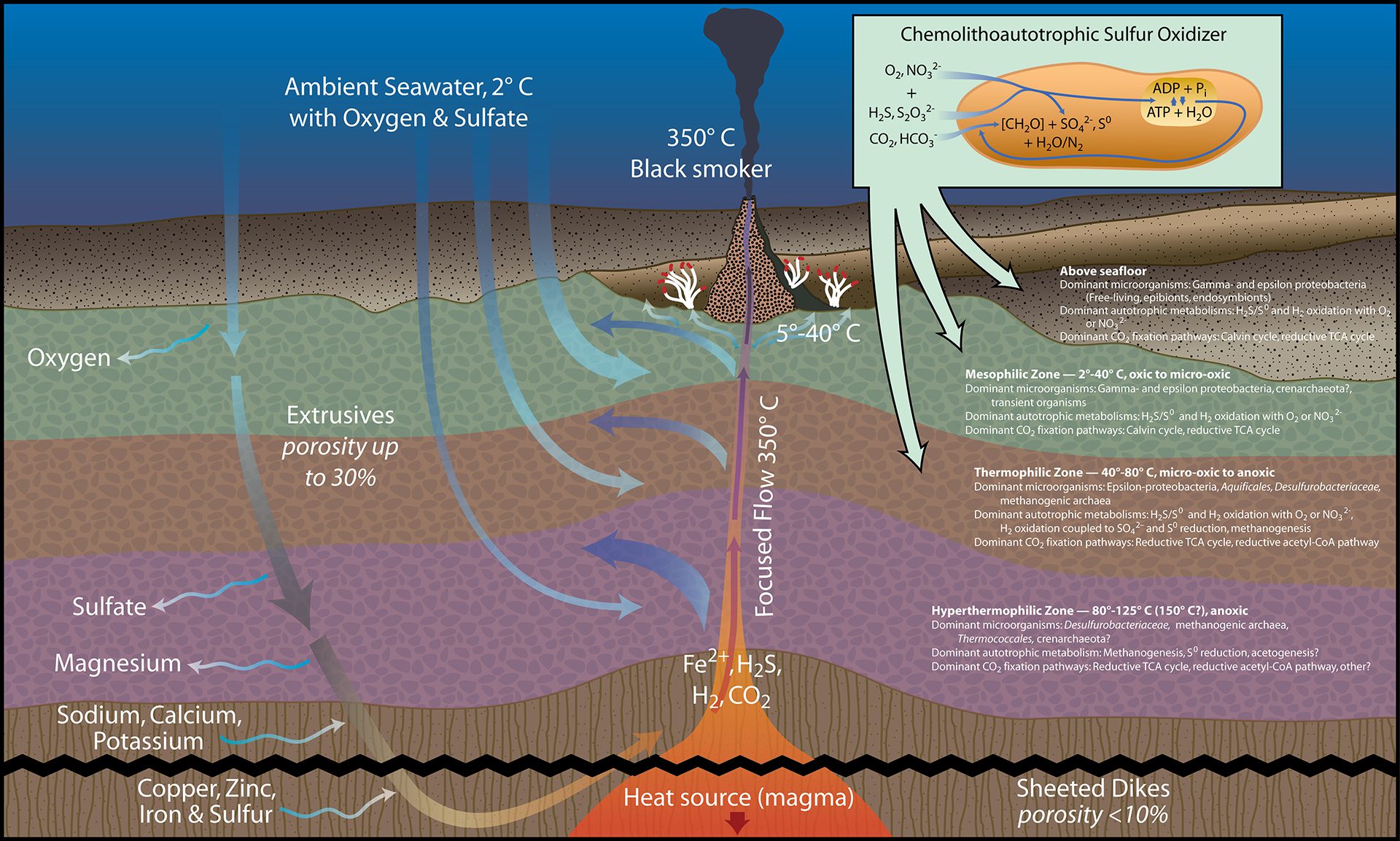
Source: Woods Hole Oceanographic Institution — Life and chemistry at deep-sea hydrothermal vents – Woods Hole ... · www.whoi.edu
Trap: Assuming all deep sea life depends on photosynthesis - vent ecosystems use chemosynthesis
Confusion: Mixing up hydrothermal vents (hot) with cold seeps (methane-based, cooler)
Trap: Thinking high pressure kills organisms - vent species are adapted to extreme pressure at ocean depths
Polar & Cold Environment Microbiology
Environment freezing point temperature
Psychrophiles: Life in Freezing Environments
Psychrophiles grow optimally at temperatures below 15°C, some surviving to -20°C
Found in polar ice, permafrost, deep ocean, and high-altitude environments
Use antifreeze proteins and modified enzymes to prevent cellular damage
Play crucial roles in polar food webs and biogeochemical cycles
Cold Adaptation Strategies
Psychrophiles have evolved remarkable mechanisms to survive sub-zero temperatures. They produce antifreeze proteins that prevent ice crystal formation inside cells, modify their membrane composition to remain fluid at low temperatures, and synthesize cold-active enzymes that function efficiently in freezing conditions.
Cold-Environment Microorganisms
Environment | Temperature Range | Key Organisms | Adaptations |
|---|---|---|---|
Antarctic ice | -40°C to -10°C | Psychrobacter, Arthrobacter | Antifreeze proteins, cold-shock proteins |
Arctic permafrost | -20°C to -5°C | Methanobrevibacter, Clostridium | Slow metabolism, spore formation |
Deep ocean | 2°C to 4°C | Psychromonas, Colwellia | Pressure-resistant enzymes |
High-altitude glaciers | -15°C to 0°C | Polaromonas, Hymenobacter | UV resistance, desiccation tolerance |
Ecological Importance
Primary decomposers in polar ecosystems - break down organic matter in permafrost
Methane production - some psychrophiles release greenhouse gases from thawing permafrost
Biotechnology applications - cold-active enzymes used in industrial processes
Climate indicators - their activity reflects polar warming trends
Polar Microbial Habitats
Map showing distribution of psychrophilic microorganisms in Arctic tundra, Antarctic ice sheets, and high-altitude glaciers with temperature zones
Psychrophiles dominate microbial communities where temperatures remain below 0°C year-round
Trap: Confusing psychrophiles (cold-loving) with psychrotrophs (cold-tolerant but prefer moderate temps)
Misconception: Thinking freezing temperatures kill all microorganisms - many actively grow below 0°C
Trap: Assuming Antarctica has no microbial life - it hosts diverse psychrophile communities
Acidophile Bacteria & Acid Environments
Environment acidic pH
Acidophiles: Life in Extreme Acid Conditions
Acidophiles thrive in environments with pH below 3, some surviving at pH 0-1
Found in acid mine drainage, volcanic springs, and industrial waste sites
Use specialized proton pumps and acid-resistant proteins to maintain cellular pH
Important in bioleaching - extracting metals from ores using biological processes
Acid Tolerance Mechanisms
Acidophiles maintain an internal pH around 6-7 even in extremely acidic environments through specialized proton pumps that actively expel excess hydrogen ions. They produce acid-resistant enzymes and buffering compounds that protect cellular machinery from acid damage.
Major Acidophile Groups
Organism | Optimal pH | Habitat | Key Application |
|---|---|---|---|
Acidithiobacillus ferrooxidans | pH 2.0-2.5 | Acid mine drainage | Copper, uranium mining |
Sulfolobus | pH 1.0-3.0 | Hot sulfur springs | Thermoacidophile research |
Picrophilus torridus | pH 0.5 | Volcanic solfataras | Extreme acid adaptation |
Ferroplasma | pH 1.7 | Iron-rich acid waters | Iron oxidation |
Acidophile Applications
# Acidophile Uses
## **Bioleaching**
- Copper extraction
- Gold recovery
- Rare earth metals
## **Bioremediation**
- Acid mine cleanup
- Metal contamination
- Industrial waste
## **Biotechnology**
- Acid-stable enzymes
- Industrial catalysts
- Pharmaceutical processes
## **Research**
- Protein folding
- Extreme life limits
- Astrobiology models
Environmental Impact
Acid mine drainage - acidophiles accelerate sulfide mineral oxidation, creating highly acidic runoff
Metal mobilization - make toxic metals more soluble and bioavailable in ecosystems
Bioremediation potential - can be used to neutralize acid contamination through controlled processes
Indicator species - their presence signals severe environmental acidification
Trap: Thinking pH below 3 kills all life - acidophiles actively grow at pH 1-2
Confusion: Mixing up optimal pH (where they grow best) vs survival pH (extreme limits they tolerate)
Misconception: Assuming acidophiles create acid environments - often they just exploit existing acidic conditions
Trap: Confusing acidophiles with alkaliphiles - opposite pH preferences