Consider the following statements: Statement-I: Israel has established diplomatic relations with some Arab States. Statement-II: The 'Arab Peace Initiative' Mediated by Saudi Arabia was signed by Israel and Arab League. Which one of the following is correct in respect of the above statements?
Contents15
- ABoth Statement-I and Statement-II are correct and Statement-II is the correct explanation for Statement-I
- BBoth Statement-I and Statement-II are correct and Statement-II is not the correct explanation for Statement-I
- CStatement-I is correct but Statement-II is incorrect
- DStatement-I is incorrect but Statement-II is correct
Show answer
Answer: (C) Statement-I is correct but Statement-II is incorrect
Statement-I is correct:
Israel has diplomatic relations with some Arab states —
- Egypt (1979)
- Jordan (1994)
- UAE and Bahrain (2020, Abraham Accords).
Statement-II is wrong:
The Arab League's Peace Initiative (2002) offered Israel normalization in exchange for withdrawal from Palestinian territories, but Israel did NOT sign it.
So Statement-I is correct but Statement-II is not.
Answer is (c).
Israel established diplomatic relations with UAE and Bahrain in 2020 through the Abraham Accords, making this a current topic for UPSC.
The Arab Peace Initiative of 2002 was proposed by Saudi Arabia but never signed by Israel - it remains an offer on the table requiring Israeli withdrawal from occupied territories.
UPSC is testing whether students can distinguish between actual diplomatic agreements versus unaccepted peace proposals in Middle East diplomacy.
Israel-Arab Diplomatic Relations
World Affairs (International Relations) Israel Arab States diplomatic relations
Israel-Arab Diplomatic Relations: Timeline & Key Agreements
Israel has diplomatic relations with Egypt (1979), Jordan (1994), UAE & Bahrain (2020)
Camp David Accords led to Egypt-Israel peace treaty
Abraham Accords (2020) normalized Israel-UAE-Bahrain relations
Most Arab states still do not recognize Israel
Israel has established diplomatic relations with only a few Arab states despite decades of conflict. These breakthrough agreements represent major shifts in Middle East geopolitics.
Israel's Diplomatic Relations with Arab States
Country | Year | Agreement | Key Context |
|---|---|---|---|
Egypt | 1979 | Camp David Accords | First Arab state to recognize Israel |
Jordan | 1994 | Jordan-Israel Peace Treaty | Signed after Oslo Accords momentum |
UAE | 2020 | Abraham Accords | US-mediated normalization |
Bahrain | 2020 | Abraham Accords | Followed UAE's lead |
Morocco | 2020 | Abraham Accords | US recognized Western Sahara in return |
Sudan | 2020 | Abraham Accords | Removed from US terror list in return |
Abraham Accords Signatories
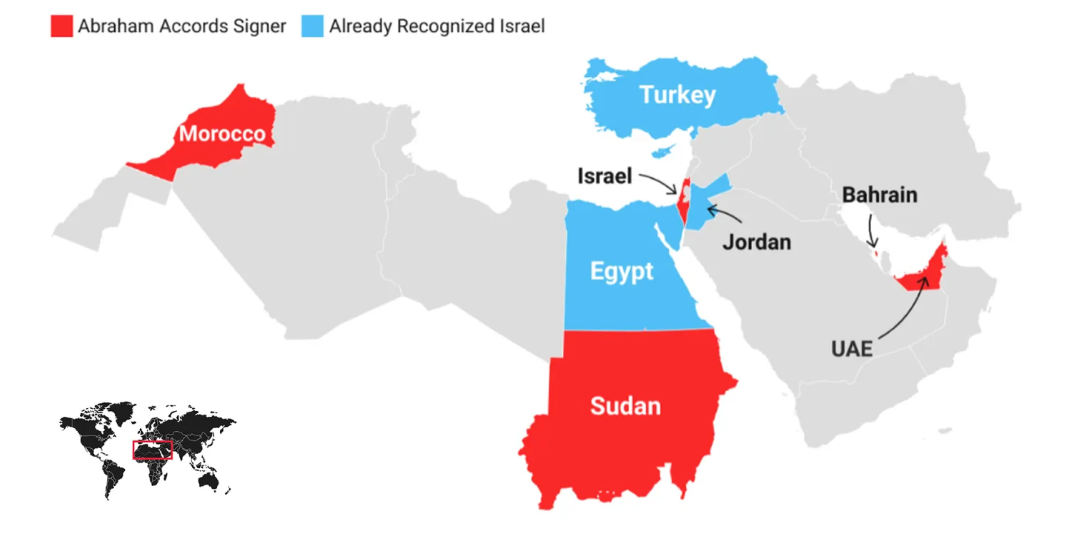
Source: Aspenia Online — Assessing the effects and prospects of the 2020 Abraham Accords ... · aspeniaonline.it
Strategic Implications
Camp David Accords broke the Arab unity against Israel - Egypt was expelled from Arab League until 1989
Abraham Accords bypassed Palestinian issue - focused on Iran threat and economic benefits
Saudi Arabia has not normalized but allows Israeli flights over its airspace
Syria and Lebanon remain in official state of war with Israel
Gulf states see Israel as ally against Iranian influence in the region
Trap: Don't confuse Arab Peace Initiative (not signed by Israel) with actual diplomatic agreements
Trap: Morocco and Sudan joined Abraham Accords in 2020, not just UAE and Bahrain
Trap: Egypt was first Arab state to recognize Israel (1979), not UAE
Trap: Saudi Arabia has not established full diplomatic relations despite facilitating talks
Arab Peace Initiative
World Affairs (International Relations) Arab Peace Initiative Saudi Arabia Arab League
Arab Peace Initiative: Saudi Proposal & Israel's Response
Arab Peace Initiative (2002) proposed by Saudi Crown Prince Abdullah
Offered full normalization in exchange for Israeli withdrawal to 1967 borders
Israel rejected the initiative - never signed it
Based on 'land for peace' formula
The Arab Peace Initiative was a comprehensive peace proposal offering Israel full normalization with all Arab states in exchange for complete withdrawal from occupied territories. Israel has never signed this initiative.
Arab Peace Initiative Terms
Arab Offer | Israeli Requirements | Status |
|---|---|---|
Full diplomatic relations with all 22 Arab states | Withdraw to 1967 borders | Rejected by Israel |
Economic cooperation and security guarantees | Accept Palestinian state with East Jerusalem as capital | Never implemented |
End to Arab-Israeli conflict | Just solution to Palestinian refugee problem | Remains on table |
Regional security framework | Dismantle all settlements in occupied territories | No progress |
Key Features & Reactions
Launched at 2002 Arab League Summit in Beirut by Saudi Crown Prince Abdullah
Reaffirmed multiple times by Arab League - remains official Arab position
Israel's objections: refugees' right of return, 1967 borders, Jerusalem's status
US position: supportive of initiative as framework but wants direct negotiations
Differs from Oslo Accords - offers comprehensive regional peace, not step-by-step approach
Initiative Timeline
%%{init: {"flowchart": {"wrappingWidth": 460}}}%%
flowchart TD
  s1["`****2002**: Saudi proposal**
Crown Prince Abdullah proposes at Arab League Summit`"]
  s2["`****2002**: Arab League adoption**
All 22 members endorse the initiative`"]
  s3["`****2007**: Reaffirmation**
Arab League restates commitment with minor modifications`"]
  s4["`****2017**: Latest reaffirmation**
Arab League maintains offer remains on table`"]
  s1 --> s2
  s2 --> s3
s3 --> s4Major Trap: Arab Peace Initiative was proposed by Arab League but never signed by Israel
Trap: Don't confuse with Abraham Accords - API requires territorial withdrawal, Abraham Accords don't
Trap: Initiative is from 2002, not recent - predates Abraham Accords by 18 years
Trap: Saudi Arabia mediated/proposed the initiative but hasn't normalized relations with Israel itself
Abraham Accords
World Affairs (International Relations)
Abraham Accords: 2020 Normalization Breakthrough
Abraham Accords (2020) normalized Israel-UAE-Bahrain relations
US-mediated under Trump administration with Jared Kushner
Morocco and Sudan joined later in 2020
Focused on economic ties and Iran containment, not Palestinian issue
The Abraham Accords represent the most significant Arab-Israel diplomatic breakthrough since the Egypt-Israel peace treaty. Unlike previous peace efforts, these agreements bypassed the Palestinian issue and focused on shared strategic interests.
Abraham Accords Participants & Benefits
Country | Date Signed | US Incentive | Key Benefits |
|---|---|---|---|
UAE | Aug 2020 | F-35 fighter jets deal | Tech cooperation, tourism, trade |
Bahrain | Sep 2020 | Security guarantees | Financial sector cooperation |
Morocco | Dec 2020 | US recognized Western Sahara | Defense cooperation, agriculture |
Sudan | Jan 2021 | Removed from terror list | Economic aid, debt relief |
Strategic Context
Iran threat - shared concern about Iranian influence brought Arab states and Israel together
Economic pragmatism - focus on trade, technology, tourism rather than ideological positions
Palestinian bypassing - broke Arab consensus that Palestinian issue must be resolved first
Saudi approval - Saudi Arabia allowed use of its airspace, signaling quiet support
Biden continuation - Democratic administration has maintained Trump's Abraham Accords framework
Abraham Accords Impact
# Abraham Accords
## Economic
- Bilateral trade growth
- Technology partnerships
- Tourism boom
- Investment flows
## Security
- Intelligence sharing
- Iran containment
- Defense cooperation
- Regional stability
## Diplomatic
- Broke Arab unity
- Embassies opened
- Regular summits
- Multilateral forumsTrap: Abraham Accords are 2020 agreements, not historical - very recent development
Trap: 4 countries joined (UAE, Bahrain, Morocco, Sudan), not just the original two
Trap: Trump administration brokered these, but Biden has continued the framework
Trap: These bypassed Palestinian issue - different approach from Arab Peace Initiative
Middle East Peace Initiatives
World Affairs (International Relations)
Major Middle East Peace Initiatives: Comparative Analysis
Oslo Accords (1993) established Palestinian self-rule in parts of West Bank/Gaza
Camp David Accords (1978) led to Egypt-Israel peace treaty
Arab Peace Initiative (2002) remains unimplemented comprehensive offer
Madrid Conference (1991) brought Arabs and Israelis to same negotiating table
Multiple peace initiatives have attempted to resolve the Arab-Israeli conflict through different approaches - bilateral agreements, comprehensive regional deals, and step-by-step processes.
Major Peace Initiatives Comparison
Initiative | Year | Mediator | Approach | Outcome |
|---|---|---|---|---|
Camp David | 1978 | US (Carter) | Egypt-Israel bilateral | Success - Peace treaty signed |
Madrid Conference | 1991 | US-USSR | Multilateral framework | Partial - Led to Oslo process |
Oslo Accords | 1993 | Norway | Israel-PLO recognition | Partial - Created PA, but failed |
Arab Peace Initiative | 2002 | Saudi Arabia | Comprehensive regional | Failed - Israel rejected |
Abraham Accords | 2020 | US (Trump) | Gulf-Israel normalization | Success - 4 countries joined |
Key Patterns & Lessons
Bilateral vs multilateral - Individual country deals (Egypt, Jordan, UAE) more successful than comprehensive approaches
US role crucial - All successful agreements involved intensive American mediation and incentives
Economic incentives work - Countries that normalized got significant US aid/benefits
Palestinian centrality debated - Abraham Accords bypassed Palestinian issue, earlier initiatives made it central
Regional dynamics matter - Iran threat helped bring Gulf states and Israel together
Trap: Oslo created Palestinian Authority but didn't end conflict - often confused as comprehensive solution
Trap: Madrid (1991) was conference format, Camp David (1978) was actual negotiating retreat
Trap: Different US presidents - Carter (Camp David), Bush Sr. (Madrid), Clinton (Oslo), Trump (Abraham)
Trap: Arab Peace Initiative and Abraham Accords are opposite approaches - comprehensive vs bilateral