In which one of the following States is Pakhui Wildlife Sanctuary located?
Contents12
- AArunachal Pradesh
- BManipur
- CMeghalaya
- DNagaland
Show answer
Answer: (A) Arunachal Pradesh
Correct Answer: (a) Arunachal Pradesh
Pakhui Wildlife Sanctuary (also known as Pakke Tiger Reserve) is located in the East Kameng district of Arunachal Pradesh.
Key facts:
- It covers over 860 sq km of area.
- It is bounded by the Kameng River and Pakke River.
- It is a dedicated Tiger Reserve.
- It is home to species like tigers, elephants, hornbills, and the rare clouded leopard.
- The Pakke Paga Hornbill Festival is celebrated here to promote hornbill conservation.
Why not the others?
- Manipur — Has Keibul Lamjao National Park (only floating national park in the world).
- Meghalaya — Has Nongkhyllem and Balpakram National Parks.
- Nagaland — Has Intanki National Park.
REMEMBER: Pakhui/Pakke = Arunachal Pradesh = Tiger Reserve = East Kameng district. The 'Pakke' name can help you remember — 'Pakke' sounds distinctive for Arunachal Pradesh. Also remember the Pakke Paga Hornbill Festival.
Pakhui Wildlife Sanctuary is also known as Pakke Tiger Reserve and covers over 860 sq km in East Kameng district of Arunachal Pradesh.
The sanctuary hosts the annual Pakke Paga Hornbill Festival to promote hornbill conservation, making it a recognizable current affairs reference.
UPSC tests Northeast protected areas because students often confuse the smaller northeastern states and their specific wildlife sanctuaries.
Pakhui Wildlife Sanctuary (Pakke Tiger Reserve)
Environment Pakhui Wildlife Sanctuary
Pakhui Wildlife Sanctuary: Location, Species & Conservation
Pakhui Wildlife Sanctuary is located in East Kameng district, Arunachal Pradesh
Also known as Pakke Tiger Reserve - covers over 860 sq km
Famous for Pakke Paga Hornbill Festival promoting hornbill conservation
Home to tigers, elephants, hornbills and rare clouded leopards
Key Identity
Pakhui Wildlife Sanctuary in Arunachal Pradesh is also designated as Pakke Tiger Reserve. Located in East Kameng district, it's bounded by the Kameng and Pakke rivers, covering over 860 square kilometers of protected forest area.
Core Facts
Aspect | Details |
|---|---|
Location | East Kameng district, Arunachal Pradesh |
Area | Over 860 sq km |
Rivers | Kameng River and Pakke River |
Status | Wildlife Sanctuary + Tiger Reserve |
Key Species | Tigers, elephants, hornbills, clouded leopards |
Cultural Event | Pakke Paga Hornbill Festival |
Location Map
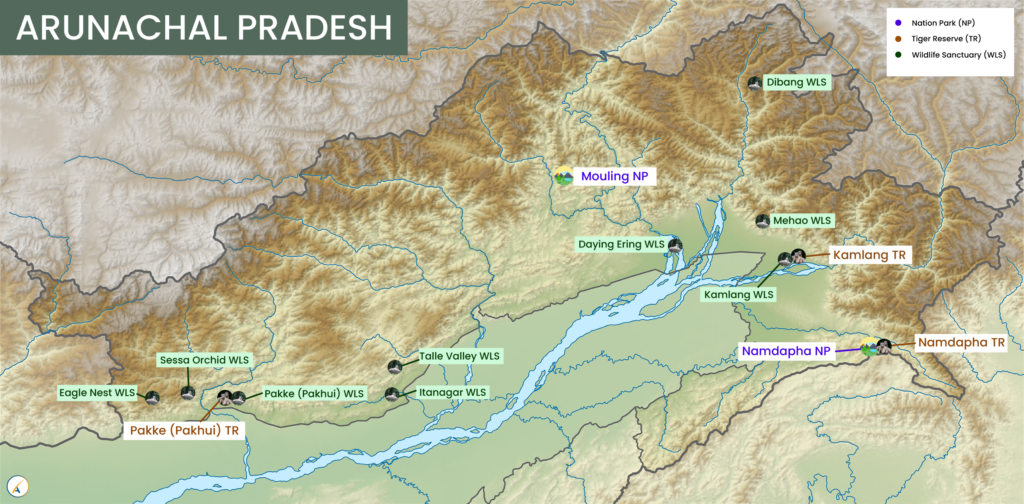
Source: LotusArise — Arunachal Pradesh National Parks, Tiger Reserves and Wildlife ... · lotusarise.com
Question Context
This PYQ tested direct factual recall of protected area locations. The key was knowing that Pakhui = Pakke Tiger Reserve = Arunachal Pradesh. The dual name (Pakhui/Pakke) and its status as both wildlife sanctuary and tiger reserve make it a frequently tested location.
Name confusion: Pakhui and Pakke refer to the same sanctuary - don't treat them as different places
State mix-up: All options are northeastern states - but only Arunachal Pradesh has Pakhui
River boundary: Remember it's bounded by Kameng and Pakke rivers - not just one river
Dual status: It's both a Wildlife Sanctuary AND Tiger Reserve - don't pick just one designation
Protected Areas in Northeast India
Environment Manipur Meghalaya Nagaland
Major Protected Areas in Northeast States
Manipur: Keibul Lamjao - world's only floating national park
Meghalaya: Nongkhyllem and Balpakram National Parks
Nagaland: Intanki National Park - main protected area
Arunachal Pradesh: Pakhui/Pakke Tiger Reserve in East Kameng
State-wise Key Protected Areas
State | Major Protected Area | Unique Feature | District/Location |
|---|---|---|---|
Arunachal Pradesh | Pakhui/Pakke Tiger Reserve | Hornbill conservation hub | East Kameng |
Manipur | Keibul Lamjao National Park | World's only floating park | Bishnupur |
Meghalaya | Balpakram National Park | Known as 'Land of Spirits' | South Garo Hills |
Meghalaya | Nongkhyllem National Park | Elephant habitat | Ri-Bhoi |
Nagaland | Intanki National Park | Tiger and elephant reserve | Peren |
Northeast Pattern
Northeast India has unique protected areas due to its biodiversity hotspot status. Each state typically has 1-2 major national parks or wildlife sanctuaries that UPSC frequently tests. Manipur's floating park and Arunachal's tiger reserves are the most commonly asked.
Keibul Lamjao trap: Only floating national park in the world - don't confuse with wetland parks
Meghalaya confusion: Has both Nongkhyllem AND Balpakram - don't pick just one
Nagaland recall: Intanki is the main park - not Dzukou Valley (that's a tourist spot)
State-park pairing: Northeast questions often test exact state-protected area combinations
Tiger Reserves Classification
Environment
Tiger Reserves in India: Status & Management
India has 50+ Tiger Reserves under Project Tiger (1973)
Managed by NTCA (National Tiger Conservation Authority)
Each has Core Area (critical tiger habitat) + Buffer Zone
Pakke in Arunachal Pradesh is one of the northeastern tiger reserves
Tiger Reserve System
Tiger Reserves are special protected areas under Project Tiger (launched 1973), managed by NTCA. Unlike regular national parks, they have a two-zone structure: core areas with minimal human interference and buffer zones allowing limited activities.
Tiger Reserve vs Wildlife Sanctuary
Aspect | Tiger Reserve | Wildlife Sanctuary |
|---|---|---|
Authority | NTCA + State | State Government |
Structure | Core + Buffer zones | Single protected area |
Primary Focus | Tiger conservation | General wildlife protection |
Funding | Central + State | Mainly State |
Legal Status | Wildlife Protection Act | Wildlife Protection Act |
Human Activity | Strictly regulated | Limited regulation |
Northeast Tiger Reserves
Pakke Tiger Reserve (Arunachal Pradesh) is significant as one of the few tiger reserves in Northeast India, along with Manas (Assam) and Dampa (Mizoram). These reserves face unique challenges due to international borders and tribal areas.
Dual identity: Many places are both Wildlife Sanctuary AND Tiger Reserve - like Pakhui/Pakke
Authority confusion: Tiger Reserves are under NTCA, not just state forest departments
Zone structure: Tiger Reserves have Core + Buffer, regular sanctuaries don't
Northeast count: Don't assume all northeastern states have tiger reserves - only Assam, Arunachal, Mizoram do