Which of the following are in Agasthyamala Biosphere Reserve?
Contents16
- ANeyyar, Peppara and Shendurney Wildlife Sanctuaries; and Kalakad Mundanthurai Tiger Reserve
- BMudumalai, Sathyamangalam and Wayanand Wildlife Sanctuaries; and Silent Valley National Park
- CKaundinya, Gundla Brahmeswaram and Papikonda Wildlife Sanctuaries; and Mukurthi National Park
- DKawal and Sri Venkateswara Wildlife Sanctuaries; and Nagarjunasagar-Srisailam Tiger Reserve
Show answer
Answer: (A) Neyyar, Peppara and Shendurney Wildlife Sanctuaries; and Kalakad Mundanthurai Tiger Reserve
The correct answer is (A) — Neyyar, Peppara and Shendurney Wildlife Sanctuaries, and Kalakad Mundanthurai Tiger Reserve.
The Agasthyamala Biosphere Reserve is located at the southern tip of the Western Ghats, spanning parts of Kerala and Tamil Nadu.
It includes three wildlife sanctuaries:
- Neyyar
- Peppara
- Shendurney
and the Kalakad Mundanthurai Tiger Reserve.
It is a UNESCO-recognized biosphere reserve rich in biodiversity and medicinal plants.
Tip: Agasthyamala = southernmost biosphere reserve in Western Ghats. Think 'southern tip' = Kerala/Tamil Nadu border.
Agasthyamala Biosphere Reserve spans the Kerala-Tamil Nadu border at the southernmost tip of the Western Ghats, containing three wildlife sanctuaries and one tiger reserve.
UPSC tests biosphere reserves because they represent the highest level of protected area management, combining conservation with sustainable development and research activities.
The question checks if students can distinguish between different biosphere reserves by their component protected areas rather than just memorizing names.
Agasthyamala Biosphere Reserve
Environment Agasthyamala Neyyar Peppara Shendurney Kalakad Mundanthurai
Agasthyamala Biosphere Reserve: Components & Geography
Agasthyamala is at the southernmost tip of Western Ghats, spanning Kerala-Tamil Nadu border
Contains 3 wildlife sanctuaries (Neyyar, Peppara, Shendurney) and 1 tiger reserve (Kalakad Mundanthurai)
UNESCO-recognized biosphere reserve since 2001
Rich in medicinal plants and endemic species of Western Ghats
Location & Significance
Agasthyamala Biosphere Reserve sits at the southernmost end of the Western Ghats, straddling the Kerala-Tamil Nadu border. Named after Agasthya Mala peak (1868m), it represents the last major biodiversity refuge before the Western Ghats terminate at the southern tip of India.
Protected Areas Within Agasthyamala
Protected Area | State | Type | Area (approx) |
|---|---|---|---|
Neyyar Wildlife Sanctuary | Kerala | Wildlife Sanctuary | 128 sq km |
Peppara Wildlife Sanctuary | Kerala | Wildlife Sanctuary | 53 sq km |
Shendurney Wildlife Sanctuary | Kerala | Wildlife Sanctuary | 171 sq km |
Kalakad Mundanthurai Tiger Reserve | Tamil Nadu | Tiger Reserve | 895 sq km |
Biodiversity Features
Home to Lion-tailed macaque, Nilgiri tahr, and Asian elephant
Contains over 2000 medicinal plant species — highest concentration in India
Part of Western Ghats biodiversity hotspot with high endemism
Tropical evergreen forests dominate the landscape
Geographic Context
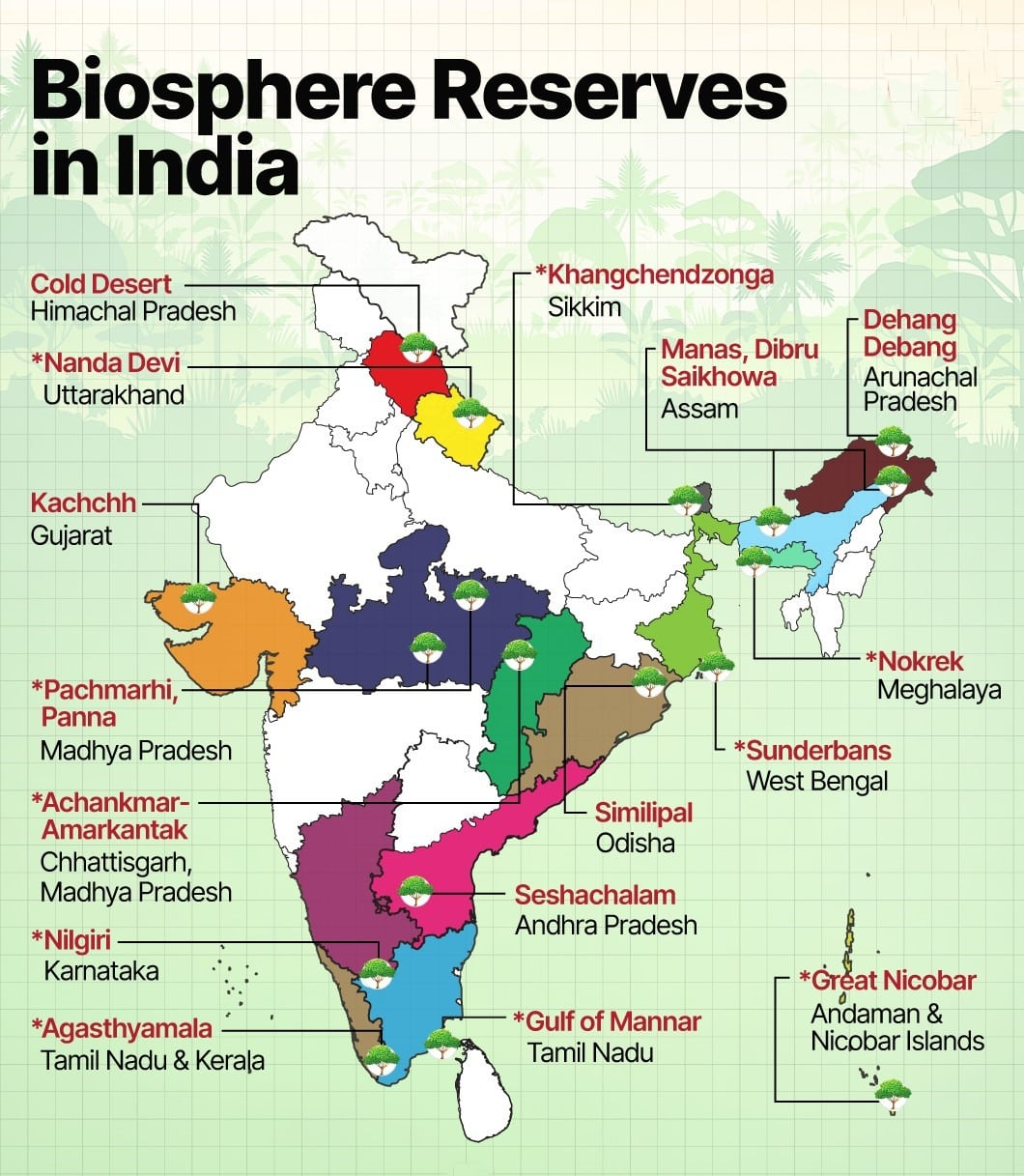
Source: StudyIQ — Agasthyamalai Biosphere Reserve (ABR) · www.studyiq.com
Trap: Options B, C, D mix protected areas from different states/regions — Mudumalai (Tamil Nadu-Karnataka border), Wayanad (Kerala), Papikonda (Andhra Pradesh)
Memory aid: Agasthyamala = 'A' for southernmost, Kerala-TN border only
Confusion: Don't mix with Nilgiri Biosphere Reserve which has Mudumalai, Bandipur, Nagarhole
Pattern: UPSC tests exact component matching — learn which sanctuaries belong to which biosphere reserve
India's Biosphere Reserves System
Environment
India's Biosphere Reserves: Concept & Major Examples
India has 18 biosphere reserves, 12 UNESCO-recognized
Three-zone model: Core (strict protection) → Buffer → Transition (human activity)
Focus on in-situ conservation with sustainable development
Biosphere Reserve Concept
Biosphere Reserves follow UNESCO's Man and Biosphere (MAB) Programme — they protect ecosystems while allowing sustainable human activities in outer zones. Unlike national parks with strict boundaries, biosphere reserves use a graduated protection system.
Three-Zone Structure
%%{init: {"flowchart": {"wrappingWidth": 460}}}%%
flowchart TD
  s1["`**Core Area**
**Legally protected** — national parks/sanctuaries with no human interference`"]
  s2["`**Buffer Zone**
**Limited activities** — research, education, eco-tourism allowed`"]
  s3["`**Transition Zone**
**Human settlements** — sustainable agriculture, forestry, tourism permitted`"]
  s1 --> s2
  s2 --> s3
Key Indian Biosphere Reserves
Biosphere Reserve | States | UNESCO Status | Key Feature |
|---|---|---|---|
Nilgiri | TN, Kerala, Karnataka | 2000 | First UNESCO-recognized |
Nanda Devi | Uttarakhand | 2004 | High-altitude ecosystem |
Sundarbans | West Bengal | 2001 | Mangrove forests |
Gulf of Mannar | Tamil Nadu | 2001 | Marine biodiversity |
Agasthyamala | Kerala, Tamil Nadu | 2016 | Southernmost Western Ghats |
Great Nicobar | Andaman & Nicobar | 2013 | Island biodiversity |
Don't confuse: Biosphere reserves can span multiple states — unlike most national parks
Key distinction: Biosphere reserves allow human habitation in transition zones
Number trap: India has 18 total, but only 12 UNESCO-recognized — questions may ask either
Western Ghats Protected Areas
Environment Western Ghats
Western Ghats: Major Protected Areas & Conservation
Western Ghats span 6 states from Gujarat to Kerala along west coast
UNESCO World Heritage Site and biodiversity hotspot with 30% endemic species
Contains 3 major biosphere reserves: Nilgiri, Agasthyamala, Great Western Ghats
Geographic Significance
The Western Ghats form a 1600 km mountain chain along India's west coast, acting as a climatic barrier that intercepts monsoon winds. This creates diverse ecosystems from tropical rainforests in the south to dry deciduous forests in the north.
State-wise Major Protected Areas
State | Major National Parks/Sanctuaries | Tiger Reserves | Key Species |
|---|---|---|---|
Gujarat | Vansda NP | - | Leopard, Pangolin |
Maharashtra | Sanjay Gandhi NP, Koyna | Sahyadri | Tiger, Leopard |
Karnataka | Kudremukh NP, Bhadra | Bandipur, Nagarhole | Tiger, Elephant, Gaur |
Tamil Nadu | Indira Gandhi NP | Kalakad Mundanthurai | Lion-tailed macaque, Nilgiri tahr |
Kerala | Silent Valley NP, Periyar | Periyar | Tiger, Elephant, Lion-tailed macaque |
Goa | Mollem NP | - | Tiger, Leopard |
Biodiversity Highlights
Endemic species: Over 30% of flora and fauna found nowhere else
Flagship species: Lion-tailed macaque, Nilgiri tahr, Malabar giant squirrel
Forest types: From tropical evergreen (south) to moist deciduous (north)
Medicinal plants: Highest concentration in Agasthyamala region
Geography trap: Western Ghats protected areas often span state borders — don't assign to single states
Name confusion: Silent Valley is in Kerala, Valley of Flowers is in Uttarakhand (not Western Ghats)
Species mixing: Lion-tailed macaque is Western Ghats endemic, Golden langur is Northeast India
Components of Major Biosphere Reserves
Environment Mudumalai Wayanad Silent Valley Kaundinya Papikonda
Major Biosphere Reserves & Their Components
Nilgiri BR contains Mudumalai, Bandipur, Nagarhole, Silent Valley
Each biosphere reserve has specific geographic clustering — don't mix regions
Seshachalam Hills BR (Andhra Pradesh) contains Kaundinya, Sri Venkateswara sanctuaries
Biosphere Reserves vs Components (from Options)
Biosphere Reserve | Component Protected Areas | States | Geographic Region |
|---|---|---|---|
Nilgiri | Mudumalai WLS, Bandipur NP, Nagarhole NP, Silent Valley NP | TN, Karnataka, Kerala | Western Ghats (Central) |
Agasthyamala | Neyyar, Peppara, Shendurney WLS; Kalakad Mundanthurai TR | Kerala, Tamil Nadu | Western Ghats (South) |
Seshachalam Hills | Kaundinya WLS, Sri Venkateswara NP | Andhra Pradesh | Eastern Ghats |
Nagarjunasagar-Srisailam | Nagarjunasagar-Srisailam TR, Kawal WLS | Telangana, Andhra Pradesh | Deccan Plateau |
Geographic Logic
Western Ghats: Nilgiri (central), Agasthyamala (southern tip)
Eastern Ghats: Seshachalam Hills in Andhra Pradesh
Deccan Interior: Nagarjunasagar-Srisailam spanning Telangana-AP
Components are always geographically clustered within same mountain range/region
Option B trap: Mixes Nilgiri BR components (Mudumalai, Wayanad, Silent Valley) — but Wayanad is separate
Option C trap: Papikonda (Andhra Pradesh) wrongly paired with Mukurthi (Tamil Nadu-Kerala border)
Regional mixing: UPSC creates wrong options by mixing Eastern and Western Ghats components
Memory trick: Each BR stays within one mountain system — Western Ghats, Eastern Ghats, or Deccan