From the ecological point of view, which one of the following assumes importance in being a good link between the Eastern Ghats and the Western Ghats?
Contents14
- ASathyamangalam Tiger Reserve
- BNallamala Forest
- CNagarhole National Park
- DSeshachalam Biosphere Reserve
Show answer
Answer: (A) Sathyamangalam Tiger Reserve
Sathyamangalam Tiger Reserve is located in the Erode district of Tamil Nadu and is the largest wildlife sanctuary in the state, with a forest area of about 1,411.6 sq km.
Ecologically, it occupies a crucial corridor position in the Nilgiri Biosphere Reserve, serving as a significant wildlife link between the Western Ghats and the rest of the Eastern Ghats.
This makes it a vital ecological bridge allowing the movement of wildlife (including tigers, elephants, and bears) between these two mountain systems.
The reserve also adjoins four other important protected areas:
- Billigiriranga Swamy Temple (BRT) Wildlife Sanctuary
- Sigur Plateau
- Mudumalai National Park
- Bandipur National Park
This forms a large contiguous habitat.
Option (b) Nallamala Forest is located in Andhra Pradesh/Telangana and is part of the Eastern Ghats but does not serve as a link to the Western Ghats.
Option (c) Nagarhole National Park is in Karnataka, entirely within the Western Ghats ecosystem, not a link between the two Ghats.
Option (d) Seshachalam Biosphere Reserve is in Andhra Pradesh in the Eastern Ghats and similarly does not act as a bridge to the Western Ghats.
Sathyamangalam was in the news for an increase in bear population and for revival of its eco-tourism plan in 2016.
The key association: Sathyamangalam = ecological corridor = Western Ghats ↔ Eastern Ghats link.
Sathyamangalam Tiger Reserve in Tamil Nadu is the only protected area that physically connects the Western Ghats and Eastern Ghats mountain systems, allowing wildlife movement between them.
Wildlife corridors became prominent in conservation discussions around 2016-17 due to increasing human-wildlife conflict and habitat fragmentation across India.
The question tests understanding of biogeographical connectivity rather than just location knowledge of individual protected areas.
Sathyamangalam Tiger Reserve
Geography Sathyamangalam Tiger Reserve ecological link Eastern Ghats Western Ghats
Sathyamangalam Tiger Reserve: The Ecological Bridge Between Ghats
Sathyamangalam Tiger Reserve in Tamil Nadu serves as crucial ecological corridor between Eastern and Western Ghats
Located in Erode district, covers 1,411.6 sq km - largest wildlife sanctuary in Tamil Nadu
Part of Nilgiri Biosphere Reserve and connects four major protected areas
Enables wildlife movement including tigers, elephants, and bears between mountain systems
Sathyamangalam Tiger Reserve occupies a unique geographical position that makes it the most important wildlife corridor in South India. Unlike other reserves that lie entirely within one mountain system, Sathyamangalam bridges the gap between the Eastern and Western Ghats, allowing genetic exchange and seasonal migration of large mammals.
Key Features & Connectivity
Aspect | Details |
|---|---|
Location | Erode district, Tamil Nadu |
Area | 1,411.6 sq km (largest sanctuary in Tamil Nadu) |
Biosphere | Nilgiri Biosphere Reserve |
Ecological Role | Wildlife corridor between Eastern & Western Ghats |
Connected Areas | BRT Wildlife Sanctuary, Sigur Plateau, Mudumalai, Bandipur |
Key Species | Tigers, elephants, sloth bears, leopards |
Corridor Position
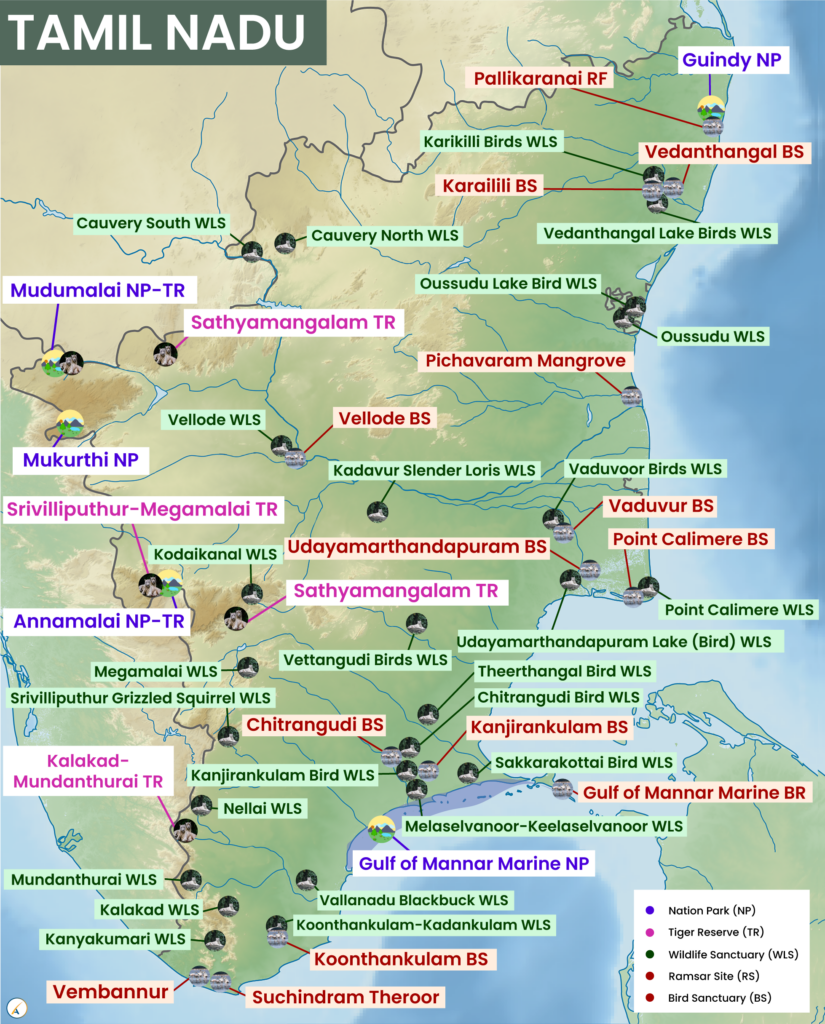
Source: LotusArise — Tamil Nadu National Parks, Tiger Reserves, Wildlife Sanctuaries ... · lotusarise.com
Why This Question Was Asked
2017 context: Sathyamangalam was in news for bear population increase and eco-tourism revival in 2016
UPSC angle: Tests understanding of wildlife corridors and habitat connectivity concepts
Geography link: Combines physical geography (Ghats) with environmental conservation
Trap: Other options are famous reserves but don't serve as inter-Ghat bridges
Location confusion: Nallamala and Seshachalam are in Eastern Ghats only, Nagarhole is in Western Ghats only
Key distinction: Only Sathyamangalam occupies the transitional zone between both mountain systems
Protected Areas in Eastern & Western Ghats
Geography Nallamala Forest Nagarhole National Park Seshachalam Biosphere Reserve
Major Protected Areas: Eastern vs Western Ghats Location
Nallamala Forest in Andhra Pradesh/Telangana - part of Eastern Ghats only
Nagarhole National Park in Karnataka - entirely within Western Ghats
Seshachalam Biosphere Reserve in Andhra Pradesh - Eastern Ghats location
Location & Ghat System
Protected Area | State | Mountain System | Key Feature |
|---|---|---|---|
Sathyamangalam Tiger Reserve | Tamil Nadu | Bridge between both | Ecological corridor |
Nallamala Forest | Andhra Pradesh/Telangana | Eastern Ghats | Tiger reserve, Nagarjunasagar-Srisailam |
Nagarhole National Park | Karnataka | Western Ghats | Part of Nilgiri Biosphere |
Seshachalam Biosphere Reserve | Andhra Pradesh | Eastern Ghats | Red sanders conservation |
Why Each Option Was Wrong
Nallamala Forest: Located entirely in Eastern Ghats - cannot link to Western Ghats
Nagarhole: Lies completely within Western Ghats ecosystem in Karnataka
Seshachalam: Eastern Ghats biosphere in Andhra Pradesh - no Western Ghats connection
Don't assume: Famous reserves automatically serve as ecological bridges
Location matters: Check which Ghat system each protected area belongs to
Biosphere ≠ Corridor: Being a biosphere reserve doesn't mean it connects mountain systems
Eastern & Western Ghats Geography
Geography Eastern Ghats Western Ghats
Eastern & Western Ghats: Physical Geography & Ecological Significance
Western Ghats: Continuous chain, UNESCO World Heritage Site, biodiversity hotspot
Eastern Ghats: Discontinuous hills, lower elevation, older geological formation
Both systems meet in Nilgiri Hills of Tamil Nadu creating unique transitional zone
Comparative Features
Feature | Western Ghats | Eastern Ghats |
|---|---|---|
Structure | Continuous chain | Discontinuous hills |
Elevation | Higher (up to 2,695m) | Lower (up to 1,680m) |
States Covered | Kerala, Karnataka, Tamil Nadu, Maharashtra, Goa, Gujarat | Andhra Pradesh, Telangana, Odisha, Tamil Nadu |
Monsoon Impact | Western monsoon - high rainfall | Eastern monsoon - moderate rainfall |
Biodiversity | UNESCO hotspot, high endemism | Rich but lower endemism |
Geological Age | Relatively younger | Older formation |
Ghat Systems Overview
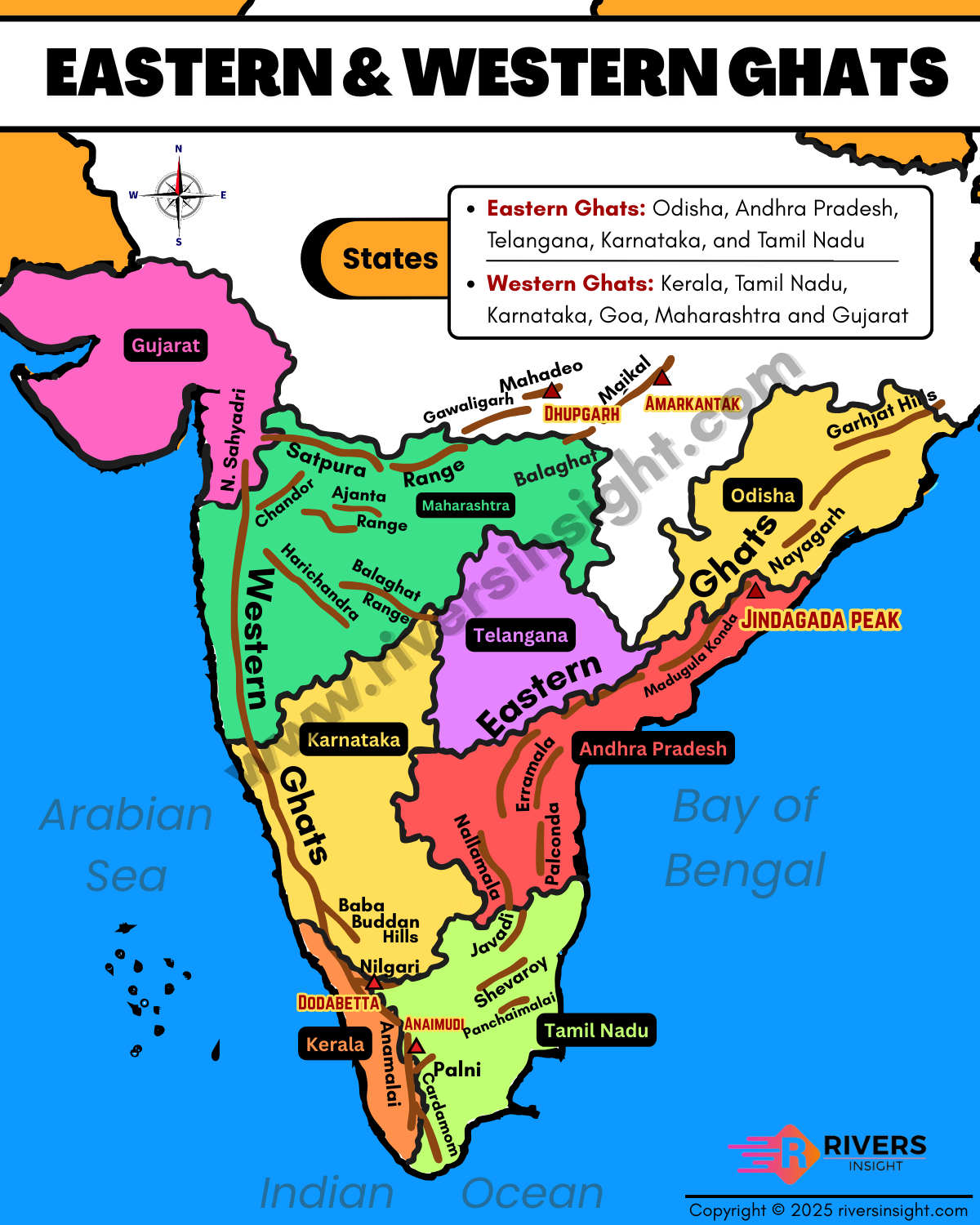
Source: Rivers Insight — Western Ghats & Eastern Ghats: Physical Features & Map - Rivers ... · riversinsight.com
Ecological Importance
Western Ghats: Major watershed for peninsular rivers, monsoon barrier
Eastern Ghats: Important for tribal communities, mining regions, red sanders habitat
Gap between systems: Creates need for wildlife corridors like Sathyamangalam
Wildlife Corridors & Habitat Connectivity
Environment ecological link
Wildlife Corridors: Connecting Fragmented Habitats
Wildlife corridors connect fragmented habitats enabling genetic exchange and migration
Prevent inbreeding and maintain viable populations of large mammals
Sathyamangalam model: Connects multiple protected areas forming contiguous habitat
Wildlife corridors are strips of habitat that connect otherwise isolated protected areas. They allow animals to move between habitats for breeding, feeding, and seasonal migration. Without corridors, small isolated populations face genetic bottlenecks and eventual local extinction.
How Corridors Work
%%{init: {"flowchart": {"wrappingWidth": 460}}}%%
flowchart TD
  s1["`**Habitat Fragmentation**
Human activities create **isolated patches** of forest`"]
  s2["`**Population Isolation**
Animal populations become **genetically isolated**`"]
  s3["`**Corridor Creation**
**Wildlife corridors** connect fragmented habitats`"]
  s4["`**Wildlife Movement**
Animals move freely for **breeding and feeding**`"]
  s5["`**Genetic Health**
**Gene flow** maintains healthy populations`"]
  s1 --> s2
  s2 --> s3
  s3 --> s4
  s4 --> s5
Benefits for Large Mammals
Tigers: Need large territories (60-100 sq km) - corridors provide access
Elephants: Seasonal migration routes for water and fodder
Bears: Move between different fruiting seasons in various forests
Corridor ≠ Protected Area: A corridor connects habitats, doesn't just contain them
Size matters: Small corridors may not work for large ranging species like tigers
UPSC tests: Understanding of ecological functions, not just location knowledge