With reference to 'Indian Ocean Dipole (IOD)' sometimes mentioned in the news while forecasting Indian monsoon, which of the following statements is/are correct? 1. IOD phenomenon is characterised by a difference in sea surface temperature between tropical Western Indian Ocean and tropical Eastern Pacific Ocean. 2. An IOD phenomenon can influence an El Nino's impact on the monsoon. Select the correct answer using the code given below:
Contents13
- A1 only
- B2 only
- CBoth 1 and 2
- DNeither 1 nor 2
Show answer
Answer: (B) 2 only
Statement 1 is incorrect:
The Indian Ocean Dipole (IOD) is characterised by a difference in sea surface temperature (SST) between the tropical WESTERN Indian Ocean and the tropical EASTERN Indian Ocean — not the Eastern Pacific Ocean.
The question deliberately replaces 'Eastern Indian Ocean' with 'Eastern Pacific Ocean' to confuse students.
The El Nino phenomenon involves the Pacific Ocean, while IOD is entirely an Indian Ocean phenomenon.
A positive IOD means the western Indian Ocean is warmer than the eastern Indian Ocean, and a negative IOD means the opposite.
Statement 2 is correct:
An IOD phenomenon can significantly influence the impact of El Nino on the Indian monsoon.
For example, a positive IOD can counteract (weaken) the negative effects of El Nino on the Indian monsoon, potentially bringing good rainfall even during an El Nino year.
Conversely, a negative IOD can worsen a drought during an El Nino year.
This interplay between IOD and El Nino is a key concept in understanding Indian monsoon variability.
So only statement 2 is correct.
IOD is entirely within the Indian Ocean (western vs eastern parts), while El Nino involves the Pacific Ocean - UPSC tests this geographic distinction by mixing up the oceans in Statement 1.
IOD and El Nino interactions became a key forecasting factor around 2015-2017 when positive IOD helped offset El Nino's drought effects on Indian monsoons.
The question tests understanding of how multiple climate phenomena interact, not just isolated knowledge of individual systems.
Indian Ocean Dipole (IOD)
Geography Indian Ocean Dipole IOD sea surface temperature tropical Western Indian Ocean
Indian Ocean Dipole: Mechanism & Monsoon Impact
IOD is a climate pattern in the Indian Ocean only — western vs eastern parts
Positive IOD = western Indian Ocean warmer than eastern part
IOD can strengthen or weaken El Nino's monsoon impact
IOD helps predict Indian monsoon variability
What is IOD
The Indian Ocean Dipole (IOD) is a climate oscillation that measures the difference in sea surface temperatures between the western and eastern tropical Indian Ocean. Unlike El Nino which operates in the Pacific, IOD is purely an Indian Ocean phenomenon.
IOD Phases & Characteristics
IOD Phase | Western Indian Ocean | Eastern Indian Ocean | Impact on Indian Monsoon |
|---|---|---|---|
Positive IOD | Warmer than normal | Cooler than normal | Enhances monsoon rainfall |
Negative IOD | Cooler than normal | Warmer than normal | Weakens monsoon rainfall |
Neutral IOD | Normal temperatures | Normal temperatures | Minimal direct impact |
IOD Spatial Pattern
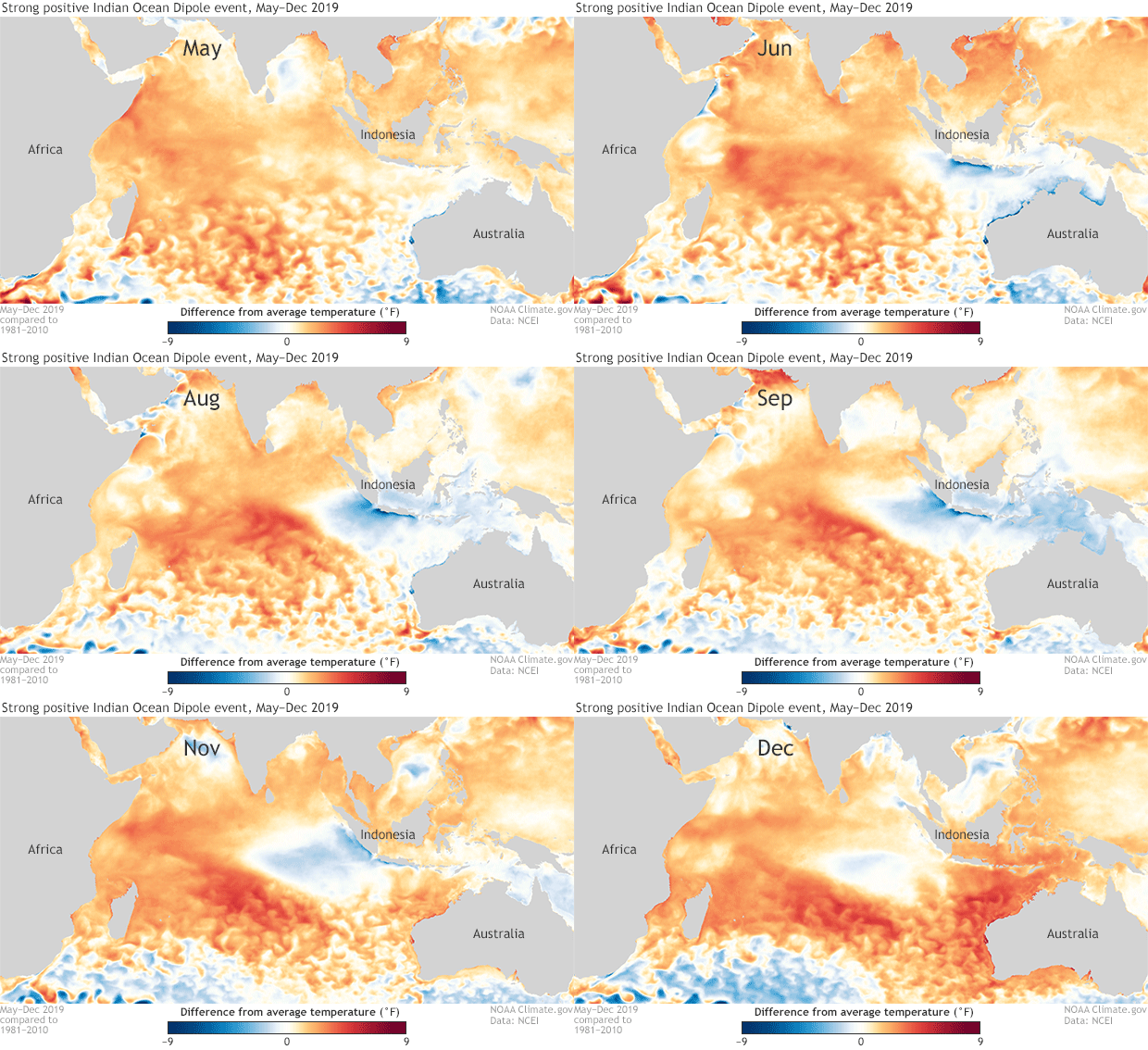
Source: Climate — Meet ENSO's neighbor, the Indian Ocean Dipole | NOAA Climate.gov · www.climate.gov
IOD-El Nino Interaction
Positive IOD can counteract El Nino's drought effect on Indian monsoon
Negative IOD can worsen El Nino's negative monsoon impact
IOD and El Nino can occur simultaneously or independently
2019 example: Positive IOD helped India escape severe drought despite moderate El Nino
Question Context
This question tests the precise definition of IOD and its relationship with monsoon prediction. Statement 1 was the trap — swapping 'Eastern Indian Ocean' with 'Eastern Pacific Ocean' to confuse IOD with El Nino.
Trap: IOD involves Indian Ocean only — not Pacific Ocean like El Nino
Trap: Statement 1 replaces 'Eastern Indian Ocean' with 'Eastern Pacific Ocean'
Confusion: Don't mix IOD mechanism (Indian Ocean) with El Nino mechanism (Pacific Ocean)
Remember: Western Indian Ocean = Africa side, Eastern Indian Ocean = Australia side
El Nino & Monsoon Interactions
Geography El Nino monsoon
El Nino-Monsoon Dynamics & Modifying Factors
El Nino typically weakens Indian monsoon rainfall
IOD can modify El Nino's monsoon impact significantly
El Nino operates in Pacific Ocean — different from IOD
El Nino-Monsoon Link
El Nino involves warming of eastern Pacific Ocean waters, which typically weakens the Indian monsoon by altering global wind patterns and reducing moisture transport to India.
Combined IOD-El Nino Scenarios
El Nino Status | IOD Status | Net Monsoon Impact | Example Years |
|---|---|---|---|
Strong El Nino | Positive IOD | Moderate impact (IOD counters El Nino) | 2015, 2019 |
El Nino | Negative IOD | Severe drought (both reduce rainfall) | 2009 |
La Nina | Positive IOD | Excellent monsoon (both enhance rainfall) | 2007 |
Neutral | Strong Positive IOD | Good monsoon (IOD dominates) | 2006 |
Forecasting Implications
Both IOD and El Nino must be considered for accurate monsoon prediction
Single-factor predictions often fail — interactions matter more
Timing of IOD and El Nino development affects their combined impact
Indian Ocean warming (positive IOD) can override Pacific cooling effects
Don't assume: El Nino = automatic drought (IOD can counteract it)
Ocean confusion: El Nino = Pacific, IOD = Indian Ocean
Mechanism trap: Both affect monsoon but through different oceanic systems
Monsoon Forecasting Factors
Geography forecasting monsoon
Key Factors in Indian Monsoon Forecasting
Multiple oceanic and atmospheric factors influence monsoon prediction
IOD and El Nino are primary but not the only predictors
IMD uses statistical and dynamical models for forecasting
Major Monsoon Predictors
# Monsoon Forecasting
## Pacific Factors
- El Nino/La Nina
- Pacific Decadal Oscillation
- Equatorial Pacific SST
## Indian Ocean Factors
- Indian Ocean Dipole
- Indian Ocean SST
- Equatorial Indian Ocean Oscillation
## Atlantic Factors
- Atlantic Multidecadal Oscillation
- North Atlantic SST
## Land Factors
- Snow cover (Eurasia)
- Soil moisture
- Land-sea temperature contrast
Forecasting Challenges
Interaction effects between different factors are complex and non-linear
Timing mismatches — factors may develop at different rates
Regional variations — same factors affect different parts of India differently
Climate change is altering traditional factor-monsoon relationships
UPSC loves: Questions mixing different oceanic oscillations (IOD, El Nino, etc.)
Don't oversimplify: Monsoon prediction needs multiple factors, not just one
Institution: IMD (not private agencies) issues official monsoon forecasts