Consider the following statements: 1. In India, State Governments do not have the power to auction non-coal mines. 2. Andhra Pradesh and Jharkhand do no have gold mines. 3. Rajasthan has iron ore mines. Which of the statements given above is/are correct?
Contents18
- A1 and 2
- B2 only
- C1 and 3
- D3 only
Show answer
Answer: (D) 3 only
Correct Answer: (d) 3 only
Statement 1 is WRONG:
State Governments DO have the power to auction non-coal mines.
Unlike coal (which is auctioned by the Central Government), non-coal mineral mining licences are auctioned by the respective State Governments.
Statement 2 is WRONG:
Both Andhra Pradesh and Jharkhand DO have gold deposits.
India has gold deposits across several states including Andhra Pradesh, Jharkhand, Karnataka, Kerala, Madhya Pradesh, and Rajasthan.
Karnataka (especially the Kolar Gold Fields) is the most famous for gold.
Statement 3 is CORRECT:
Iron ore is found in Rajasthan, specifically in the Bhilwara district.
India has iron ore deposits in many states including Odisha, Jharkhand, Chhattisgarh, Karnataka, Goa, and Rajasthan.
REMEMBER:
Non-coal mines = auctioned by STATE governments (not Centre).
Gold deposits exist in many states including AP and Jharkhand.
Iron ore exists in Rajasthan (Bhilwara).
The Mines and Minerals (Development and Regulation) Amendment Act of 2015 gave state governments the power to auction non-coal mines, while coal mining remained with the central government.
UPSC is testing the federal division of mining powers - states control non-coal minerals while the Centre controls coal, a key distinction in India's mineral administration.
Mining Rights & Auction Powers
Indian Polity State Governments auction non-coal mines
Mining Rights & Auction Powers: Centre vs State Division
State governments auction non-coal mining licenses
Central government auctions coal mining licenses
Mining is a state subject under List II of 7th Schedule
Constitutional Framework
Mining falls under the State List (Entry 23) in the Seventh Schedule, giving states primary authority over mineral resources within their territory. However, coal has special central oversight due to its strategic importance.
Auction Authority Division
Mineral Type | Auction Authority | Legislation | Key Feature |
|---|---|---|---|
Coal | Central Government | Coal Mines Act, 2015 | Strategic mineral, central control |
Non-coal minerals | State Governments | MMDR Act, 2015 | Iron ore, gold, limestone, etc. |
Atomic minerals | Central Government | Atomic Energy Act | Uranium, thorium - central monopoly |
MMDR Act 2015 Changes
Introduced auction system replacing discretionary allocation
States conduct e-auctions for non-coal mining leases
District Mineral Foundation receives auction premiums
Eliminated distinction between captive and merchant mining
Trap: Statement 1 says states cannot auction non-coal mines - this is WRONG
Common confusion: Coal vs non-coal auction authority is frequently reversed in options
Remember: Non-coal = State, Coal = Centre, Atomic = Centre
Gold Deposits in India
Geography Andhra Pradesh Jharkhand gold mines
Gold Deposits Distribution Across Indian States
Karnataka has the largest gold deposits (Kolar, Hutti)
Both AP and Jharkhand have gold deposits
Gold found in 6+ states across India
India's Gold Mining
India has limited but significant gold deposits across multiple states. Karnataka leads production, while several other states have smaller but commercially viable deposits.
Major Gold-Producing States
State | Major Mines/Areas | Status | Key Feature |
|---|---|---|---|
Karnataka | Kolar Gold Fields, Hutti | Active/Closed | Deepest mines in Asia |
Andhra Pradesh | Anantapur district | Active | Gold & copper deposits |
Jharkhand | Sonbhadra region | Active | Associated with copper |
Rajasthan | Banswara, Udaipur | Active | Recent discoveries |
Kerala | Wayanad district | Exploration | Alluvial gold |
Madhya Pradesh | Sidhi district | Exploration | Diamond belt region |
Gold Distribution Map

Source: Chegg India — Gold Mines in India: Top 10 Major Mines & Locations · www.cheggindia.com
Trap: Statement 2 claims AP and Jharkhand have no gold - this is WRONG
UPSC loves: Testing which states have/don't have specific minerals
Don't confuse: Kolar closed for commercial reasons, not lack of reserves
Iron Ore Deposits in India
Geography Rajasthan iron ore mines
Iron Ore Distribution: Major Belts & Mining Centers
Rajasthan has iron ore in Bhilwara district
Odisha is the largest iron ore producer
India has 4 major iron ore belts
India's Iron Ore Wealth
India holds the 4th largest iron ore reserves globally. The deposits are concentrated in eastern and central states, with high-grade hematite being the predominant type.
Major Iron Ore Producing States
State | Major Districts | Type | Production Share |
|---|---|---|---|
Odisha | Keonjhar, Mayurbhanj | Hematite | ~50% |
Jharkhand | Singhbhum, Dhanbad | Hematite/Magnetite | ~25% |
Chhattisgarh | Durg, Bastar | Hematite | ~10% |
Karnataka | Bellary, Chitradurga | Hematite | ~8% |
Goa | North & South Goa | Hematite | ~3% |
Rajasthan | Bhilwara | Magnetite | ~2% |
Iron Ore Belt Classification
# India's Iron Ore Belts
## **Odisha-Jharkhand Belt**
- Largest reserves
- Mayurbhanj-Keonjhar
- Singhbhum district
## **Durg-Bastar Belt**
- Chhattisgarh
- Bailadila ranges
- High grade ore
## **Bellary-Chitradurga Belt**
- Karnataka
- Kudremukh
- Baba Budan hills
## **Others**
- Goa (coastal)
- Rajasthan (Aravalli)
- Maharashtra (Ratnagiri)
Rajasthan's Iron Ore
Bhilwara district is the main iron ore area in Rajasthan
Deposits are of magnetite type (different from eastern India's hematite)
Located in the Aravalli mountain range
Lower grade compared to Odisha-Jharkhand belt
Statement 3 is CORRECT: Rajasthan does have iron ore mines
Don't assume: Just because Rajasthan isn't a top producer doesn't mean it has no deposits
UPSC pattern: Tests knowledge of mineral presence in non-obvious states
India's Mineral Distribution Patterns
Geography
Geological Basis of India's Mineral Distribution
Peninsular India has most metallic minerals
Sedimentary rocks contain coal and petroleum
Archean rocks are richest in metallic ores
Geological Control
India's mineral distribution follows clear geological patterns. The ancient Peninsular Plateau, with its Archean and Dharwar formations, contains most metallic minerals, while younger sedimentary regions hold fossil fuels.
Geological Formation vs Minerals
Rock Type | Age | Major Minerals | Key Regions |
|---|---|---|---|
Archean | Most ancient | Iron ore, gold, copper | Karnataka, Odisha, Jharkhand |
Dharwar | Pre-Cambrian | Iron, gold, manganese | Karnataka, Andhra Pradesh |
Gondwana | Carboniferous | Coal | Jharia, Raniganj, Korba |
Tertiary | Recent | Petroleum, natural gas | Assam, Gujarat, Mumbai High |
Alluvial | Quaternary | Placer deposits | River valleys, coastal areas |
Regional Mineral Concentration
# India's Mineral Regions
## **North-Eastern Plateau**
- Jharkhand-Odisha belt
- Iron, coal, mica
- Chota Nagpur plateau
## **South-Western Plateau**
- Karnataka-Goa belt
- Iron, manganese, gold
- Western Ghats region
## **Central Belt**
- MP-Chhattisgarh
- Diamond, coal, bauxite
- Narmada valley
## **Western Regions**
- Rajasthan-Gujarat
- Petroleum, copper, zinc
- Aravalli ranges
Mineral Belt Map
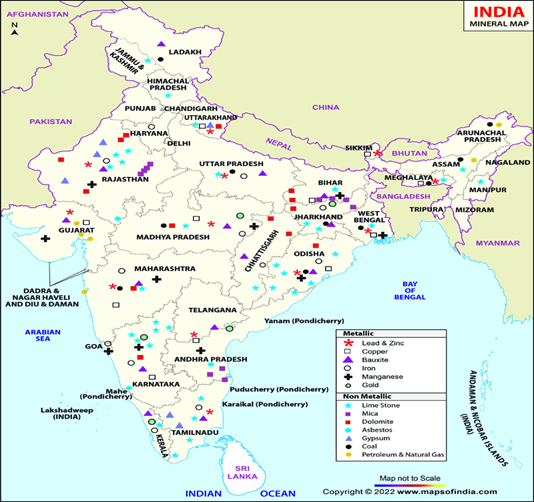
Source: Apti Plus — Mineral Resources in India: Types, Distribution & Uses · aptiplus.in