Consider the following States: 1. Andhra Pradesh 2. Kerala 3. Himachal Pradesh 4. Tripura How many of the above are generally known as tea-producing States?
Contents13
- AOnly one State
- BOnly two States
- COnly three States
- DAll four States
Show answer
Answer: (D) All four States
This is another UPSC question where the wording “generally known as tea-producing States” is intentionally broad.
All four States are considered tea-producing States.
Andhra Pradesh — tea cultivation is carried out in regions such as the Araku Valley and some hilly tribal areas.
Kerala — a major tea-producing State, especially:
- Munnar
- Wayanad
Himachal Pradesh — known for Kangra tea, produced mainly in the Kangra Valley.
Tripura — an important tea-growing State in Northeast India.
The trap in the question is that many aspirants associate tea production only with the major traditional States like:
- Assam,
- West Bengal,
- Tamil Nadu,
- Kerala.
But UPSC used the phrase “generally known as tea-producing States” rather than “major tea-producing States.”
Therefore, even smaller or emerging tea-producing regions like Andhra Pradesh are included.
Hence, the correct answer is All four States.
Tea requires specific agro-climatic conditions - high altitude, cool temperatures, well-distributed rainfall, and acidic soil - which limits production to certain geographical regions.
Tea cultivation is concentrated in northeastern states like Assam and West Bengal, southern hill stations in Kerala and Tamil Nadu, and select northern hill areas like Kangra valley in Himachal Pradesh.
The question tests knowledge of India's agricultural geography by mixing obvious tea states with non-tea producing plains like Andhra Pradesh.
Tea Cultivation in India
Geography tea-producing States Andhra Pradesh Kerala Himachal Pradesh Tripura
Tea Cultivation in India: States, Regions & Agro-Climatic Requirements
Major tea states: Assam, West Bengal, Tamil Nadu, Kerala, Karnataka, Tripura
Kerala, Himachal Pradesh, Tripura are tea-producing; Andhra Pradesh is not
Tea requires cool, humid, well-drained hilly terrain with 150-250cm rainfall
Kangra tea (Himachal Pradesh) has distinct flavor due to high altitude
Agro-Climatic Requirements
Tea is a plantation crop that thrives in specific conditions: cool temperatures (20-30°C), high humidity, well-distributed rainfall (150-250cm annually), and well-drained acidic soils on hill slopes. This explains why tea grows in the Western Ghats, Eastern Ghats, and Himalayan foothills — not in plains states like Andhra Pradesh.
Tea-Producing States Analysis
State | Tea Production | Key Regions | Notable Features |
|---|---|---|---|
Kerala | ✓ Major Producer | Munnar, Wayanad, Idukki | High-quality tea from Western Ghats |
Himachal Pradesh | ✓ Producer | Kangra Valley, Palampur | Kangra tea - distinct high-altitude flavor |
Tripura | ✓ Traditional Producer | Throughout state | About 54 tea estates, Northeast tradition |
Andhra Pradesh | ✗ Not a tea state | Plains region | Lacks suitable hill terrain and climate |
Tea Regions Map
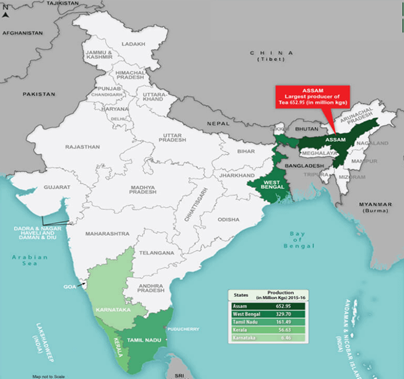
Source: IASbaba — Indian Tea Industry | IASbaba · iasbaba.com
Question Analysis
This question tests knowledge of India's agricultural geography and crop distribution patterns. The trap is assuming all four states produce tea without considering agro-climatic requirements. Andhra Pradesh is primarily a plains state focused on rice, cotton, and groundnuts — it lacks the hilly terrain and climate suitable for tea cultivation.
Trap: Confusing Andhra Pradesh (plains, no tea) with Tamil Nadu (Nilgiri tea)
Trap: Assuming all hill states produce tea — many lack suitable climate
Trap: Forgetting Tripura as a traditional tea state due to its small size
Memory aid: Tea = Hills + High humidity — Andhra Pradesh has neither
Major Tea Producing States
Geography tea-producing States
Major Tea Producing States of India: Production & Regional Specialties
Top 6 states: Assam (50%+ production), West Bengal, Tamil Nadu, Kerala, Karnataka, Tripura
Assam leads with bulk tea; Darjeeling produces premium varieties
South India: Kerala (Munnar), Tamil Nadu (Nilgiris), Karnataka (Coorg)
Smaller producers: Himachal Pradesh (Kangra), Uttarakhand, Arunachal Pradesh
State-wise Tea Production
State | Production Share | Famous Varieties/Regions | Key Characteristics |
|---|---|---|---|
Assam | ~50% of India's tea | Assam tea, CTC blends | Largest producer, strong malty flavor |
West Bengal | ~25% of India's tea | Darjeeling, Terai, Dooars | Premium Darjeeling muscatel flavor |
Tamil Nadu | ~7-8% | Nilgiri tea | High-altitude, citrusy flavor |
Kerala | ~5-6% | Munnar, Wayanad | Cardamom Hills region |
Karnataka | ~3-4% | Coorg (Kodagu) | Coffee-tea mixed cultivation |
Tripura | ~1-2% | Traditional estates | 54 tea gardens, small-scale |
Regional Tea Clusters
# Tea Production Regions
## Northeast
- Assam (Brahmaputra Valley)
- West Bengal (Darjeeling)
- Tripura
- Arunachal Pradesh
## South India
- Tamil Nadu (Nilgiris)
- Kerala (Western Ghats)
- Karnataka (Coorg)
## North India
- Himachal Pradesh (Kangra)
- Uttarakhand (Kumaon)
Production Patterns
Assam dominates with over 50% of India's tea production, followed by West Bengal (mainly Darjeeling district). South Indian states — Tamil Nadu, Kerala, Karnataka — together contribute about 15-20%. The northeast cluster (Assam, West Bengal, Tripura) produces bulk tea, while hill stations across India produce specialty varieties.
Trap: Thinking Darjeeling = separate state — it's in West Bengal
Trap: Forgetting Karnataka as a tea producer (focus often on coffee)
Trap: Confusing Ooty (Tamil Nadu) with Munnar (Kerala)
Memory: A-W-T-K-K-T = Assam West Bengal Tamil Nadu Kerala Karnataka Tripura
Plantation Agriculture in India
Geography
Plantation Agriculture in India: Crops, Characteristics & Regional Distribution
Major plantation crops: Tea, Coffee, Rubber, Spices (cardamom, pepper), Coconut
Requires large capital investment, skilled labor, and specific agro-climatic conditions
Concentrated in Western Ghats, Eastern Ghats, and Northeast hills
Export-oriented with processing facilities on plantation sites
Plantation Agriculture Features
Plantation agriculture involves large-scale cultivation of cash crops on estates with centralized processing. Unlike subsistence farming, it requires heavy capital investment, scientific methods, and permanent labor. Crops are typically export-oriented and grown in specific agro-climatic zones.
Major Plantation Crops Distribution
Crop | Leading States | Agro-Climatic Needs | Processing |
|---|---|---|---|
Tea | Assam, West Bengal, Tamil Nadu | Cool hills, 150-250cm rainfall | CTC factories on estates |
Coffee | Karnataka, Kerala, Tamil Nadu | Hill slopes, 150-200cm rainfall | Pulping and curing units |
Rubber | Kerala, Tamil Nadu, Karnataka | Hot humid, 200cm+ rainfall | Latex processing centers |
Spices | Kerala, Karnataka, Tamil Nadu | Western Ghats climate | Drying and packaging units |
Coconut | Kerala, Tamil Nadu, Karnataka | Coastal areas, sandy soil | Copra and oil mills |
Plantation Crop Regions
# Plantation Agriculture
## Western Ghats
- Tea (Munnar, Nilgiris)
- Coffee (Coorg, Wayanad)
- Spices (Malabar Coast)
- Rubber (Kerala lowlands)
## Eastern Hills
- Tea (Darjeeling)
- Tea (Assam)
- Spices (Eastern Ghats)
## Coastal Plains
- Coconut (Kerala coast)
- Coconut (Tamil Nadu)
- Rubber (coastal Kerala)Trap: Confusing plantation (large estates) with horticulture (small farms)
Trap: Assuming all hill crops are plantation crops — many are subsistence
Trap: Missing the processing component — plantations have on-site facilities
Key difference: Plantation = Large scale + Capital intensive + Processing facilities