Consider the following statements: 1. The Barren Island volcano is an active volcano located in the Indian territory. 2. Barren Island lies about 140 km east of Great Nicobar. 3. The last time the Barren Island volcano erupted was in 1991 and it has remained inactive since then. Which of the statements given above is/are correct?
Contents15
- A1 only
- B2 and 3
- C3 only
- D1 and 3
Show answer
Answer: (A) 1 only
Correct Answer: (a) 1 only
Statement 1 is CORRECT: Barren Island volcano is India's only confirmed active volcano.
It is located in the Andaman Sea, in the Indian territory of the Andaman and Nicobar Islands.
Statement 2 is WRONG: Barren Island lies about 140 km east of PORT BLAIR (which is in South Andaman), NOT east of Great Nicobar.
Great Nicobar is the southernmost island of the Andaman and Nicobar chain, located much further south.
The question tries to confuse you by swapping Port Blair with Great Nicobar.
Statement 3 is WRONG (if present): Barren Island volcano was dormant for over 150 years before it erupted again in 1991.
It has shown activity multiple times since then (1991, 1994-95, 2005-06, and later).
It did not stay dormant after its first recorded eruption.
REMEMBER: Barren Island = India's ONLY active volcano = in Andaman Sea = 140 km east of PORT BLAIR (not Great Nicobar).
It woke up again in 1991 after being dormant for 150+ years.
Great Nicobar is the southernmost island — don't confuse it with Port Blair's location.
Barren Island is India's only active volcano, making it a unique geographical feature that UPSC frequently tests to check knowledge of India's physical geography.
The question contains a classic UPSC trap - confusing Port Blair with Great Nicobar, testing whether students know the specific locations within Andaman and Nicobar Islands.
UPSC is testing precise geographical knowledge rather than general awareness - knowing that Barren Island is 140 km east of Port Blair, not Great Nicobar which is much further south.
Barren Island Volcano
Geography Barren Island volcano active volcano Indian territory
Barren Island Volcano: India's Only Active Volcano
India's only confirmed active volcano located in Andaman Sea
Located 140 km east of Port Blair, NOT Great Nicobar
Erupted in 1991 after being dormant for 150+ years
Has shown multiple eruptions since 1991 (1994-95, 2005-06, later)
What Makes It Special
Barren Island is India's only confirmed active volcano, making it geologically unique in the country. It sits in the Andaman Sea as part of the volcanic arc created by the subduction of the Indo-Australian plate beneath the Burma plate.
Key Facts & Timeline
Aspect | Details |
|---|---|
Location | Andaman Sea, Andaman & Nicobar Islands |
Distance | 140 km east of Port Blair |
Dormant Period | 150+ years before 1991 |
Recent Activity | 1991, 1994-95, 2005-06 and later |
Volcano Type | Stratovolcano (cone-shaped) |
Significance | India's only active volcano |
Location Map

Source: INSIGHTS IAS — Barren Island Volcano: India's Only Active Volcano · www.insightsonindia.com
Question Context
This question tests precise geographical knowledge and recent volcanic activity. Statement 1 is the only correct one, confirming Barren Island's status as India's active volcano in Indian territory.
Trap: Confusing Port Blair (140 km west) with Great Nicobar (southernmost island)
Trap: Assuming volcano stayed dormant after 1991 — it has erupted multiple times since
Trap: Forgetting that Barren Island is India's only active volcano, not one of many
Andaman & Nicobar Islands Geography
Geography Great Nicobar Port Blair
Andaman & Nicobar Islands: Key Geographic Features
Port Blair is the capital and main administrative center
Great Nicobar is the southernmost island of the chain
Union Territory in Bay of Bengal with strategic importance
Two main island groups: Andaman (north) and Nicobar (south)
Strategic Island Chain
The Andaman and Nicobar Islands form India's easternmost Union Territory in the Bay of Bengal. This 572-island archipelago serves as a crucial strategic outpost, with distinct northern and southern island groups.
Key Islands & Locations
Feature | Location | Significance |
|---|---|---|
Port Blair | South Andaman Island | Capital & administrative center |
Great Nicobar | Southernmost island | Largest island, closest to Sumatra |
Car Nicobar | Northernmost Nicobar | Air Force base location |
North Andaman | Northernmost major island | Diglipur town, limestone caves |
Little Andaman | Southern Andaman group | Onge tribal reserve |
Island Classification
# Andaman & Nicobar Islands
## Andaman Group (North)
- North Andaman
- Middle Andaman
- South Andaman (Port Blair)
- Little Andaman
## Nicobar Group (South)
- Car Nicobar
- Camorta
- Great Nicobar
- Little Nicobar
## Administration
- Union Territory
- Capital: Port Blair
- Lt. Governor
- 3 Districts
Island Chain Overview
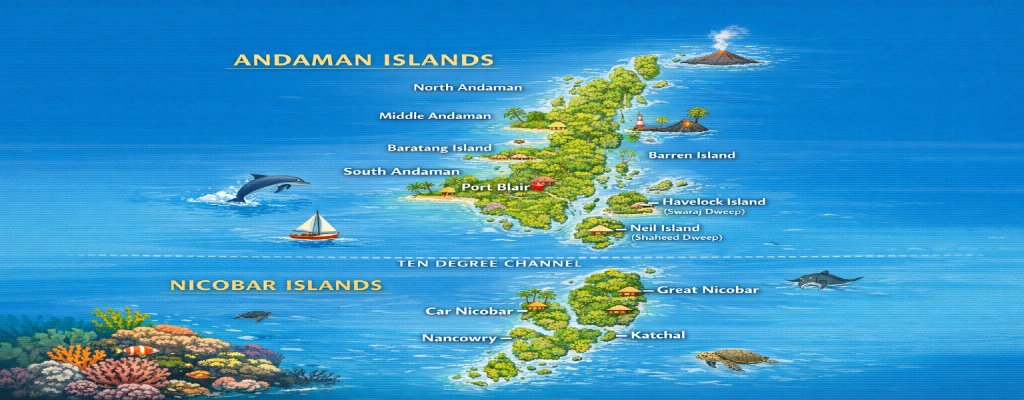
Source: Go Andaman Holidays — Andaman Nicobar Map: Islands, Districts & Tourist Zones · www.goandamanholidays.com
Trap: Mixing up Port Blair (capital in South Andaman) with Great Nicobar (southernmost island)
Trap: Assuming Great Nicobar is the capital — it's Port Blair that serves as the administrative center
Trap: Confusing Andaman (northern group) with Nicobar (southern group) locations
Volcanoes in India
Geography active volcano
Volcanic Activity in India: Active vs Dormant
Barren Island is India's only confirmed active volcano
Narcondam Island has a dormant volcano in Andaman Sea
Deccan Traps formed by ancient volcanic activity 66 million years ago
Most Indian landmass is on stable continental crust with low volcanic risk
Why India Has Few Volcanoes
India sits mostly on the stable Indo-Australian plate, away from active plate boundaries where most volcanoes form. The only volcanic activity occurs in the Andaman Sea region due to the subduction zone where the Indo-Australian plate slides beneath the Burma plate.
Volcanic Features in India
Volcano/Feature | Type | Location | Last Activity | Status |
|---|---|---|---|---|
Barren Island | Stratovolcano | Andaman Sea | 2005-06 & later | Active |
Narcondam | Dormant volcano | Andaman Sea | Unknown (prehistoric) | Dormant |
Deccan Traps | Flood basalts | Western & Central India | 66 million years ago | Extinct |
Dhosi Hill | Extinct volcano | Haryana-Rajasthan border | Very ancient | Extinct |
Barren Island Activity Timeline
%%{init: {"flowchart": {"wrappingWidth": 460}}}%%
flowchart TD
  s1["`**Pre-1787**
**Unknown activity** — no recorded eruptions`"]
  s2["`**1787-1832**
**Active period** with recorded eruptions`"]
  s3["`**1832-1991**
**Dormant for 150+ years** — no activity`"]
  s4["`**1991**
**Reactivation** — volcano awakens after long dormancy`"]
  s5["`**1994-95, 2005-06**
**Continued activity** — multiple eruption cycles`"]
  s6["`**Present**
**Monitored closely** — remains potentially active`"]
  s1 --> s2
  s2 --> s3
  s3 --> s4
  s4 --> s5
  s5 --> s6
Tectonic Context
The Andaman volcanic arc formed due to the subduction of the Indo-Australian plate beneath the Burma plate. This creates the conditions for Barren Island's activity and explains why it's India's only active volcano.
Deccan Traps represent a different type of volcanism — massive flood basalt eruptions that occurred when India passed over the Réunion hotspot during its northward drift 66 million years ago.
Trap: Thinking India has multiple active volcanoes — only Barren Island is confirmed active
Trap: Confusing Narcondam (dormant) with Barren Island (active) — both in Andaman Sea
Trap: Assuming Deccan Traps are active volcanoes — they're 66-million-year-old extinct formations