At one of the place in India, if you stand on the seashore and watch the sea, 'you will find that the sea water recedes from the shore line a few kilometres and comes back to the shore, twice a day, and you can actually walk on the sea floor when the water recedes. This unique phenomenon is seen at
Contents15
- ABhavnagar
- BBheemunipatnam
- CChandipur
- DNagapattinam
Show answer
Answer: (C) Chandipur
This unique tidal phenomenon is associated with Chandipur beach (also called Chandipur-on-Sea), located in the Balasore district of Odisha.
Chandipur is famous worldwide for its 'hide-and-seek' beach — during low tide, the sea water recedes (withdraws) from the shoreline by 1 to 5 kilometres, exposing the sea floor and allowing people to literally walk on it.
During high tide, the water returns. This phenomenon occurs twice daily due to the tidal cycle. The extremely flat and gentle slope of the continental shelf at Chandipur, combined with the tidal range, causes this dramatic recession of water.
Chandipur is also known as the location of the Indian Army's Integrated Test Range (ITR) where missiles like BrahMos, Agni, and Akash are test-fired — which is why it appears in news frequently.
Option (a)
- Bhavnagar (Gujarat) — has the highest tidal range in India (up to 10-12 metres) but the sea does not recede kilometres inland in the same dramatic way.
Option (b)
- Bheemunipatnam (Andhra Pradesh) — is an ancient port town but is not known for this specific phenomenon.
Option (d)
- Nagapattinam (Tamil Nadu) — is a coastal town known for fishing and was severely affected by the 2004 tsunami, but does not exhibit this tidal retreat.
Chandipur beach in Odisha is the only place in India where sea water recedes 1-5 kilometers during low tide, exposing the sea floor for walking twice daily.
Chandipur houses India's Integrated Test Range where missiles like BrahMos and Agni are tested, making it frequently appear in current affairs.
The question tests knowledge of unique geographical phenomena rather than just standard tidal concepts - students must know specific locations with distinctive coastal features.
Chandipur Beach Tidal Phenomenon
Geography Chandipur sea water recedes walk on the sea floor
Chandipur Beach: India's 'Hide-and-Seek' Beach Phenomenon
Chandipur beach in Balasore district, Odisha shows unique tidal phenomenon where sea recedes 1-5 km during low tide
Occurs twice daily due to tidal cycle - people can walk on exposed sea floor
Caused by extremely flat continental shelf and high tidal range
Also known as Chandipur-on-Sea and houses Indian Army's Integrated Test Range
What Makes Chandipur Special
Chandipur beach in Odisha is world-famous for its 'hide-and-seek' behavior. Unlike normal beaches, the sea water here withdraws dramatically during low tide, exposing the sea floor for kilometers. This allows visitors to literally walk where fish were swimming hours earlier.
The Tidal Cycle Process
%%{init: {"flowchart": {"wrappingWidth": 460}}}%%
flowchart TD
  s1["`**High Tide**
Sea water covers the beach normally`"]
  s2["`**Tide Begins to Recede**
Water slowly withdraws from shoreline`"]
  s3["`**Maximum Low Tide**
Sea recedes **1-5 kilometers** inland, exposing sea floor`"]
  s4["`**People Walk on Sea Floor**
Visitors can walk and explore the exposed area`"]
  s5["`**Tide Returns**
Water comes back to original position`"]
  s6["`**Cycle Repeats**
Happens **twice daily** following tidal pattern`"]
  s1 --> s2
  s2 --> s3
  s3 --> s4
  s4 --> s5
  s5 --> s6
Scientific Explanation
Extremely flat continental shelf: The sea floor has a very gentle slope, so even small tidal changes expose large areas
High tidal range: Significant difference between high and low tide levels amplifies the recession effect
Geographical location: Positioned where Bay of Bengal tidal patterns create optimal conditions
Twice daily occurrence: Follows the normal tidal cycle of approximately 12.5 hours between high tides
Chandipur Beach Location
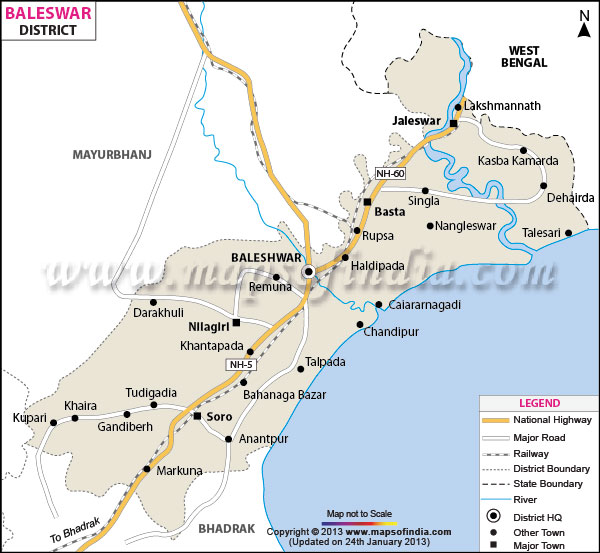
Source: India Map — Baleshwar District Map · www.mapsofindia.com
Connection to Question
This question tests knowledge of India's unique coastal phenomena. The description of sea water receding 'a few kilometres' and allowing people to 'walk on sea floor' specifically points to Chandipur's world-famous characteristic.
Bhavnagar trap: Has India's highest tidal range but water doesn't recede kilometers like Chandipur
Don't confuse tidal range with tidal recession: High tides ≠ dramatic water withdrawal
Location precision: It's Balasore district, Odisha - not just 'East coast'
Frequency detail: Happens twice daily, not once or irregularly
Major Tidal Phenomena in India
Geography Bhavnagar Bheemunipatnam Nagapattinam
Tidal Phenomena Across Indian Coastline: Key Locations
Bhavnagar (Gujarat) has India's highest tidal range up to 12 meters in Gulf of Khambhat
Chandipur (Odisha) shows unique water recession of 1-5 km during low tide
Bay of Bengal generally has lower tidal range compared to Arabian Sea
Tidal characteristics depend on coastal topography and sea floor slope
Coastal Locations & Tidal Features
Location | State | Water Body | Key Tidal Feature | Significance |
|---|---|---|---|---|
Chandipur | Odisha | Bay of Bengal | Water recedes 1-5 km | Hide-and-seek beach phenomenon |
Bhavnagar | Gujarat | Gulf of Khambhat | Highest tidal range (12m) | Major tidal port operations |
Bheemunipatnam | Andhra Pradesh | Bay of Bengal | Normal tidal pattern | Ancient port town |
Nagapattinam | Tamil Nadu | Bay of Bengal | Low tidal range | Fishing port, tsunami-affected 2004 |
Regional Tidal Patterns
Arabian Sea coast: Generally higher tidal ranges, especially in Gulf of Khambhat and Gulf of Kachchh
Bay of Bengal coast: Lower tidal ranges but unique phenomena like Chandipur's recession
Funnel effect: Gujarat's gulfs amplify tidal range due to narrowing water bodies
Continental shelf influence: Gentle slopes create dramatic visual effects during tidal changes
Factors Affecting Tidal Phenomena
# Tidal Phenomena Factors
## Topography
- Continental shelf slope
- Coastal shape
- Sea floor gradient
## Geography
- Gulf configuration
- Bay characteristics
- Ocean connectivity
## Tidal Forces
- Lunar influence
- Solar influence
- Tidal range variationDon't assume highest tidal range = most dramatic visual effect: Bhavnagar has highest range but Chandipur has most visible recession
Bay of Bengal vs Arabian Sea: Arabian Sea generally has higher tidal ranges
Gulf locations: Both Gulf of Khambhat (Bhavnagar) and Gulf of Kachchh have high tidal ranges
Historical vs current significance: Bheemunipatnam was historically important but not for unique tidal phenomena
Tides: Mechanism and Controlling Factors
Geography twice a day tidal cycle
Understanding Tides: Formation, Types & Controlling Factors
Tides occur twice daily due to Moon's gravitational pull and Earth's rotation
High and low tides alternate approximately every 6 hours 12.5 minutes
Tidal range varies with coastal topography, continental shelf, and funnel effects
Spring tides (new/full moon) have highest range, neap tides (quarter moon) have lowest
Basic Tidal Mechanism
Tides are the rhythmic rise and fall of sea levels caused primarily by the Moon's gravitational force. As Earth rotates, different parts experience varying gravitational pull, creating bulges of water that we observe as high and low tides.
Daily Tidal Cycle
%%{init: {"flowchart": {"wrappingWidth": 460}}}%%
flowchart TD
  s1["`**High Tide 1**
Maximum water level at coastline`"]
  s2["`**Falling Tide**
Water level drops over ~6 hours`"]
  s3["`**Low Tide**
Minimum water level, maximum recession`"]
  s4["`**Rising Tide**
Water returns over ~6 hours`"]
  s5["`**High Tide 2**
Second high tide of the day`"]
  s6["`**Cycle Repeats**
Pattern repeats every **24 hours 50 minutes**`"]
  s1 --> s2
  s2 --> s3
  s3 --> s4
  s4 --> s5
  s5 --> s6
Factors Controlling Tidal Range
Factor | Effect on Tides | Example Location | Tidal Range |
|---|---|---|---|
Funnel-shaped coast | Amplifies tidal range | Gulf of Khambhat | Up to 12m |
Flat continental shelf | Increases recession distance | Chandipur | 1-5 km recession |
Narrow gulf/bay | Concentrates tidal energy | Bay of Fundy (world) | 16m+ range |
Open ocean coast | Normal tidal variation | Most Indian beaches | 1-3m range |
Types of Tides by Range
Spring Tides: Occur during new moon and full moon when Sun, Moon, Earth align - highest tidal range
Neap Tides: Occur during quarter moons when Sun and Moon forces partially cancel - lowest tidal range
Diurnal Tides: One high and one low tide per day - rare in Indian waters
Semi-diurnal Tides: Two high and two low tides per day - most common type in India
Timing confusion: Tidal cycle is 24 hours 50 minutes, not exactly 24 hours
Don't confuse tidal range with tidal recession: Range = vertical difference, recession = horizontal withdrawal
Spring vs neap: Spring tides are highest (not related to season), neap tides are lowest
Semi-diurnal pattern: India mostly has 2 high + 2 low tides daily, not just one cycle