On June 21 every year, which of the following latitude(s) experience(s) a sunlight of more than 12 hours? 1. Equator 2. Tropic of Cancer 3. Tropic of Capricorn 4. Arctic Circle Select the correct answer using the code given below:
Contents14
- A1 only
- B2 only
- C3 and 4
- D2 and 4
Show answer
Answer: (D) 2 and 4
Correct Answer: (d) Tropic of Cancer and Arctic Circle (2 and 4).
June 21 is the Summer Solstice — the Northern Hemisphere is tilted toward the sun.
Equator — gets almost exactly 12 hours of sunlight year-round (not MORE than 12).
Tropic of Cancer (23.5°N) — gets MORE than 12 hours because it's in the hemisphere tilted toward the sun. ✓ CORRECT.
Tropic of Capricorn (23.5°S) — gets LESS than 12 hours (it's winter in the Southern Hemisphere).
Arctic Circle (66.5°N) — gets 24 hours of continuous daylight! ✓ CORRECT.
Easy rule for June 21:
- Northern Hemisphere = longer days (more than 12 hours).
- Southern Hemisphere = shorter days (less than 12 hours).
- Equator = always ~12 hours.
On June 21 (Summer Solstice), the Northern Hemisphere tilts toward the sun, giving all northern latitudes more than 12 hours of daylight while southern latitudes get less than 12 hours.
The Equator maintains approximately 12 hours of daylight year-round due to Earth's spherical shape, never significantly more or less.
This tests understanding of Earth's axial tilt and seasonal variations in daylight duration across different latitude zones.
Summer Solstice (June 21)
Geography June 21 Summer Solstice
Summer Solstice: Earth's Tilt & Daylight Hours on June 21
June 21 is the Summer Solstice when Northern Hemisphere tilts maximum toward the sun
Tropic of Cancer and Arctic Circle get more than 12 hours of sunlight
Equator gets exactly 12 hours year-round, Tropic of Capricorn gets less than 12 hours
Arctic Circle experiences 24 hours of continuous daylight (midnight sun)
What Happens
On June 21, Earth's axis tilts 23.5 degrees toward the sun, creating the Summer Solstice in the Northern Hemisphere. This tilt determines how many hours of sunlight each latitude receives.
Daylight Hours by Latitude
Latitude | Position | Daylight Hours | Reason |
|---|---|---|---|
Arctic Circle (66.5°N) | Far North | 24 hours | Midnight sun - never sets |
Tropic of Cancer (23.5°N) | Northern limit | More than 12 | Direct overhead sun at noon |
Equator (0°) | Middle | Exactly 12 | Always equal day/night |
Tropic of Capricorn (23.5°S) | Southern limit | Less than 12 | Winter in Southern Hemisphere |
How Earth's Tilt Works
%%{init: {"flowchart": {"wrappingWidth": 460}}}%%
flowchart TD
  s1["`**Earth's Axis Tilts 23.5°**
Northern Hemisphere leans toward the sun`"]
  s2["`**Sun's Rays Hit Directly**
Tropic of Cancer receives overhead sun`"]
  s3["`**Longer Days in North**
All northern latitudes get extended daylight`"]
  s4["`**Shorter Days in South**
Southern Hemisphere experiences winter`"]
  s1 --> s2
  s2 --> s3
  s3 --> s4
Earth's Position
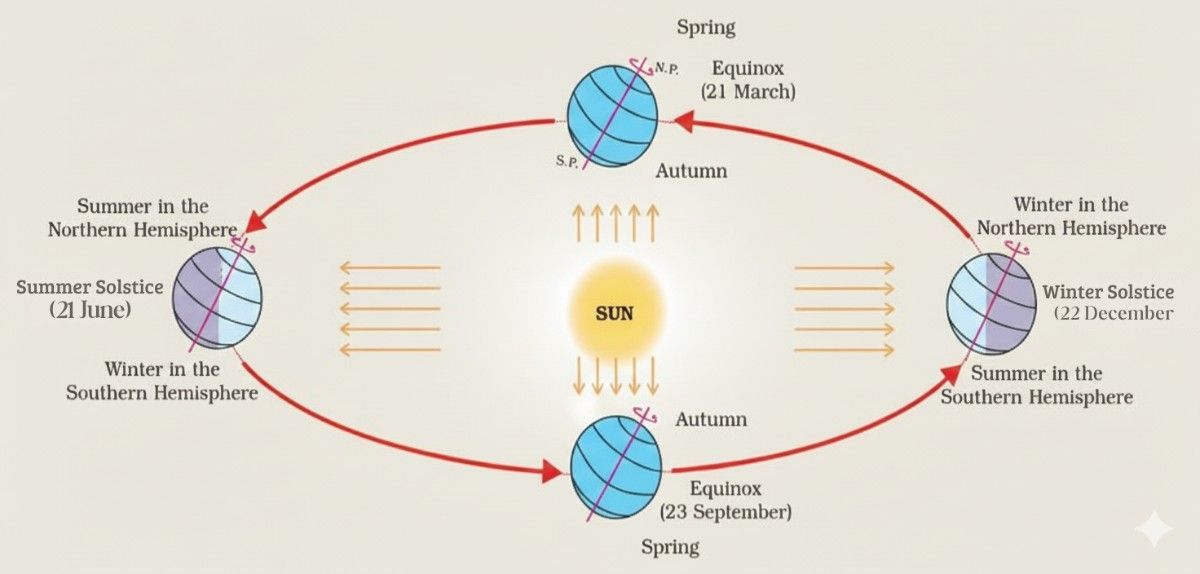
Source: SuperKalam — Summer Solstice and Winter Solstice [UPSC Notes] · superkalam.com
Equator trap: Always gets exactly 12 hours, never MORE than 12 hours on any day
Tropic of Capricorn trap: Gets LESS daylight on June 21 because it's winter in Southern Hemisphere
Season confusion: June 21 = summer in North, winter in South due to Earth's tilt
Arctic Circle fact: Gets 24 hours of daylight, which is definitely more than 12 hours
Winter Solstice (December 21)
Geography
Winter Solstice: Opposite Pattern on December 21-22
December 21-22 is Winter Solstice when Southern Hemisphere tilts toward sun
Tropic of Capricorn and Antarctic Circle get more than 12 hours of sunlight
Tropic of Cancer and Arctic Circle get less than 12 hours
December vs June Solstice
Latitude | June 21 (Summer) | December 21 (Winter) |
|---|---|---|
Arctic Circle (66.5°N) | 24 hours daylight | 24 hours darkness |
Tropic of Cancer (23.5°N) | More than 12 hours | Less than 12 hours |
Equator (0°) | Exactly 12 hours | Exactly 12 hours |
Tropic of Capricorn (23.5°S) | Less than 12 hours | More than 12 hours |
Antarctic Circle (66.5°S) | 24 hours darkness | 24 hours daylight |
Key Pattern
The solstices are mirror opposites. Whatever happens in the Northern Hemisphere on June 21 happens in the Southern Hemisphere on December 21, and vice versa.
Solstice swap: Don't confuse which hemisphere gets longer days on which date
Antarctic Circle: Gets midnight sun in December, not June like Arctic Circle
Equinoxes (March & September)
Geography Equator
Equinoxes: When All Latitudes Get Equal Day & Night
March 20-21 and September 22-23 are equinoxes when sun is directly over equator
All latitudes get exactly 12 hours of daylight and 12 hours of darkness
No latitude gets more than 12 hours on equinox dates
Solar Events Calendar
Date | Event | Sun's Position | Which Latitudes Get >12 Hours |
|---|---|---|---|
March 20-21 | Spring Equinox | Directly over Equator | None - all get exactly 12 |
June 21 | Summer Solstice | Directly over Tropic of Cancer | Northern latitudes |
September 22-23 | Autumn Equinox | Directly over Equator | None - all get exactly 12 |
December 21-22 | Winter Solstice | Directly over Tropic of Capricorn | Southern latitudes |
Why Equinoxes Matter
During equinoxes, Earth's axis is perpendicular to the sun's rays - neither hemisphere tilts toward or away from the sun. This creates equal day and night everywhere on Earth.
Key Latitudes (Tropics & Circles)
Geography Tropic of Cancer Tropic of Capricorn Arctic Circle
Critical Latitudes: Degrees & Significance for UPSC
Tropic of Cancer: 23.5°N - northern limit of sun's direct rays
Tropic of Capricorn: 23.5°S - southern limit of sun's direct rays
Arctic Circle: 66.5°N - northern limit of midnight sun
Antarctic Circle: 66.5°S - southern limit of midnight sun
Major Latitudes
Latitude | Degrees | Significance | Special Feature |
|---|---|---|---|
Equator | 0° | Equal day/night year-round | Always ~12 hours sunlight |
Tropic of Cancer | 23.5°N | Direct sun on June 21 | Marks northern tropics boundary |
Tropic of Capricorn | 23.5°S | Direct sun on December 21 | Marks southern tropics boundary |
Arctic Circle | 66.5°N | Midnight sun in summer | 24-hour daylight on June 21 |
Antarctic Circle | 66.5°S | Midnight sun in summer | 24-hour daylight on December 21 |
Latitude System
# Earth's Key Latitudes
## Tropics (23.5°)
- Cancer (North)
- Capricorn (South)
- Direct overhead sun
- Tropical climate boundary
## Polar Circles (66.5°)
- Arctic (North)
- Antarctic (South)
- Midnight sun limit
- Polar day/night
## Equator (0°)
- Equal day/night
- 12 hours always
- No seasons
- Maximum heatDegree memory: Tropics = 23.5°, Circles = 66.5° (not 23° and 67°)
North-South pairs: Cancer/Arctic are North, Capricorn/Antarctic are South
Midnight sun: Arctic gets it in June, Antarctic gets it in December