In the northern hemisphere, the longest day of the year normally occurs in the:
Contents15
- AFirst half of the month of June
- BSecond half of the month of June
- CFirst half of the month of July
- DSecond half of the month of July
Show answer
Answer: (B) Second half of the month of June
The answer is (B) Second half of June.
The longest day in the Northern Hemisphere occurs during the Summer Solstice, which falls around June 21 every year.
This is when the North Pole is tilted most toward the Sun.
June 21 falls in the SECOND half of June (June 16-30).
On this day:
- Northern Hemisphere gets maximum sunlight = longest day
- Southern Hemisphere gets minimum sunlight = shortest day (winter solstice there)
Simple memory aid: "June 21 = longest day in the north, shortest day in the south."
Summer solstice around June 21 marks the longest day in the Northern Hemisphere when the North Pole tilts most toward the Sun.
UPSC is testing whether students can distinguish between early June (first half) and late June (second half) since June 21 falls in the second half of the month.
Summer Solstice
Geography longest day June
Summer Solstice: Date, Mechanism & UPSC Facts
Summer Solstice occurs around June 21 in Northern Hemisphere
June 21 falls in second half of June (June 16-30)
Northern Hemisphere gets maximum daylight hours on this day
Southern Hemisphere experiences Winter Solstice simultaneously
What is Summer Solstice
Summer Solstice is when the North Pole tilts most toward the Sun - exactly 23.5 degrees. This creates the longest day and shortest night in the Northern Hemisphere.
Solstice Comparison
Event | Date | Northern Hemisphere | Southern Hemisphere |
|---|---|---|---|
Summer Solstice | June 21 | Longest day | Shortest day (Winter Solstice) |
Winter Solstice | December 21 | Shortest day | Longest day (Summer Solstice) |
Earth's Tilt Visualization
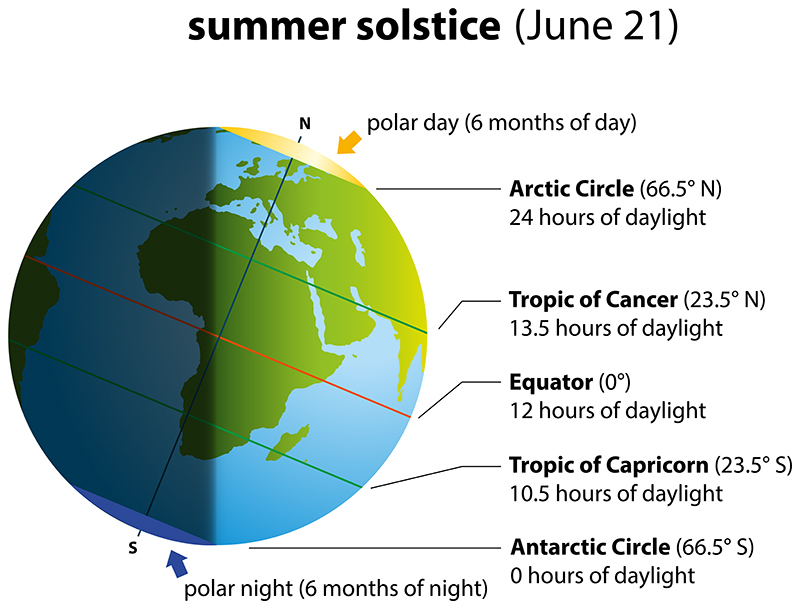
Source: Earth.com — What is the Summer Solstice? - Earth.com · www.earth.com
Key Facts for UPSC
The exact date can vary by 1-2 days due to leap years, but always falls around June 20-22
Tropic of Cancer (23.5°N) receives direct overhead sunlight on this day
After Summer Solstice, days start getting shorter in Northern Hemisphere
The term 'solstice' means 'sun stands still' - Sun appears to pause before reversing direction
Trap: June 21 falls in second half of June (16-30), not first half (1-15)
Trap: Don't confuse with Summer Season - meteorological summer is June-August
Trap: Summer Solstice in Northern Hemisphere = Winter Solstice in Southern Hemisphere
Trap: December 21 is Winter Solstice for Northern Hemisphere, not summer
Winter Solstice
Geography
Winter Solstice: Shortest Day in Northern Hemisphere
Winter Solstice occurs around December 21 in Northern Hemisphere
Shortest day and longest night in Northern Hemisphere
South Pole tilts toward Sun, giving Southern Hemisphere its summer
Winter Solstice Mechanism
On December 21, the South Pole tilts most toward the Sun. The Northern Hemisphere receives minimum sunlight, creating the shortest day of the year.
Winter Solstice Facts
Tropic of Capricorn (23.5°S) receives direct overhead sunlight
Arctic Circle experiences polar night - 24 hours of darkness
After Winter Solstice, days start getting longer in Northern Hemisphere
Marks the astronomical beginning of winter in Northern Hemisphere
Trap: December 21 is shortest day for Northern Hemisphere only
Trap: Same day is Summer Solstice for Southern Hemisphere
Trap: Don't mix up with Winter Season timing in different regions
Earth's Tilt and Seasons
Geography
Earth's Axial Tilt: The Science Behind Seasons
Earth's axis is tilted at 23.5 degrees from vertical
This tilt creates seasons as Earth revolves around Sun
Same tilt causes opposite seasons in Northern and Southern hemispheres
Why Seasons Occur
Earth's 23.5-degree axial tilt means different hemispheres receive varying amounts of sunlight throughout the year. When one hemisphere tilts toward the Sun, it experiences summer while the other experiences winter.
Seasonal Cycle Process
%%{init: {"flowchart": {"wrappingWidth": 460}}}%%
flowchart TD
  s1["`**June 21**
Northern Hemisphere tilts toward Sun → Summer Solstice`"]
  s2["`**September 23**
Neither hemisphere tilts toward Sun → Autumn Equinox`"]
  s3["`**December 21**
Southern Hemisphere tilts toward Sun → Winter Solstice (North)`"]
  s4["`**March 21**
Neither hemisphere tilts toward Sun → Spring Equinox`"]
  s1 --> s2
  s2 --> s3
  s3 --> s4
Effects of Earth's Tilt
# Earth's 23.5° Tilt
## Seasonal Changes
- Temperature variation
- Daylight duration
- Sun's angle
## Special Days
- Summer Solstice
- Winter Solstice
- Equinoxes
## Geographic Effects
- Tropical zones
- Polar nights
- Midnight sun
Equinoxes
Geography
Equinoxes: Equal Day and Night Worldwide
March 21 = Spring Equinox, September 23 = Autumn Equinox
12 hours day, 12 hours night everywhere on Earth
Sun is directly overhead at the Equator
What is an Equinox
Equinox occurs when neither hemisphere tilts toward the Sun. The Sun's rays fall directly on the Equator, giving equal day and night duration worldwide.
Spring vs Autumn Equinox
Equinox | Date | Northern Hemisphere | Southern Hemisphere | Sun Position |
|---|---|---|---|---|
Spring (Vernal) | March 21 | Spring begins | Autumn begins | Moving north |
Autumn | September 23 | Autumn begins | Spring begins | Moving south |
Trap: Equal day/night happens on equinoxes, not solstices
Trap: March 21 is spring for Northern Hemisphere, autumn for Southern
Trap: Sun is overhead at Equator during equinoxes, not tropics