Consider the following statements: 1. The Earth's magnetic field has reversed every few hundred thousand years. 2. When the Earth was created more than 4000 million years ago, there was 54% oxygen and no carbon dioxide. 3. When living organisms originated, they modified the early atmosphere of the Earth. Which of the statements given above is/are correct?
Contents18
- A1 only
- B2 and 3 only
- C1 and 3 only
- D1, 2 and 3
Show answer
Answer: (C) 1 and 3 only
Correct Answer: (c) 1 and 3 only
Statement 1 is CORRECT: Earth's magnetic field has indeed reversed many times throughout its history.
The North and South magnetic poles have swapped positions.
Over the last 20 million years, this has happened roughly every 200,000 to 300,000 years.
The last reversal occurred about 780,000 years ago.
Statement 2 is WRONG: Earth did NOT have 50% more oxygen than today when it was created 4 billion years ago.
In fact, early Earth had very little or NO free oxygen.
The atmosphere was mostly carbon dioxide, nitrogen, and water vapor.
Oxygen levels only rose significantly about 2.4 billion years ago during the 'Great Oxidation Event' when photosynthetic organisms began producing oxygen.
Statement 3 is CORRECT: The molten iron in Earth's outer core moves and creates electrical currents, which in turn generate the magnetic field.
Think of it as a giant natural dynamo — flowing liquid iron generates Earth's magnetic field.
This is called the 'geodynamo theory.'
REMEMBER:
- Earth's magnetic field has flipped many times (every ~200,000-300,000 years).
- Early Earth had almost NO oxygen (not more).
- Earth's magnetic field is created by molten iron flowing in the outer core (dynamo effect).
Earth's magnetic field reversals occur every few hundred thousand years, with the last one happening about 780,000 years ago, making current predictions about future reversals relevant for scientific monitoring.
The early Earth atmosphere question tests a common misconception - students often assume early Earth was oxygen-rich, but it actually had almost no free oxygen until cyanobacteria evolved around 2.4 billion years ago.
UPSC is testing whether students can distinguish between early Earth conditions versus the oxygen-rich atmosphere created later by living organisms.
Earth's Magnetic Field Reversals
Geography Earth's magnetic field reversed
Earth's Magnetic Field Reversals: Frequency & Evidence
Earth's magnetic field reverses every 200,000-300,000 years on average
Last reversal occurred 780,000 years ago - we're overdue
Generated by molten iron flow in outer core (geodynamo)
Evidence preserved in rock magnetization and ocean floor
What Is Magnetic Reversal
Geomagnetic reversal means Earth's North and South magnetic poles completely swap positions. The magnetic field doesn't disappear - it flips 180 degrees. This is a natural process that has happened hundreds of times in Earth's history.
Key Facts About Reversals
Over the last 20 million years, reversals happened every 200,000-300,000 years
The reversal process takes 1,000-10,000 years to complete
During reversal, magnetic field weakens by 90% but doesn't vanish
No mass extinctions are directly linked to magnetic reversals
Compass needles would point south after a complete reversal
How We Know This
Paleomagnetic evidence is preserved in rocks and ocean floor sediments. When rocks form, iron minerals align with Earth's magnetic field at that time. By studying rock layers of different ages, scientists can map the reversal timeline going back millions of years.
Trap: Don't confuse magnetic reversal with magnetic field disappearing completely
Trap: Reversals happen every few hundred thousand years, not every few thousand years
UPSC loves testing the 780,000 years ago last reversal date
Early Earth's Atmosphere
Geography 4000 million years ago 54% oxygen carbon dioxide
Early Earth's Atmosphere: Composition & Evolution
Early Earth had almost NO free oxygen - mostly CO₂ and nitrogen
Great Oxidation Event at 2.4 billion years ago brought oxygen
Current atmosphere is 21% oxygen, 78% nitrogen
Early atmosphere was reducing, not oxidizing like today
Atmospheric Evolution Timeline
Time Period | Oxygen Level | Main Gases | Key Event |
|---|---|---|---|
4.6 billion years ago (Earth formation) | 0% | H₂, He, CH₄, NH₃ | Primary atmosphere lost |
4-2.5 billion years ago (Archean) | <1% | CO₂, N₂, H₂O vapor | Volcanic outgassing |
2.4 billion years ago | 1-2% | CO₂ drops, O₂ rises | Great Oxidation Event |
Present day | 21% | N₂ (78%), O₂ (21%) | Photosynthesis established |
Why Early Earth Had No Oxygen
Volcanic outgassing released CO₂, water vapor, sulfur compounds - not oxygen
No photosynthetic organisms existed to produce oxygen
Any free oxygen was immediately consumed by iron oxidation (rust formation)
Early atmosphere was chemically reducing - opposite of today's oxidizing atmosphere
The Great Oxidation Event
Around 2.4 billion years ago, cyanobacteria (blue-green algae) evolved photosynthesis and began pumping oxygen into the atmosphere. This was initially toxic to most existing life forms, causing the first mass extinction. Oxygen levels rose from near-zero to significant amounts over several hundred million years.
Major Trap: Statement 2 claims early Earth had 54% oxygen - completely wrong, it had almost zero
Don't confuse water vapor (H₂O) with free oxygen (O₂) in early atmosphere
Early Earth had more CO₂, not less - opposite of the statement's claim
Life's Role in Atmospheric Change
Geography living organisms modified early atmosphere
How Living Organisms Modified Earth's Atmosphere
Cyanobacteria introduced oxygen through photosynthesis 2.4 billion years ago
Life forms removed CO₂ and added O₂ to atmosphere
Plants and algae continue to maintain oxygen levels today
Early oxygen was toxic to anaerobic life forms
The Biological Revolution
When photosynthetic organisms first evolved, they fundamentally changed Earth's chemistry. Through photosynthesis (CO₂ + H₂O + sunlight → glucose + O₂), they began removing carbon dioxide and releasing oxygen as a waste product.
How Life Changed the Atmosphere
%%{init: {"flowchart": {"wrappingWidth": 460}}}%%
flowchart TD
  s1["`****3.5 billion years ago****
First cyanobacteria evolve photosynthesis`"]
  s2["`****2.4 billion years ago****
Oxygen accumulates in atmosphere (Great Oxidation Event)`"]
  s3["`****2-1 billion years ago****
Anaerobic organisms go extinct or adapt`"]
  s4["`****600 million years ago****
Complex oxygen-breathing life evolves`"]
  s5["`****Present****
Plants maintain 21% oxygen through photosynthesis`"]
  s1 --> s2
  s2 --> s3
  s3 --> s4
  s4 --> s5
Major Atmospheric Changes by Life
Oxygen increase: From <1% to 21% over 2 billion years
CO₂ reduction: From dominant gas to 0.04% today
Ozone layer formation: O₃ shields surface from UV radiation
Methane cycling: Bacteria produce and consume atmospheric methane
Nitrogen fixation: Bacteria convert N₂ to usable compounds
Question Connection
Statement 3 correctly identifies that living organisms modified the early atmosphere. This is a fundamental principle - life didn't just adapt to Earth's environment, it actively transformed the atmospheric composition through biological processes like photosynthesis.
Statement 3 is correct - organisms DID modify early atmosphere
Don't think atmosphere was static - life actively changed its composition
Key process: photosynthesis by cyanobacteria, not just any random organisms
Earth's Magnetic Field Generation
Geography
Geodynamo Theory: How Earth Generates Its Magnetic Field
Earth's magnetic field created by molten iron flow in outer core
Geodynamo effect - moving liquid iron generates electrical currents
Outer core is 2,900-5,150 km below surface
Core temperature 4,000-6,000°C keeps iron molten
The Dynamo Mechanism
Earth's outer core contains liquid iron and nickel at extremely high temperatures. As Earth rotates, this molten metal flows in complex patterns. Moving liquid iron acts like a natural dynamo - it generates electrical currents, which create magnetic fields.
Magnetic Field Generation Process
%%{init: {"flowchart": {"wrappingWidth": 460}}}%%
flowchart TD
  s1["`****Heat Source****
Radioactive decay heats Earth's core to 4,000-6,000°C`"]
  s2["`****Molten Iron****
Outer core iron remains liquid due to extreme heat`"]
  s3["`****Convection Currents****
Hot iron rises, cool iron sinks in outer core`"]
  s4["`****Earth's Rotation****
Coriolis effect creates spiraling flow patterns`"]
  s5["`****Electrical Currents****
Moving liquid iron generates electric currents`"]
  s6["`****Magnetic Field****
Electric currents create Earth's dipolar magnetic field`"]
  s1 --> s2
  s2 --> s3
  s3 --> s4
  s4 --> s5
  s5 --> s6
Earth's Core Structure
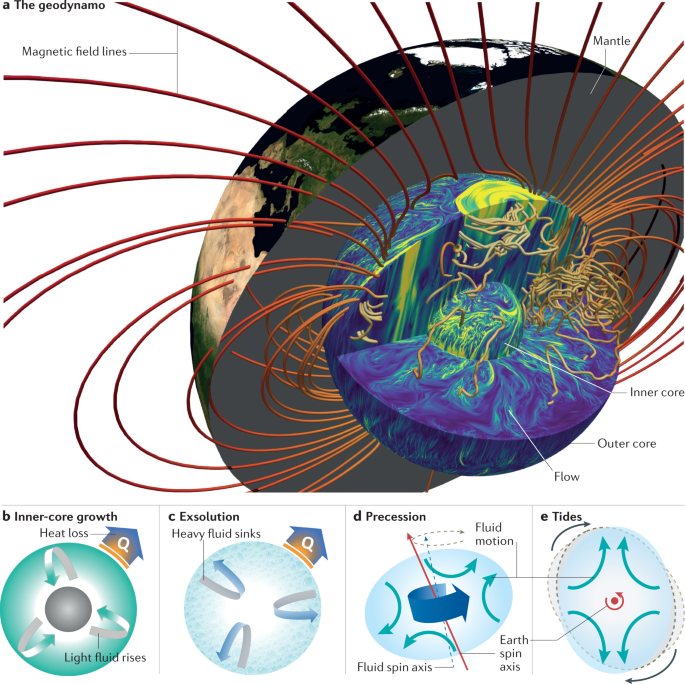
Source: Nature — Sustaining Earth's magnetic dynamo | Nature Reviews Earth ... · www.nature.com
Key Components of Geodynamo
Outer core composition: 80% iron, 20% nickel + light elements
Convection: Heat-driven circulation of molten metal
Coriolis effect: Earth's rotation organizes flow patterns
Self-sustaining: Magnetic field helps maintain the currents that create it
Outer core generates magnetism, not the inner core (which is solid)
It's molten iron flow, not just static molten iron that creates the field
Geodynamo explains both field generation AND field reversals