Consider the following information:
Contents16
Consider the following information:
| Region | Name of the mountain range | Type of mountain | |
|---|---|---|---|
| 1. | Central Asia | Vosges | Fold mountain |
| 2. | Europe | Alps | Block mountain |
| 3. | North America | Appalachians | Fold mountain |
| 4. | South America | Andes | Fold mountain |
In how many of the above rows is the information correctly matched?
- AOnly one
- BOnly two
- COnly three
- DAll four
Show answer
Answer: (B) Only two
Correct Answer: (b) Only two rows are correct (Rows 3 and 4).
Row 1 — Vosges in Central Asia as Fold mountain: ✗ WRONG on two counts.
The Vosges are in Europe (France/Germany border region), not Central Asia, and they are Block mountains, not Fold mountains.
Row 2 — Alps in Europe as Block mountain: ✗ WRONG.
The Alps are indeed in Europe, but they are Fold mountains (formed by tectonic plate collision), not Block mountains.
Row 3 — Appalachians in North America as Fold mountains: ✓ CORRECT.
Row 4 — Andes in South America as Fold mountains: ✓ CORRECT.
They're the longest continental mountain range.
Key facts:
- Fold mountains = formed by tectonic compression (Alps, Himalayas, Andes, Appalachians).
- Block mountains = formed by faulting (Vosges, Black Forest, Vindhyas).
The question tests knowledge of mountain types - fold mountains form from tectonic plate collision and compression, while block mountains form from faulting and vertical displacement of crustal blocks.
UPSC is testing whether students can distinguish between European mountain ranges like the Alps (fold) versus Vosges (block), and whether they know the Vosges are in Europe, not Central Asia.
Fold Mountains
Geography Fold mountain Alps Appalachians Andes
Fold Mountains: Formation, Examples & UPSC Classifications
Fold mountains form when tectonic plates collide and compress rock layers
Major examples: Himalayas, Alps, Andes, Appalachians, Rocky Mountains
Formed by lateral compression at convergent plate boundaries
Usually the youngest and highest mountain ranges on Earth
Formation Process
Fold mountains form when two tectonic plates move toward each other and compress the rock layers between them. The immense pressure causes the Earth's crust to buckle and fold upward, creating mountain ranges. This process happens at convergent plate boundaries over millions of years.
Major Fold Mountain Ranges
Mountain Range | Location | Plates Involved | Age/Period |
|---|---|---|---|
Himalayas | Asia (India-Tibet border) | Indian + Eurasian | 50 million years ago |
Alps | Europe (France, Switzerland, Italy) | African + Eurasian | 65 million years ago |
Andes | South America (western coast) | Nazca + South American | 25 million years ago |
Appalachians | North America (eastern USA) | North American + African | 480 million years ago |
Rocky Mountains | North America (western USA/Canada) | Pacific + North American | 80 million years ago |
Formation Diagram
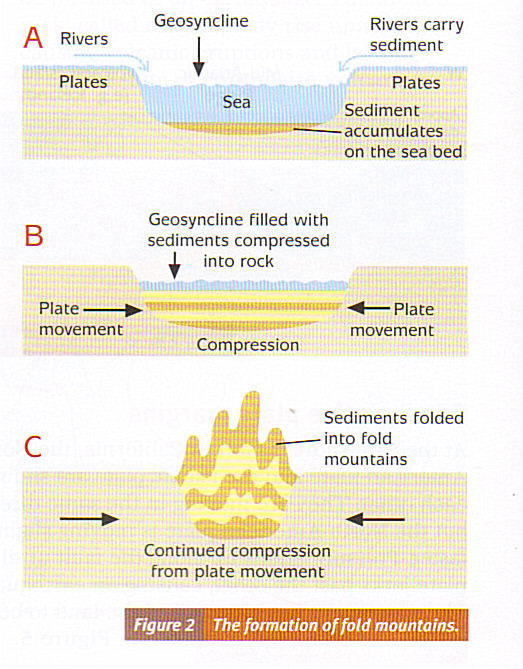
Source: Geography Pods — 4. Fold Mountains - GEOGRAPHY FOR 2026 & BEYOND · www.geographypods.com
Alps are FOLD mountains, not block mountains (Row 2 in the question)
Vosges are in Europe (France-Germany border), not Central Asia
Don't confuse Appalachians (North America, fold) with Atlas Mountains (Africa, fold)
Andes are the longest continental mountain range - key identifying fact for UPSC
Block Mountains
Geography Block mountain Vosges
Block Mountains: Formation by Faulting & Key Examples
Block mountains form by faulting - vertical movement along fractures
Created when crustal blocks are uplifted or downthrown along fault lines
Examples: Vosges, Black Forest, Vindhyas, Sierra Nevada
Also called fault-block mountains or horst mountains
Formation Process
Block mountains form through faulting - when the Earth's crust breaks along fracture lines and blocks of rock move vertically. The uplifted block becomes a mountain (horst), while the dropped block forms a valley (graben). Unlike fold mountains, there's no lateral compression - just vertical displacement.
Major Block Mountains
Mountain Range | Location | Formation | Key Feature |
|---|---|---|---|
Vosges | Europe (France-Germany border) | Rhine Rift faulting | Paired with Black Forest |
Black Forest | Europe (Germany) | Rhine Rift faulting | Opposite side of Rhine Valley |
Vindhyas | India (Central India) | Ancient faulting | Separates North-South India |
Sierra Nevada | North America (California) | Pacific faulting | Granite batholith exposed |
Harz Mountains | Europe (Germany) | Hercynian faulting | Ancient fault block |
Block Mountain Formation
%%{init: {"flowchart": {"wrappingWidth": 460}}}%%
flowchart TD
  s1["`**Tensional Forces**
Earth's crust experiences **stretching forces**`"]
  s2["`**Fault Development**
**Fractures** develop in the crustal rocks`"]
  s3["`**Block Movement**
Crustal blocks move **vertically** along fault lines`"]
  s4["`**Horst & Graben**
**Uplifted block = Mountain**, **Dropped block = Valley**`"]
  s1 --> s2
  s2 --> s3
s3 --> s4Vosges are in Europe, not Central Asia - common location trap
Vosges are block mountains, not fold mountains - formation type confusion
Black Forest and Vosges are paired - both sides of the Rhine Rift Valley
Don't confuse horst (uplifted block) with graben (down-dropped valley)
Mountain Classification Types
Geography Type of mountain
Complete Mountain Classification: All Types & Formation
Mountains classified by formation process: Fold, Block, Volcanic, Residual
Fold = compression, Block = faulting, Volcanic = eruption, Residual = erosion
UPSC frequently tests type vs location matching in tables
Mountain Types by Formation
Type | Formation Process | Key Examples | Characteristics |
|---|---|---|---|
Fold Mountains | Tectonic compression at plate boundaries | Himalayas, Alps, Andes, Appalachians | Youngest, highest, parallel ranges |
Block Mountains | Vertical faulting and crustal displacement | Vosges, Black Forest, Vindhyas, Sierra Nevada | Steep sides, horst-graben pattern |
Volcanic Mountains | Lava accumulation from repeated eruptions | Mt. Fuji, Vesuvius, Kilauea, Stromboli | Conical shape, active/dormant craters |
Residual Mountains | Differential erosion of ancient rocks | Nilgiris, Aravallis, Urals, Appalachian remnants | Rounded peaks, very ancient origin |
Mountain Formation Processes
# Mountain Formation
## **Tectonic Forces**
- Compression → Fold Mountains
- Tension → Block Mountains
- Transform → Linear Ridges
## **Volcanic Activity**
- Shield Volcanoes
- Stratovolcanoes
- Cinder Cones
- Volcanic Domes
## **Erosional Processes**
- Differential Erosion
- Resistant Rock Remnants
- Plateau Dissection
Mountain Types Comparison

Source: Shutterstock — 88,856 Folded Mountain Diagram Royalty-Free Images, Stock Photos ... · www.shutterstock.com
Alps = Fold mountains (not block) - most common type confusion
Age pattern: Fold mountains usually youngest, Residual mountains oldest
Volcanic mountains can be active, dormant, or extinct - check the specific status
Appalachians appear as both fold (original) and residual (eroded remnants) in different contexts
World Mountain Ranges Location
Geography Central Asia Europe North America South America
World Mountain Ranges: Continental Distribution & Key Systems
Each continent has major mountain systems along specific patterns
Europe: Alps, Pyrenees, Carpathians, Urals, Vosges, Black Forest
Asia: Himalayas, Karakoram, Hindu Kush, Tian Shan, Altai
Americas: Andes (South), Rockies + Appalachians (North)
Mountain Ranges by Continent
Continent/Region | Major Ranges | Type | Key Features |
|---|---|---|---|
Europe | Alps, Pyrenees, Carpathians, Urals | Fold + Block | Vosges & Black Forest = Block type |
Asia (Central) | Himalayas, Karakoram, Tian Shan, Pamir | Fold | World's highest peaks |
North America | Rocky Mountains, Appalachians, Sierra Nevada | Fold + Block | Appalachians = ancient fold |
South America | Andes Mountains | Fold | Longest continental range |
Africa | Atlas, Drakensberg, Ethiopian Highlands | Fold + Block | Great Rift Valley = faulting |
Australia | Great Dividing Range, MacDonnell Ranges | Fold + Residual | Ancient, eroded systems |
World Mountain Distribution
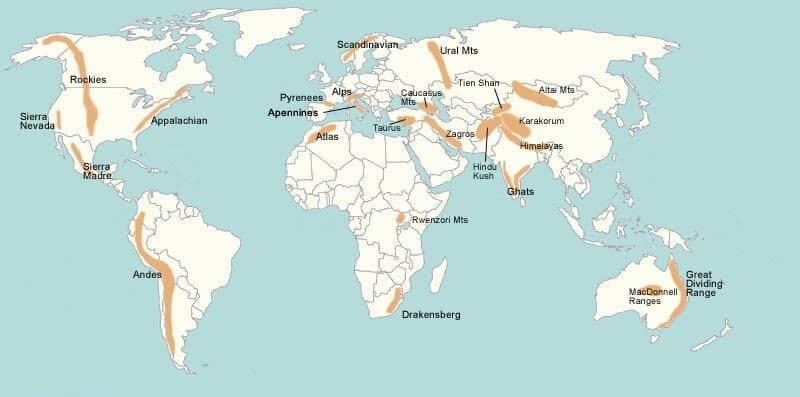
Source: LotusArise IAS — Major Mountain Ranges of the World - UPSC Notes » LotusArise IAS · lotusarise.com
UPSC Location Patterns
European ranges: Alps (central), Vosges (France-Germany), Pyrenees (France-Spain), Urals (Russia-Asia boundary)
North American pattern: Rockies on western coast, Appalachians on eastern coast
Asian complexity: Multiple parallel ranges due to Indian plate collision with Eurasia
South American simplicity: Single Andes chain along entire western coast
African uniqueness: Great Rift Valley system dominates eastern highlands
Vosges are in Europe (France-Germany border), NOT Central Asia - major location trap
Urals separate Europe from Asia - transcontinental boundary range
Andes run north-south along South America's western coast, not eastern
Atlas Mountains are in North Africa (Morocco-Algeria), not sub-Saharan Africa