With reference to 'Coriolis force', which of the following statements is/are correct? 1. It increases with increase in wind velocity. 2. It is maximum at the poles and is absent at the equator. Select the answer using the code given below:
Contents17
- A1 only
- B2 only
- CBoth 1 and 2
- DNeither 1 nor 2
Show answer
Answer: (C) Both 1 and 2
Correct Answer: (c) Both statements are correct.
Statement 1: Coriolis force increases with wind velocity — ✓ CORRECT.
The faster the wind blows, the more it gets deflected.
Statement 2: Coriolis force is maximum at the poles and zero at the equator — ✓ CORRECT.
It's directly proportional to the sine of latitude.
Key facts about Coriolis force:
- It deflects winds to the RIGHT in the Northern Hemisphere and to the LEFT in the Southern Hemisphere.
- It's zero at the equator (that's why tropical cyclones don't form right at the equator — there's no Coriolis force to spin the winds).
- Named after French physicist Gaspard-Gustave de Coriolis (1835).
Coriolis force explains why tropical cyclones cannot form at the equator and why they spin differently in northern versus southern hemispheres.
The force is proportional to both wind speed and sine of latitude, making it zero at equator and maximum at poles.
This tests foundational understanding of atmospheric circulation patterns that drive global weather systems.
Coriolis Force - Fundamentals
Geography Coriolis force
Coriolis Force: Definition, Mechanism & UPSC Testing Pattern
Coriolis force deflects moving air due to Earth's rotation — right in NH, left in SH
Force is directly proportional to wind velocity — faster winds = more deflection
Maximum at poles, zero at equator — varies with sine of latitude
Named after French physicist Gaspard-Gustave de Coriolis (1835)
What is Coriolis Force
Coriolis force is an apparent force that deflects moving objects (including air masses) due to Earth's rotation. It's not a real force but an effect observed from Earth's rotating reference frame.
Acts on any moving object on Earth's surface
Most visible in large-scale atmospheric and oceanic movements
Essential for understanding global wind patterns and cyclone formation
Coriolis Force Variations
Factor | Relationship | UPSC Key Point |
|---|---|---|
Wind Velocity | Directly proportional | Faster winds = greater deflection |
Latitude | Proportional to sin(latitude) | Maximum at poles, zero at equator |
Hemisphere | Direction reversal | Right in NH, Left in SH |
Object Speed | Only affects moving objects | Stationary objects experience no Coriolis force |
How Coriolis Force Works
%%{init: {"flowchart": {"wrappingWidth": 460}}}%%
flowchart TD
  s1["`**Earth Rotates Eastward**
Different latitudes have different **linear velocities** due to Earth's spherical shape`"]
  s2["`**Air Moves North/South**
Moving air carries the **rotational momentum** of its starting latitude`"]
  s3["`**Velocity Mismatch**
Air reaches areas with **different rotational speeds**`"]
  s4["`**Apparent Deflection**
Observed as **rightward** (NH) or **leftward** (SH) deflection`"]
  s1 --> s2
  s2 --> s3
  s3 --> s4
Question Analysis
Statement 1 tests the velocity-force relationship — many students wrongly think Coriolis force is constant
Statement 2 tests latitude variation — students often forget it's zero at equator
Both statements directly address the two main variables that control Coriolis force magnitude
Trap: Thinking Coriolis force is constant regardless of wind speed — it increases with velocity
Trap: Assuming Coriolis force exists everywhere on Earth — it's zero at the equator
Trap: Confusing direction — right deflection in NH, left in SH (not the opposite)
Trap: Mixing up maximum/minimum locations — maximum at poles, minimum (zero) at equator
Global Wind Patterns & Circulation
Geography wind velocity
Global Wind Patterns: Role of Coriolis Force in Atmospheric Circulation
Trade winds deflect to become NE trades (NH) and SE trades (SH)
Westerlies blow from SW (NH) and NW (SH) due to Coriolis deflection
Polar easterlies complete the three-cell circulation model
Coriolis Effect on Winds
Without Coriolis force, winds would blow directly from high to low pressure. Earth's rotation deflects these winds, creating the characteristic curved patterns we observe in global circulation.
Major Wind Belts
Wind Belt | Latitude Range | Direction (NH) | Direction (SH) | Coriolis Effect |
|---|---|---|---|---|
Trade Winds | 0°-30° | Northeast | Southeast | Strong deflection from equatorward flow |
Westerlies | 30°-60° | Southwest | Northwest | Moderate deflection from poleward flow |
Polar Easterlies | 60°-90° | Northeast | Southeast | Strong deflection from equatorward flow |
Global Wind Circulation
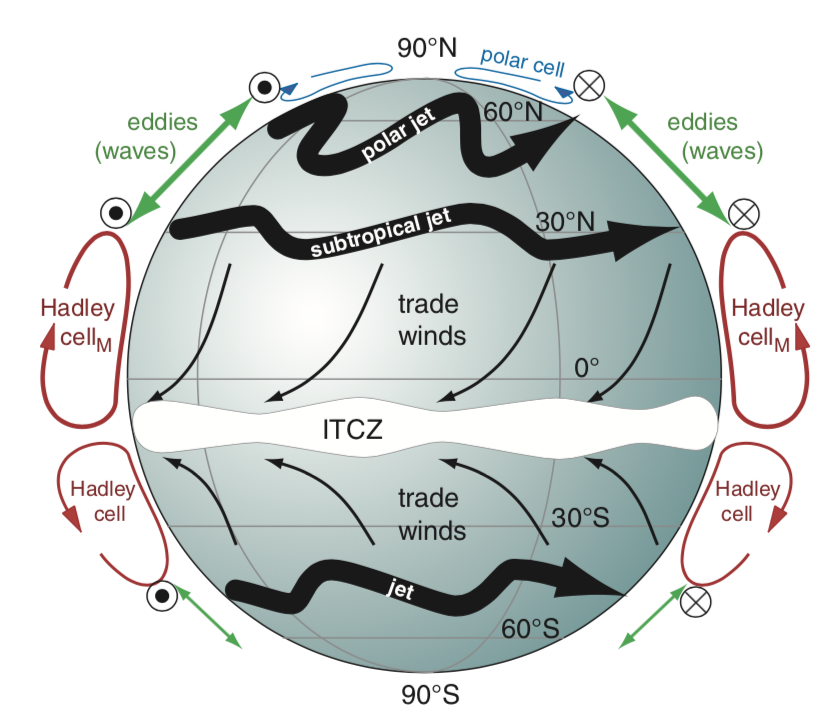
Source: UBC EOAS — Global Wind Circulations · www.eoas.ubc.ca
Trap: Forgetting that trade winds are named for their direction toward the equator, not away
Trap: Mixing up westerlies direction — they blow from the west, toward the east
Trap: Assuming winds blow straight N-S without considering Coriolis deflection
Tropical Cyclones & Coriolis Force
Geography
Tropical Cyclones: Why Coriolis Force is Essential for Formation
No tropical cyclones form within 5° latitude of equator due to insufficient Coriolis force
Cyclones rotate counterclockwise (NH) and clockwise (SH) due to Coriolis deflection
Minimum Coriolis parameter needed to initiate rotational motion in low-pressure systems
Equatorial Cyclone Gap
Tropical cyclones cannot form at the equator because Coriolis force is zero there. Without this deflecting force, air cannot develop the rotational motion essential for cyclone formation. This creates a cyclone-free zone within approximately 5° north and south of the equator.
Cyclone Formation Requirements
Factor | Requirement | Role of Coriolis Force |
|---|---|---|
Latitude | Beyond 5° from equator | Provides minimum deflection for rotation |
Sea Surface Temperature | Above 26.5°C | Coriolis organizes the rising warm air |
Low Wind Shear | Minimal vertical wind change | Allows Coriolis-driven circulation to develop |
Rotation Direction | Counterclockwise (NH), Clockwise (SH) | Direct result of Coriolis deflection |
Cyclone Formation Process
%%{init: {"flowchart": {"wrappingWidth": 460}}}%%
flowchart TD
  s1["`**Low Pressure Develops**
Over warm ocean waters (**>26.5°C**)`"]
  s2["`**Air Rushes Inward**
Toward the low pressure center`"]
  s3["`**Coriolis Force Acts**
Deflects inflowing air **sideways**`"]
  s4["`**Rotation Begins**
**Counterclockwise** (NH) or **clockwise** (SH)`"]
  s5["`**Cyclone Intensifies**
Rotation accelerates, pressure drops further`"]
  s1 --> s2
  s2 --> s3
  s3 --> s4
s4 --> s5Trap: Thinking cyclones form everywhere in tropics — they cannot form within 5° of equator
Trap: Confusing cyclone rotation — counterclockwise in NH, clockwise in SH
Trap: Assuming temperature alone causes cyclones — Coriolis force is equally essential
Pressure Belts & Wind Systems
Geography
Pressure Belts & Wind Systems: Coriolis Force in Global Circulation
Seven pressure belts created by unequal heating and Coriolis deflection
ITCZ shifts seasonally, creating monsoon patterns in tropical regions
Subtropical highs at 30° latitude control desert locations worldwide
Pressure Belt Formation
Pressure belts form due to differential heating of Earth's surface and the deflecting effect of Coriolis force on resulting air movements. These belts shift seasonally, creating regional climate patterns and monsoon systems.
Global Pressure Belts
Pressure Belt | Latitude | Characteristics | Associated Winds |
|---|---|---|---|
Equatorial Low (ITCZ) | 0°-5° | Rising air, heavy rainfall | Convergence zone, weak winds |
Subtropical High | 25°-35° | Descending air, clear skies | Trade winds toward equator |
Subpolar Low | 55°-65° | Rising air, cyclonic activity | Westerlies from south |
Polar High | 85°-90° | Descending cold air | Polar easterlies toward equator |
Three-Cell Circulation Model
# Global Circulation
## **Hadley Cell**
- 0°-30° latitude
- **Trade winds**
- ITCZ convergence
- Tropical deserts at 30°
## **Ferrel Cell**
- 30°-60° latitude
- **Westerlies**
- Mid-latitude cyclones
- Temperate climate zones
## **Polar Cell**
- 60°-90° latitude
- **Polar easterlies**
- Arctic/Antarctic highs
- Polar climate zonesTrap: Forgetting ITCZ shifts seasonally — it's not fixed at the equator
Trap: Mixing up pressure types — subtropical regions have HIGH pressure, not low
Trap: Assuming all desert locations are random — most align with 30° latitude subtropical highs