Consider the following: 1. Pyroclastic debris 2. Ash and dust 3. Nitrogen compounds 4. Sulphur compounds How many of the above are products of volcanic eruptions?
Contents16
- AOnly one
- BOnly two
- COnly three
- DAll four
Show answer
Answer: (D) All four
Correct Answer: (d) All four.
Volcanic eruptions produce ALL of the following:
- Pyroclastic debris (fragments of rock thrown out during eruption)
- Ash and dust (fine particles that can travel thousands of kilometres)
- Nitrogen compounds (gases released from the magma)
- Sulphur compounds (SO₂ and other sulphur gases — these can cause acid rain and affect climate).
Volcanoes release both solid materials (lava, pyroclastic debris, ash) and gases (nitrogen compounds, sulphur compounds, water vapour, CO₂, and small amounts of chlorine, hydrogen, and argon).
Volcanic eruptions release both solid materials like pyroclastic debris and ash, plus gases including nitrogen and sulphur compounds that can affect global climate.
The question tests whether students know volcanoes produce gases beyond the obvious solid materials - many students miss that magma releases nitrogen and sulphur compounds during eruption.
Products of Volcanic Eruptions
Geography Pyroclastic debris Ash and dust Nitrogen compounds Sulphur compounds
Products of Volcanic Eruptions: Complete Classification & UPSC Coverage
Volcanoes produce solid materials (pyroclastic debris, ash, lava) and gases (SO₂, N compounds, CO₂)
Pyroclastic debris = rock fragments thrown out during explosive eruptions
Volcanic ash can travel thousands of kilometres and disrupt air travel
Sulphur compounds (SO₂) cause acid rain and climate cooling effects
What Volcanoes Eject
Volcanic eruptions are multi-phase events that release both solid materials from fragmented rock and gases dissolved in magma. The composition depends on magma type, eruption style, and depth of the magma source.
Classification of Volcanic Products
Product Type | Examples from Question | Description | Distance Travelled |
|---|---|---|---|
Solid Materials | Pyroclastic debris, Ash and dust | Rock fragments, lava flows, volcanic bombs | Few km to global |
Gaseous Materials | Nitrogen compounds, Sulphur compounds | Dissolved gases released from magma | Global (atmospheric) |
Liquid Materials | Lava flows | Molten rock that flows on surface | Few km to 100+ km |
Solid Volcanic Products
Pyroclastic debris: Rock fragments of all sizes — from volcanic bombs (>64mm) to lapilli (2-64mm) to ash (<2mm)
Volcanic ash: Fine particles that form pyroclastic flows locally but can circle the globe in upper atmosphere
Lava flows: Molten rock that cools to form new crustal material — composition varies (basaltic, andesitic, rhyolitic)
Volcanic Gases & Compounds
Sulphur compounds: Mainly SO₂ (sulphur dioxide) — causes acid rain and temporary global cooling by reflecting sunlight
Nitrogen compounds: Various nitrogen oxides released when magma interacts with atmosphere or groundwater
Other major gases: Water vapour (dominant), CO₂, hydrogen chloride, hydrogen fluoride
Volcanic Eruption Products
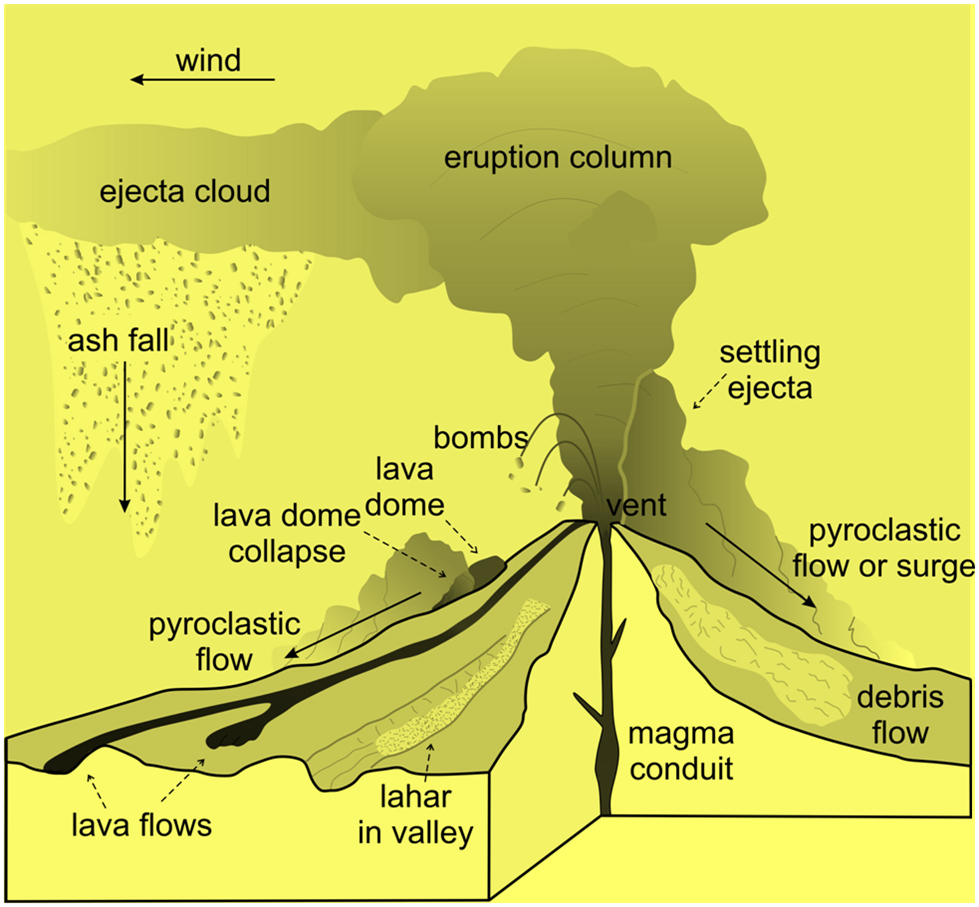
Source: Fotis Edu — Products of volcanic eruptions - FOTIS EDU · fotisedu.com
Question Context
This 2024 UPSC question tested whether students know that volcanoes produce both physical materials AND chemical compounds. Many students incorrectly assume volcanoes only eject solid materials like lava and ash, missing the significant gaseous emissions.
Trap: Thinking nitrogen compounds are not volcanic products — they are released when magma gases interact with atmospheric nitrogen
Trap: Assuming 'products' means only solid materials — volcanic gases are equally important products
Trap: Confusing pyroclastic debris with only large rocks — it includes ALL fragment sizes from bombs to fine ash
Volcanic Gas Emissions
Geography Nitrogen compounds Sulphur compounds
Volcanic Gas Emissions: Composition, Formation & Environmental Impact
Water vapour is the dominant volcanic gas (60-90% of total emissions)
SO₂ causes acid rain and temporary global cooling by creating aerosols
Nitrogen compounds form when hot magma interacts with atmospheric nitrogen
Major eruptions can inject gases into stratosphere affecting global climate
Major Volcanic Gases
Gas Type | Chemical Formula | % of Emissions | Environmental Impact |
|---|---|---|---|
Water vapour | H₂O | 60-90% | Contributes to atmospheric moisture |
Carbon dioxide | CO₂ | 10-40% | Greenhouse gas, can cause asphyxiation in valleys |
Sulphur dioxide | SO₂ | 1-5% | Forms acid rain, creates cooling aerosols |
Hydrogen sulphide | H₂S | <1% | Toxic gas with rotten egg smell |
Nitrogen oxides | NOₓ | <1% | Contribute to acid rain and smog |
Formation Mechanisms
Dissolved gases: CO₂, SO₂, and H₂O dissolve in magma under pressure — released when pressure drops during eruption
Atmospheric interaction: Nitrogen compounds form when hot volcanic materials react with atmospheric N₂
Crustal interaction: Some gases result from magma heating groundwater or interacting with crustal rocks
Climate & Environmental Effects
Acid rain: SO₂ and NOₓ combine with atmospheric water to form sulphuric and nitric acids
Global cooling: Major eruptions inject SO₂ into stratosphere, forming aerosols that reflect sunlight
Ozone depletion: Volcanic halogens (chlorine, fluorine compounds) can temporarily damage ozone layer
Trap: Forgetting that water vapour is the most abundant volcanic gas — not CO₂ or SO₂
Trap: Thinking volcanic CO₂ causes warming — major eruptions actually cause cooling due to aerosols
Trap: Assuming nitrogen compounds are not 'natural' volcanic products — they form during eruption process
Pyroclastic Materials
Geography Pyroclastic debris Ash and dust
Pyroclastic Materials: Size Classification & Formation Process
Pyroclastic = 'fire-broken' rock fragments ejected during explosive volcanic eruptions
Size classification: Bombs (>64mm), Lapilli (2-64mm), Ash (<2mm)
Volcanic ash can travel globally and disrupt aviation for weeks
Formation Process
Pyroclastic materials form when explosive volcanic eruptions fragment magma and surrounding rock. Gas expansion in magma creates violent ejection, breaking material into particles of various sizes based on explosion intensity and distance from vent.
Pyroclastic Size Classification
Material Type | Size Range | Formation | Travel Distance |
|---|---|---|---|
Volcanic Bombs | 64mm | Molten lava chunks that cool while airborne | Few kilometres |
Lapilli | 2-64mm | Solidified lava fragments, pumice pieces | 10-50 km |
Volcanic Ash | <2mm | Fine glass shards, rock powder | Global (1000s of km) |
Volcanic Dust | <0.1mm | Finest particles that stay airborne longest | Global circulation |
Pyroclastic Flow Formation
%%{init: {"flowchart": {"wrappingWidth": 460}}}%%
flowchart TD
  s1["`**Gas-rich magma rises**
Dissolved gases create pressure in magma chamber`"]
  s2["`**Explosive eruption**
Rapid gas expansion fragments magma and rock`"]
  s3["`**Material ejection**
Fragments launched at various velocities and angles`"]
  s4["`**Size sorting**
Heavier particles fall first, fine ash travels furthest`"]
  s1 --> s2
  s2 --> s3
  s3 --> s4
Hazards & Impacts
Aviation disruption: Volcanic ash damages jet engines — flights cancelled across continents (e.g., Eyjafjallajökull 2010)
Respiratory hazards: Fine silicate particles cause lung damage when inhaled
Agricultural impact: Ash fall can destroy crops but adds minerals to soil long-term
Infrastructure damage: Heavy ash accumulation collapses roofs and blocks drainage systems
Trap: Thinking pyroclastic debris is only large rocks — includes ALL fragment sizes down to fine dust
Trap: Confusing pyroclastic flows (ground-hugging) with ash clouds (atmospheric) — both contain pyroclastic material
Trap: Assuming ash and dust are different materials — dust is just the finest fraction of ash