Consider the following statements : Statement-I : The atmosphere is heated more by incoming solar radiation than by terrestrial radiation. Statement-II : Carbon dioxide and other greenhouse gases in the atmosphere are good absorbers of long wave radiation. Which one of the following is correct in respect of the above statements ?
Contents21
- ABoth Statement-I and Statement-II are correct and Statement-II explains Statement-I
- BBoth Statement-I and Statement-II are correct, but Statement-II does not explain Statement-I
- CStatement-I is correct, but Statement-II is incorrect
- DStatement-I is incorrect, but Statement-II is correct
Show answer
Answer: (D) Statement-I is incorrect, but Statement-II is correct
Correct Answer: (d) Statement-I is incorrect, Statement-II is correct.
Statement I: The atmosphere is heated MORE by solar radiation than by terrestrial radiation — ✗ WRONG.
It's actually the opposite.
The atmosphere is mostly transparent to incoming shortwave solar radiation (sunlight passes through without heating the air much).
The earth's surface absorbs this sunlight, gets heated, and then re-radiates energy as longwave (infrared) radiation.
This terrestrial radiation is what actually heats the atmosphere from below.
Statement II: CO₂ and greenhouse gases absorb longwave radiation — ✓ CORRECT.
This is exactly the greenhouse effect — these gases trap the earth's outgoing heat.
Easy way to remember:
Sun heats the ground → ground heats the air (not sun heats the air directly).
The atmosphere receives very little direct heating from incoming solar radiation because it is mostly transparent to shortwave radiation, but gets heated significantly by longwave terrestrial radiation from Earth's surface.
This fundamental heating mechanism drives the greenhouse effect - greenhouse gases like CO₂ absorb the longwave radiation emitted by Earth's surface, trapping heat in the atmosphere.
UPSC is testing whether students understand the difference between shortwave solar radiation (which passes through atmosphere) versus longwave terrestrial radiation (which heats the atmosphere).
Atmospheric Heating Mechanism
Geography atmosphere heated solar radiation terrestrial radiation
How the Atmosphere Gets Heated: Solar vs Terrestrial Radiation
The atmosphere is heated primarily by terrestrial radiation, not directly by solar radiation
Solar radiation is shortwave and passes through the atmosphere; terrestrial radiation is longwave and gets absorbed
Earth's surface absorbs solar energy first, then re-radiates it as heat that warms the atmosphere
This process is called indirect heating of the atmosphere
The Key Mechanism
The atmosphere works like a selective filter — it lets most solar radiation pass through but traps the heat that Earth radiates back. This creates the fundamental heating pattern that drives all weather and climate.
Step-by-Step Heating Process
%%{init: {"flowchart": {"wrappingWidth": 460}}}%%
flowchart TD
  s1["`**Solar radiation reaches Earth**
**Shortwave radiation** (0.3-3 μm wavelength) from the sun`"]
  s2["`**Atmosphere stays mostly transparent**
Only **19% absorbed** by atmosphere directly - mostly by water vapor and dust`"]
  s3["`**Earth's surface absorbs 51%**
Land and oceans heat up by absorbing solar energy`"]
  s4["`**Surface re-radiates as heat**
Earth emits **longwave radiation** (4-100 μm wavelength)`"]
  s5["`**Atmosphere absorbs terrestrial heat**
**CO₂, water vapor, other gases** absorb this longwave radiation efficiently`"]
  s1 --> s2
  s2 --> s3
  s3 --> s4
  s4 --> s5
Solar vs Terrestrial Radiation
Aspect | Solar Radiation | Terrestrial Radiation |
|---|---|---|
Wavelength | Shortwave (0.3-3 μm) | Longwave (4-100 μm) |
Source | Sun (6000°C surface) | Earth (15°C average) |
Atmospheric Transparency | Mostly transparent - passes through | Mostly absorbed by greenhouse gases |
Direct Heating Effect | Minimal - only 19% absorbed | Maximum - primary heating source |
Peak Wavelength | 0.5 μm (visible light) | 10 μm (infrared) |
Why This Matters for UPSC
Statement I trap: Students think 'solar radiation is stronger' means it heats atmosphere more - but strength ≠ absorption
This mechanism explains why Earth's surface is warmest, then air temperature decreases with altitude
Same principle behind greenhouse effect and global warming - more CO₂ means more longwave absorption
Trap: 'Solar radiation is stronger' does not mean it heats the atmosphere more - the atmosphere is transparent to most solar radiation
Confusion: Students mix up intensity (solar is stronger) with absorption (terrestrial is absorbed more)
Memory trick: Sun heats ground first, ground heats air second - not sun-to-air directly
Greenhouse Gases & Longwave Absorption
Geography Carbon dioxide greenhouse gases long wave radiation
Greenhouse Gases: Masters of Longwave Absorption
CO₂, CH₄, N₂O, water vapor are excellent absorbers of longwave (infrared) radiation
These gases are transparent to shortwave solar radiation but opaque to longwave terrestrial radiation
This selective absorption creates the greenhouse effect that warms Earth's surface
Without greenhouse gases, Earth's average temperature would be -18°C instead of +15°C
The Molecular Basis
Greenhouse gas molecules have vibrating bonds that resonate with specific infrared wavelengths. When longwave radiation hits these molecules, they absorb the energy, vibrate faster, and re-emit heat in all directions — including back toward Earth's surface.
Major Greenhouse Gases
Gas | Chemical Formula | Absorption Wavelength | Relative Effect | Atmospheric % |
|---|---|---|---|---|
Water Vapor | H₂O | 5-7 μm, 12-30 μm | Strongest overall | 0.1-4% (variable) |
Carbon Dioxide | CO₂ | 13-17 μm | Most important anthropogenic | 0.04% (415 ppm) |
Methane | CH₄ | 7-8 μm, 12 μm | 25x stronger than CO₂ | 0.00018% (1.9 ppm) |
Nitrous Oxide | N₂O | 4.5 μm, 7.8 μm | 300x stronger than CO₂ | 0.00003% (0.33 ppm) |
Greenhouse Effect Components
# Greenhouse Effect
## Natural Greenhouse Gases
- Water Vapor (H₂O)
- Carbon Dioxide (CO₂)
- Methane (CH₄)
- Ozone (O₃)
## Anthropogenic Sources
- Fossil Fuel Burning
- Deforestation
- Agriculture
- Industrial Processes
## Absorption Windows
- 8-12 μm (Atmospheric Window)
- 13-17 μm (CO₂ Band)
- 5-7 μm (H₂O Band)
## Climate Impact
- Surface Warming
- Positive Feedback
- Radiative Forcing
- Temperature Rise
Absorption Spectrum
Source: eoPortal — Earth Radiation Budget - eoPortal · www.eoportal.org
Correct fact: Greenhouse gases absorb longwave radiation excellently - Statement II is always correct in UPSC questions
Don't confuse: 'Good absorbers' means they trap heat efficiently, not that they're harmful - this is basic physics
Wavelength matters: CO₂ absorbs at 13-17 μm (longwave/infrared), not visible light wavelengths
Earth's Heat Budget & Energy Balance
Geography
Earth's Heat Budget: Complete Energy Balance
Earth receives 342 W/m² of solar energy on average; 30% is reflected back (albedo)
Of the absorbed 70%: surface gets 51%, atmosphere gets 19%
Earth must radiate the same amount back to space to maintain energy balance
Latent heat and sensible heat transfer energy from surface to atmosphere
The Global Energy Balance
Earth's climate system works like a giant energy accounting system — incoming solar energy must equal outgoing terrestrial energy over time. Any imbalance changes global temperature until equilibrium is restored.
Energy Flow Through the System
%%{init: {"flowchart": {"wrappingWidth": 460}}}%%
flowchart TD
  s1["`**Solar Input: 100 units**
Total solar radiation reaching Earth's atmosphere`"]
  s2["`**Reflection: 30 units**
**Albedo** - reflected by clouds, ice, surface back to space`"]
  s3["`**Absorption: 70 units**
Split between atmosphere (19 units) and surface (51 units)`"]
  s4["`**Surface Heating**
Land and oceans warm up from absorbed solar energy`"]
  s5["`**Heat Transfer to Atmosphere**
Via **radiation (21 units)**, **evaporation (23 units)**, **conduction (7 units)**`"]
  s6["`**Atmospheric Radiation**
Atmosphere radiates **64 units** back to surface, **57 units** to space`"]
  s1 --> s2
  s2 --> s3
  s3 --> s4
  s4 --> s5
  s5 --> s6
Heat Transfer Mechanisms
Process | Direction | Energy Amount | Key Factors |
|---|---|---|---|
Radiation | Surface → Atmosphere | 21 units | Longwave infrared, greenhouse gas absorption |
Latent Heat | Surface → Atmosphere | 23 units | Evaporation of water, condensation releases heat |
Sensible Heat | Surface → Atmosphere | 7 units | Direct conduction and convection |
Back Radiation | Atmosphere → Surface | 64 units | Greenhouse effect - atmosphere radiates downward |
Global Heat Budget Diagram
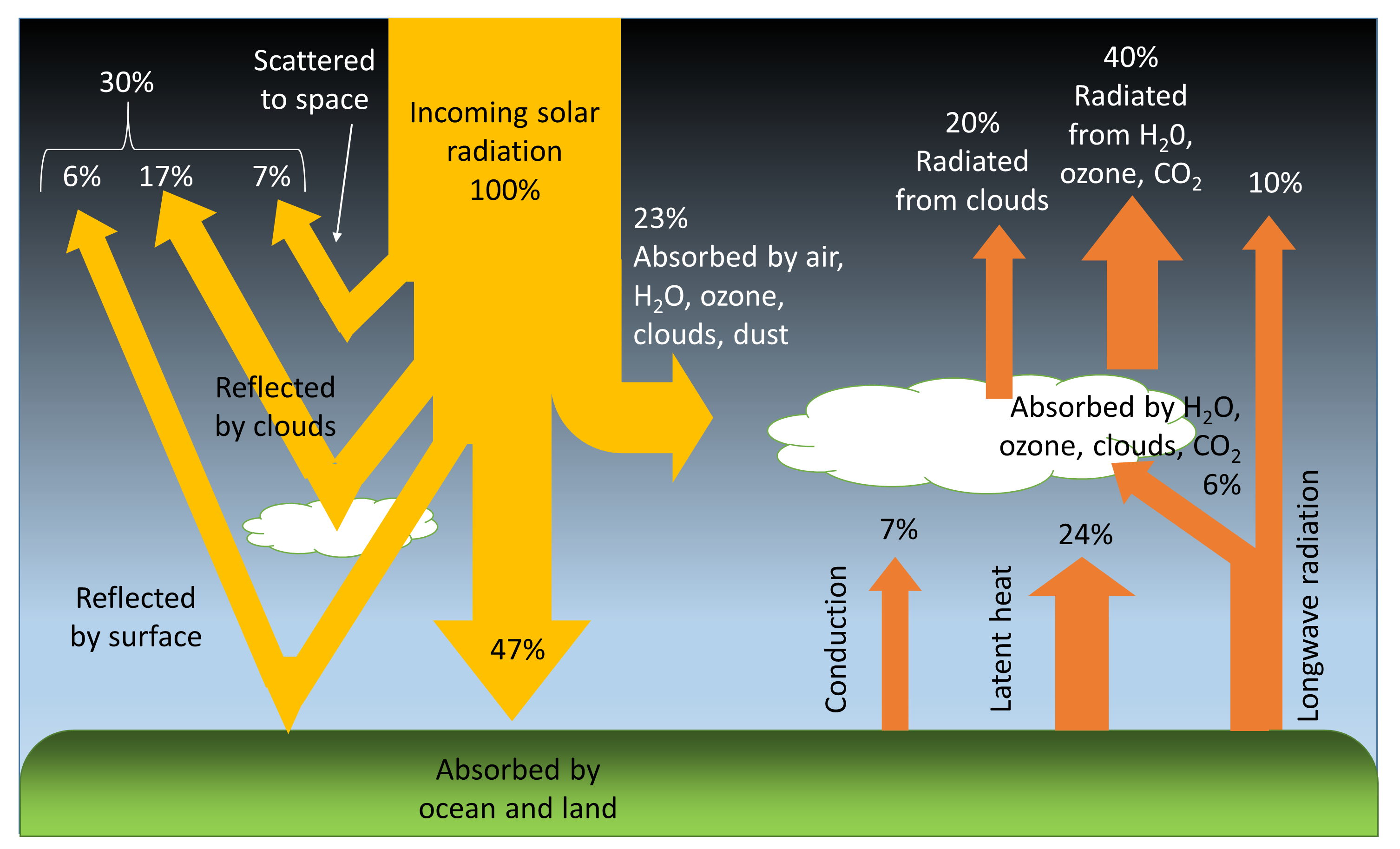
Source: Roger Williams University Open Publishing — 8.1 Earth's Heat Budget – Introduction to Oceanography · rwu.pressbooks.pub
UPSC Applications
Heat budget explains monsoons: Differential heating of land vs ocean drives seasonal wind patterns
Climate change link: Increased greenhouse gases trap more outgoing radiation, creating energy imbalance
Altitude temperature: Surface heating explains why temperature decreases with height in troposphere
Shortwave vs Longwave Radiation
Geography shortwave longwave solar radiation terrestrial radiation
Radiation Types: Understanding Shortwave vs Longwave
Shortwave: 0.3-3 μm wavelength; Longwave: 4-100 μm wavelength
Hot objects emit shorter wavelengths; cool objects emit longer wavelengths (Wien's Law)
Sun (6000°C) emits shortwave; Earth (15°C) emits longwave
Atmospheric gases have different absorption for different wavelengths
Physics Behind Wavelength
Wien's Displacement Law explains why hot objects glow different colors: as temperature increases, peak wavelength gets shorter. The Sun's 6000°C surface emits peak energy in visible light (0.5 μm), while Earth's 15°C surface peaks in infrared (10 μm).
Radiation Characteristics Comparison
Property | Shortwave (Solar) | Longwave (Terrestrial) |
|---|---|---|
Wavelength Range | 0.3-3 μm | 4-100 μm |
Peak Wavelength | 0.5 μm (green light) | 10 μm (infrared) |
Source Temperature | 6000°C (Sun's surface) | 15°C (Earth's average) |
Visible to Humans | Yes - visible light spectrum | No - infrared heat |
Atmospheric Transparency | High - passes through easily | Low - absorbed by greenhouse gases |
Energy per Photon | Higher energy | Lower energy |
Electromagnetic Spectrum Context
# Electromagnetic Spectrum
## Shortwave (Solar)
- UV (0.1-0.4 μm)
- Visible (0.4-0.7 μm)
- Near-IR (0.7-3 μm)
## Longwave (Terrestrial)
- Thermal IR (4-15 μm)
- Far IR (15-100 μm)
- Microwave (>100 μm)
## Atmospheric Windows
- Visible Window (0.3-0.7 μm)
- IR Window (8-12 μm)
- Radio Window (1cm-10m)
## Absorption Bands
- H₂O bands (5-7, 12-30 μm)
- CO₂ band (13-17 μm)
- O₃ band (9-10 μm)
Wavelength Spectrum

Source: UH Pressbooks — Chapter 2: Solar and Infrared Radiation – Atmospheric Processes ... · pressbooks-dev.oer.hawaii.edu
Wien's Law application: Hotter source = shorter wavelength. Sun (hot) = shortwave, Earth (cool) = longwave
Don't confuse intensity with absorption: Solar radiation is more intense but atmosphere absorbs terrestrial radiation better
Wavelength boundaries: Shortwave ends at 3 μm, longwave starts at 4 μm - there's a gap between them