Consider the following statements: 1. High clouds primarily reflect solar radiation and cool the surface of the Earth. 2. Low clouds have a high absorption of infrared radiation emanating from the Earth's surface and thus cause warming effect. Which of the statements given above is/are correct?
Contents13
- A1 only
- B2 only
- CBoth 1 and 2
- DNeither 1 nor 2
Show answer
Answer: (D) Neither 1 nor 2
The answer is (D) Neither statement is correct. Both are REVERSED!
Statement 1 is WRONG (it's backwards!):
HIGH clouds do NOT primarily reflect solar radiation.
It's actually LOW, THICK clouds that reflect sunlight and cool the Earth.
High, thin clouds let most sunlight pass through.
Statement 2 is WRONG (also backwards!):
LOW clouds do NOT cause warming.
It's HIGH, THIN clouds that trap outgoing infrared radiation (heat from Earth) and radiate it back down, causing a warming effect.
Correct understanding:
- LOW, THICK clouds → Reflect sunlight back to space → COOLING effect
- HIGH, THIN clouds → Let sunlight in but trap Earth's heat → WARMING effect
Think of it this way:
- Low clouds act like a MIRROR (reflecting sun = cooling)
- High clouds act like a BLANKET (trapping heat = warming)
This is a classic reversal question — both statements swap the roles of high and low clouds.
Cloud feedback mechanisms are critical for understanding climate change impacts, as they determine whether clouds amplify or reduce global warming.
UPSC is testing whether students can distinguish between the radiative effects of different cloud types - a key concept in climate science that students often confuse by mixing up which clouds cool versus warm the Earth.
High Clouds and Radiative Effects
Geography High clouds infrared radiation
High Clouds: Warming Effect Through Heat Trapping
High clouds (cirrus) trap outgoing infrared radiation and cause warming
High clouds are thin and allow most solar radiation to pass through
Act like a blanket - let sunlight in but trap Earth's heat
Mechanism
High clouds are typically thin, wispy cirrus clouds found at altitudes above 6 km. They have a dual radiative effect but the warming dominates:
• Allow most incoming solar radiation to pass through (weak reflection)
• Strongly absorb outgoing infrared radiation from Earth's surface
• Re-radiate this heat back towards Earth
High Cloud Heat Trapping Process
%%{init: {"flowchart": {"wrappingWidth": 460}}}%%
flowchart TD
  s1["`**Solar radiation passes through**
Thin high clouds reflect only 10-20% of sunlight`"]
  s2["`**Earth absorbs sunlight and heats up**
Surface warms and emits infrared radiation`"]
  s3["`**High clouds absorb Earth's heat**
Clouds capture outgoing infrared radiation`"]
  s4["`**Heat radiated back to Earth**
Net warming effect on surface`"]
  s1 --> s2
  s2 --> s3
s3 --> s4UPSC Reversal Trap: Statement 1 claims high clouds reflect solar radiation - this is the job of low clouds
Memory Aid: High clouds = Heat trapping, Low clouds = Light reflecting
Common Error: Thinking all clouds cool the Earth - high clouds actually warm it
Low Clouds and Cooling Effects
Geography Low clouds solar radiation cooling
Low Clouds: Cooling Effect Through Solar Reflection
Low clouds reflect solar radiation and cause cooling
Low clouds are thick and have high albedo (reflectivity)
Act like a mirror - reflect sunlight back to space
Mechanism
Low clouds include thick cumulus and stratus clouds below 2 km altitude. They are optically thick with high water content:
• High albedo - reflect 60-90% of incoming solar radiation
• Prevent sunlight from reaching Earth's surface
• Create cooling effect by reducing surface heating
Low vs High Cloud Properties
Property | Low Clouds | High Clouds |
|---|---|---|
Altitude | Below 2 km | Above 6 km |
Thickness | Thick, dense | Thin, wispy |
Solar reflection | 60-90% (high albedo) | 10-20% (low albedo) |
Heat trapping | Weak | Strong |
Net effect | Cooling | Warming |
Examples | Cumulus, Stratus | Cirrus |
UPSC Reversal Trap: Statement 2 claims low clouds cause warming through infrared absorption - this is high clouds
Altitude Confusion: Low = thick = cooling, High = thin = warming
Process Mix-up: Low clouds reflect sunlight (cooling), high clouds trap heat (warming)
Cloud Radiative Forcing Mechanisms
Geography absorption infrared radiation warming effect
Cloud Radiative Forcing: Competing Cooling vs Warming Effects
Clouds have dual radiative effects - reflection (cooling) and heat trapping (warming)
Net effect depends on cloud altitude, thickness, and optical properties
Shortwave radiation = solar, Longwave radiation = infrared heat
Dual Cloud Effects
# Cloud Radiative Effects
## Cooling Effect
- Reflect shortwave solar radiation
- High albedo
- Reduce surface heating
- Dominant in thick low clouds
## Warming Effect
- Absorb longwave infrared
- Re-radiate heat downward
- Greenhouse effect
- Dominant in thin high clouds
Net Climate Impact
The net radiative forcing depends on which effect dominates:
• Thick, low clouds: Cooling dominates (strong reflection > weak heat trapping)
• Thin, high clouds: Warming dominates (strong heat trapping > weak reflection)
• Overall global effect: Clouds provide slight net cooling (~-20 W/m²)
Radiative Process Diagram
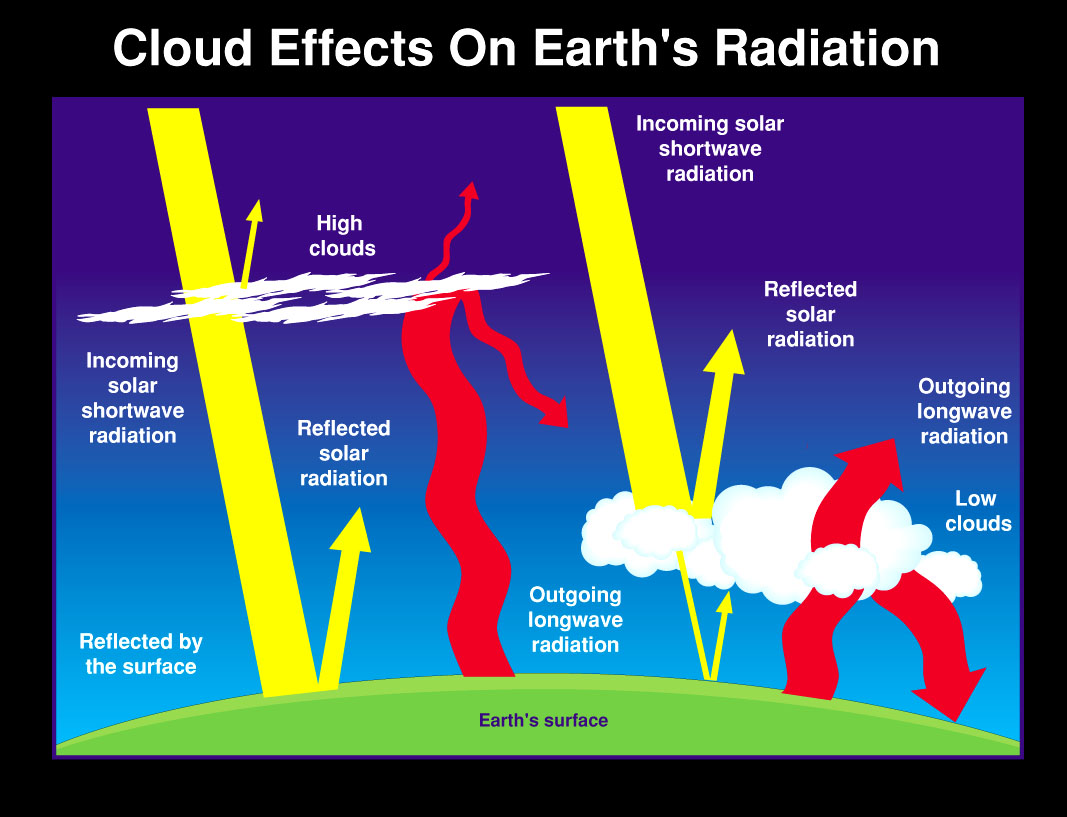
Source: Climate4you — climate4you ClimateAndClouds · www.climate4you.com
UPSC Cloud Question Patterns
Geography statements correct
UPSC Cloud Questions: Reversal Traps & Answer Strategy
UPSC reverses cloud effects - high/low cloud properties are commonly swapped
Memory technique: Low = Light reflecting, High = Heat trapping
Always check if statements contradict basic cloud physics
Question Analysis Strategy
Read carefully: Look for altitude indicators - 'high clouds' vs 'low clouds'
Check processes: Solar reflection vs infrared absorption - which cloud type does what?
Verify effects: Cooling vs warming - does the statement match the physics?
Reversal alert: Both statements wrong often means they've swapped properties
Elimination method: If one statement clearly wrong, check if both are reversed
Common UPSC Reversals
What UPSC Claims (Wrong) | Reality (Correct) | Trap Type |
|---|---|---|
High clouds reflect solar radiation | Low clouds reflect solar radiation | Altitude reversal |
Low clouds cause warming via IR absorption | High clouds cause warming via IR absorption | Process reversal |
All clouds cool the Earth | High clouds warm, low clouds cool | Oversimplification |
Cloud effects are uniform | Effects depend on altitude and thickness | Generalization trap |
Classic Reversal: This 2022 question swaps ALL cloud properties - both statements are backwards
'Neither' Pattern: When both statements reverse basic physics, answer is often (D) Neither
Altitude Keywords: 'High' and 'low' are critical - one word changes the entire answer
Process Confusion: Don't mix up solar reflection (visible light) with infrared absorption (heat)