Mediterranean Sea is a border of which of the following countries? 1. Jordan 2. Iraq 3. Lebanon 4. Syria Select the correct answer using the code given below:
Contents13
- A1, 2 and 3
- B2 and 3 only
- C3 and 4 only
- D1, 3 and 4 only
Show answer
Answer: (C) 3 and 4 only
The countries with coastlines on the Mediterranean Sea include:
- Turkey
- Syria
- Lebanon
- Israel
- Egypt
- Libya
- Tunisia
- Algeria
- Morocco
- Spain
- France
- Italy
- Greece
- Croatia
- and several others.
On the eastern shore specifically, Turkey, Syria, Lebanon, and Israel have their coastlines on the Mediterranean.
The trap in this question is that all four countries listed (Jordan, Iraq, Lebanon, Syria) are in West Asia, so students might assume all of them border the Mediterranean.
However, Jordan is a landlocked country with access only to a small stretch of the Red Sea (Gulf of Aqaba), and Iraq's coastline is on the Persian Gulf, not the Mediterranean.
Therefore, only Lebanon (3) and Syria (4) have Mediterranean coastlines, making option (c) correct.
This question tests careful map reading of the West Asia region.
Jordan is landlocked except for a tiny Red Sea coastline, while Iraq only touches the Persian Gulf - neither reaches the Mediterranean despite being in the same West Asian region as Syria and Lebanon.
UPSC uses regional geography to test precise map knowledge - students often assume neighboring countries in the same region share similar geographic features like sea access.
Mediterranean Sea Geography & Bordering Countries
Geography Mediterranean Sea
Mediterranean Sea: Location, Bordering Countries & UPSC Traps
Mediterranean Sea borders 21 countries across Europe, Africa, and West Asia
Lebanon and Syria are the only West Asian countries from the options that border the Mediterranean
Jordan is landlocked (except small Red Sea access), Iraq borders Persian Gulf only
Eastern Mediterranean shore includes Turkey, Syria, Lebanon, Israel
What & Where
The Mediterranean Sea is a semi-enclosed sea connected to the Atlantic Ocean, surrounded by Europe to the north, Africa to the south, and Asia to the east. It serves as a crucial geographical boundary between three continents and has 21 countries with direct coastlines.
Mediterranean Bordering Countries by Region
Region | Countries | Key Details |
|---|---|---|
Europe (North) | Spain, France, Italy, Greece, Croatia, Slovenia, Montenegro, Albania, Malta, Cyprus | Longest coastlines, major islands |
Africa (South) | Morocco, Algeria, Tunisia, Libya, Egypt | North African coast, Suez Canal connection |
West Asia (East) | Turkey, Syria, Lebanon, Israel | Eastern shore, Levantine coast |
Islands | Cyprus, Malta | Island nations entirely within Mediterranean |
Question Analysis
This question specifically tests the eastern Mediterranean coastline in West Asia. Among the four countries listed - Jordan, Iraq, Lebanon, Syria - only Lebanon and Syria have Mediterranean borders. The trap lies in assuming all West Asian countries in the region have Mediterranean access.
Mediterranean Coastline
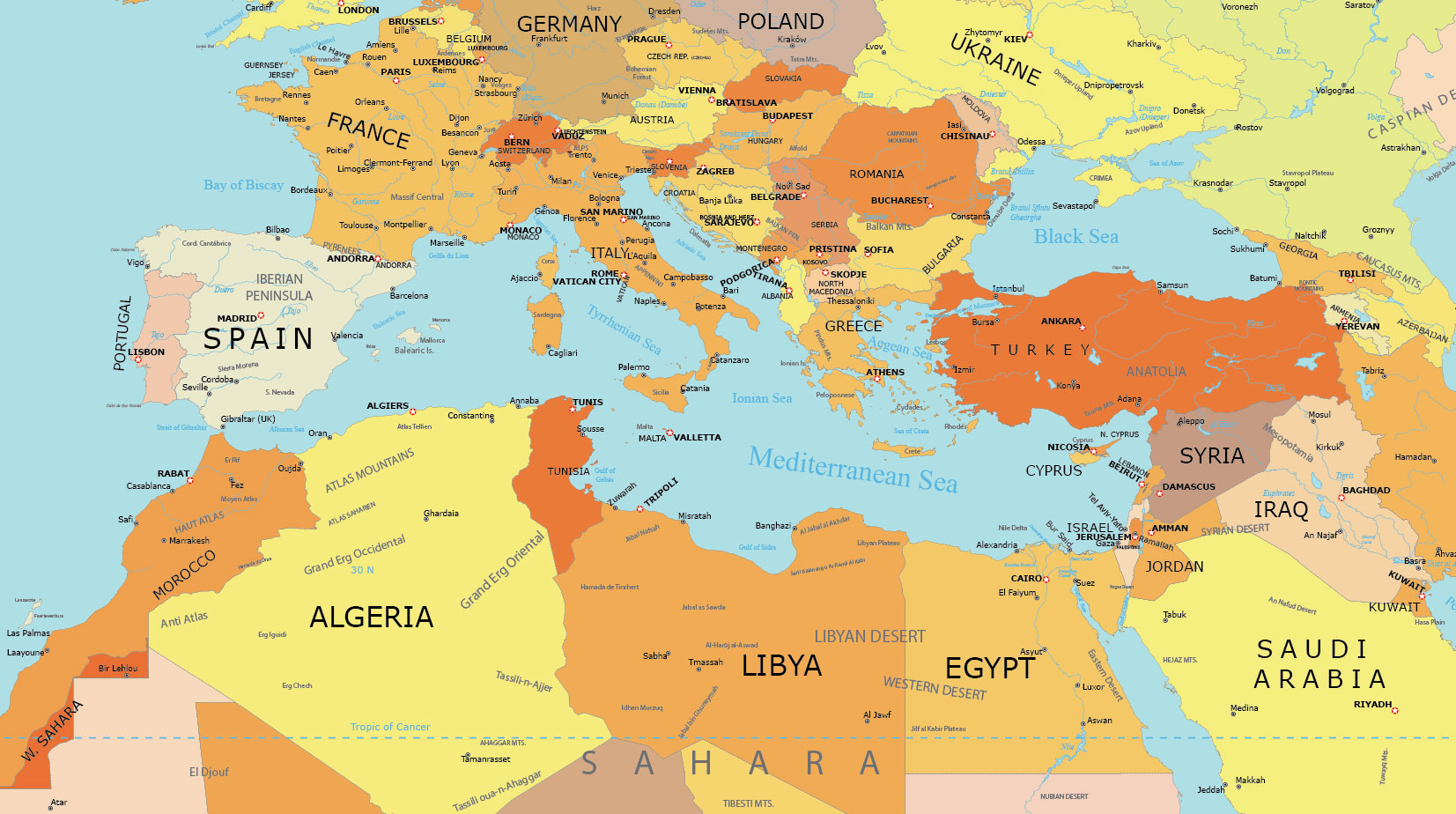
Source: GIS Geography — Map of the Mediterranean Sea - GIS Geography · gisgeography.com
Trap: Assuming all West Asian countries border Mediterranean - Jordan is landlocked, Iraq borders Persian Gulf
Trap: Confusing Red Sea access (Jordan has tiny coastline) with Mediterranean Sea access
Trap: Mixing up Persian Gulf countries (Iraq, Kuwait, UAE) with Mediterranean countries
Trap: Forgetting that Turkey has both Mediterranean and Black Sea coastlines
West Asian Countries & Their Coastlines
Geography Jordan Iraq Lebanon Syria
West Asian Countries: Coastline Access & Water Bodies
Jordan: Landlocked except 22 km Red Sea coastline at Gulf of Aqaba
Iraq: 58 km Persian Gulf coastline, no Mediterranean access
Lebanon: 210 km Mediterranean coastline, major ports Beirut & Tripoli
Syria: 180 km Mediterranean coastline, ports Latakia & Tartus
Coastline Comparison
Country | Water Body | Coastline Length | Major Ports | Access Type |
|---|---|---|---|---|
Jordan | Red Sea (Gulf of Aqaba) | 22 km | Aqaba | Limited coastal access |
Iraq | Persian Gulf | 58 km | Basra, Umm Qasr | Persian Gulf only |
Lebanon | Mediterranean Sea | 210 km | Beirut, Tripoli | Full Mediterranean access |
Syria | Mediterranean Sea | 180 km | Latakia, Tartus | Full Mediterranean access |
West Asia Water Access
# West Asian Countries
## Mediterranean Access
- Turkey
- Syria
- Lebanon
- Israel
## Persian Gulf Access
- Iraq
- Kuwait
- Saudi Arabia
- UAE
- Iran
## Red Sea Access
- Jordan (tiny)
- Saudi Arabia
- Yemen
## Landlocked
- Afghanistan
- Armenia
- Azerbaijan
West Asia Coastlines
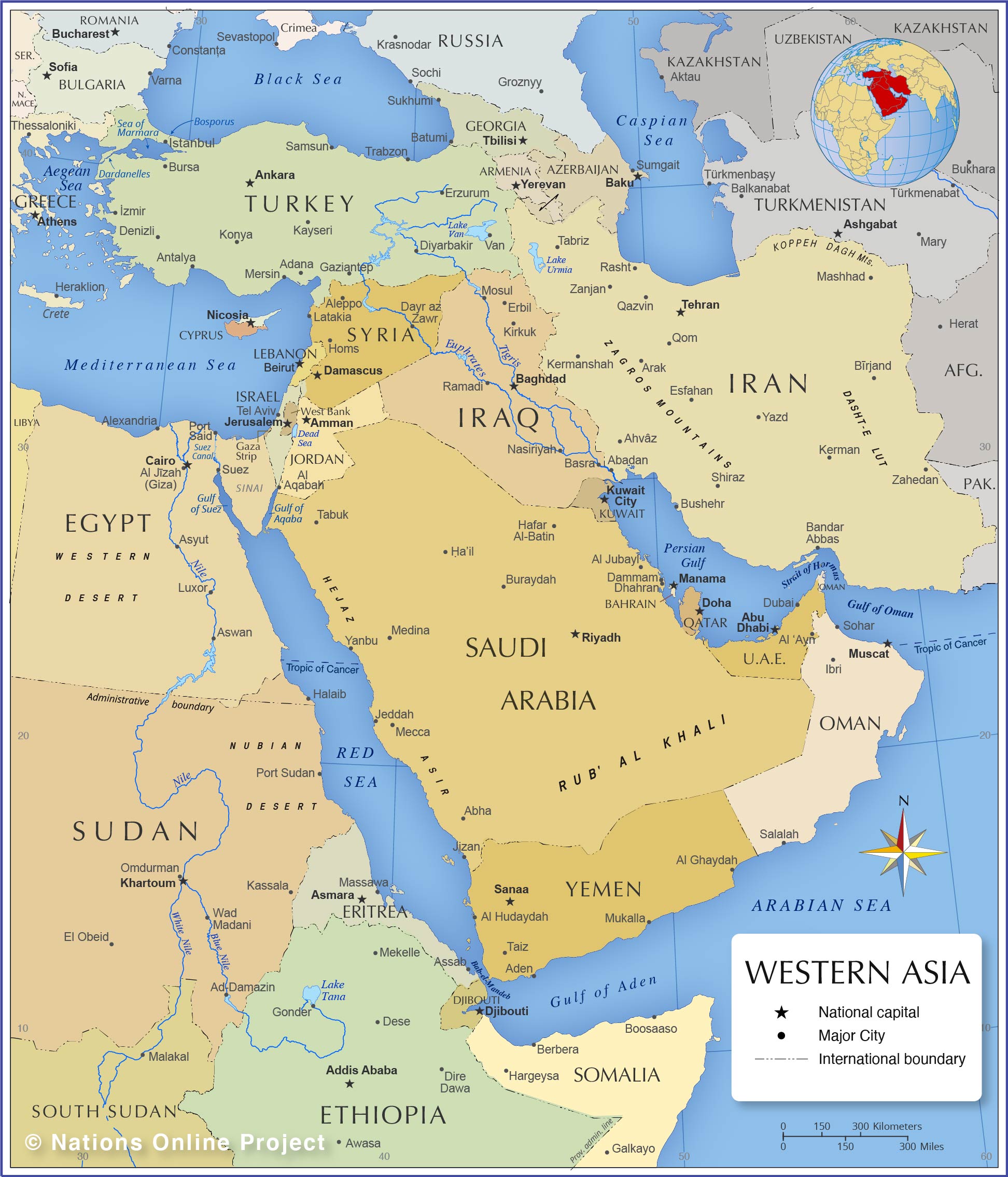
Source: Nationsonline.org — Map of Countries in Western Asia and the Middle East ... · www.nationsonline.org
Trap: Jordan appears to be landlocked on small maps - it has 22 km Red Sea access only
Trap: Iraq's Shatt al-Arab waterway leads to Persian Gulf, not Mediterranean
Trap: Don't confuse Levantine countries (Syria, Lebanon) with Arabian Peninsula countries
Trap: Turkey spans both Mediterranean and Black Sea - unique dual access in West Asia
Landlocked Countries & Limited Coastal Access
Geography
Landlocked Countries: Definition, Examples & UPSC Applications
Landlocked means completely surrounded by land with no direct sea access
Jordan exemplifies limited coastal access - 22 km on Red Sea only
Countries with very small coastlines are effectively landlocked for trade purposes
Definition & Significance
A landlocked country has no direct access to ocean coastlines and is completely surrounded by other countries. Some countries like Jordan have minimal coastal access that doesn't provide significant maritime advantages for trade or strategic purposes.
Regional Landlocked Examples
Region | Major Landlocked Countries | Coastal Access |
|---|---|---|
West Asia | Afghanistan, Armenia | None |
South Asia | Nepal, Bhutan | None |
Central Asia | Kazakhstan, Uzbekistan | Caspian Sea (landlocked) |
Africa | Chad, Central African Republic | None |
Europe | Switzerland, Austria | None |
UPSC Geography Applications
Trade implications: Landlocked countries depend on neighbors for sea access and trade routes
Strategic vulnerability: Limited access to maritime resources and naval power projection
Economic challenges: Higher transportation costs for imports/exports through other countries
Definitional precision: UPSC tests whether countries have any vs significant coastal access
Trap: Kazakhstan has Caspian Sea access but is still considered landlocked (Caspian is landlocked)
Trap: Jordan's tiny Red Sea coast doesn't make it a 'coastal country' in practical terms
Trap: Don't assume island nations like Sri Lanka are landlocked - they're entirely coastal
Trap: Russia appears landlocked on some maps but has extensive Arctic and Pacific coastlines