With reference to solar power production in India, consider the following statements: 1. India is the third largest in the world in the manufacture of silicon wafers used in photovoltaic units. 2. The solar power tariffs are determined by the Solar Energy Corporation of India. Which of the statements given above is/are correct?
Contents24
- A1 only
- B2 only
- CBoth 1 and 2
- DNeither 1 nor 2
Show answer
Answer: (D) Neither 1 nor 2
Correct Answer: (d) Neither 1 nor 2
Both statements are wrong:
Statement 1 is WRONG: India is NOT the third largest manufacturer of silicon wafers for solar panels.
The solar panel manufacturing process goes:
- Polysilicon
- Ingots
- Wafers
- Cells
- Modules (panels).
India mainly manufactures only cells and modules (the final stages).
India does NOT produce polysilicon, ingots, or wafers — these are mostly made in China, USA, and South Korea.
So India is far from being a top manufacturer of the complete supply chain.
Statement 2 is WRONG: Solar power tariffs in India are NOT determined by the Solar Energy Corporation of India (SECI).
SECI is a government body that facilitates solar projects and conducts auctions, but it does not set tariffs.
Solar tariffs are determined either through regulations of the Central Electricity Regulatory Commission (CERC) or State Electricity Regulatory Commissions (SERCs), or through competitive bidding (auctions) where companies bid the lowest price.
SECI conducts these auctions but does not decide the tariff itself.
REMEMBER: India only makes solar cells and modules (not wafers or polysilicon).
Solar tariffs are set by CERC/SERCs or through competitive bidding — NOT by SECI.
SECI facilitates auctions but doesn't determine tariffs.
India's solar capacity expanded rapidly in the mid-2010s through competitive bidding, making solar manufacturing and tariff determination mechanisms important exam topics.
India imports most raw materials for solar panels (polysilicon, wafers) from China while only assembling the final products domestically, creating a trade dependency that became strategically significant.
UPSC is testing whether students can distinguish between different roles in solar policy - SECI facilitates auctions but regulatory commissions actually determine tariffs.
Solar Panel Manufacturing Supply Chain
Indian Economy silicon wafers photovoltaic units manufacture
Solar Panel Manufacturing: 5-Stage Supply Chain & India's Position
Quick Revision
India only manufactures cells and modules (final 2 stages) — NOT silicon wafers
China, USA, South Korea dominate polysilicon, ingots, and wafer production
Solar manufacturing has 5 sequential stages: Polysilicon → Ingots → Wafers → Cells → Modules
Why Statement 1 Failed
Statement 1 claimed India is the third largest manufacturer of silicon wafers. This is wrong because India focuses only on the final assembly stages of solar panel production, not the upstream silicon processing that creates wafers.
5-Stage Solar Manufacturing Process
Stage | Process | Major Producers | India's Role |
|---|---|---|---|
1. Polysilicon | Purified silicon from quartz | China (80%+), USA | No production |
2. Ingots | Crystallized silicon blocks | China, South Korea | No production |
3. Wafers | Thin silicon slices from ingots | China, South Korea, USA | No production |
4. Cells | Photovoltaic cells from wafers | China, India, Southeast Asia | Major production |
5. Modules | Final solar panels assembly | China, India, Europe | Major production |
Solar Supply Chain Visual
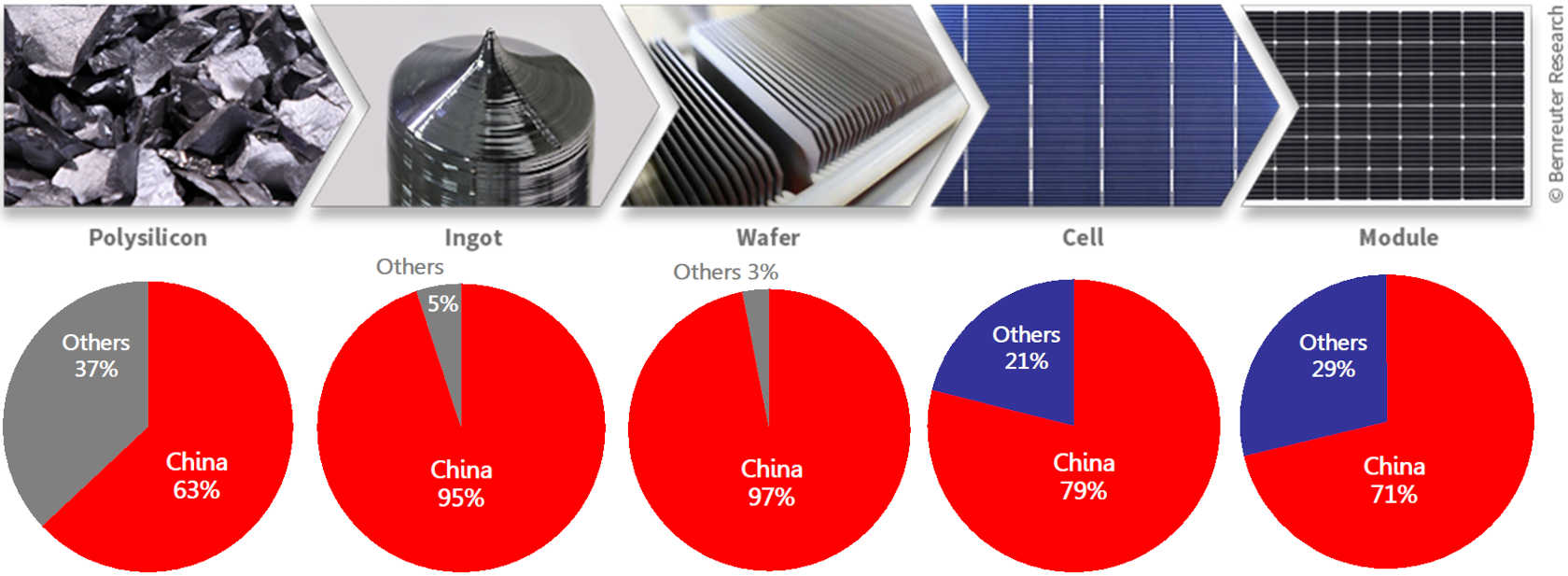
Source: Bernreuter Research — Solar Value Chain – Panel Supply Steps | Bernreuter Research · www.bernreuter.com
India's Solar Manufacturing Reality
India imports 90%+ of solar cells and nearly 100% of polysilicon/wafers from China
Make in India solar push focuses on cells and modules assembly — not upstream silicon processing
PLI scheme for solar manufacturing targets cell and module capacity expansion
China controls 80%+ of global polysilicon production — creating supply chain dependence
Trap: Confusing India's solar capacity (top 5 globally) with manufacturing capability (limited to final stages)
Trap: Assuming solar installation success means strong manufacturing across all supply chain stages
Trap: Missing that silicon wafers are upstream products India doesn't make — only cells/modules
Solar Energy Corporation of India (SECI)
Indian Economy Solar Energy Corporation of India solar power tariffs
SECI: Role, Functions & What It Does NOT Do (Tariff Setting)
Quick Revision
SECI facilitates solar projects and conducts auctions — does NOT set tariffs
Solar tariffs are set by CERC/SERCs or through competitive bidding
SECI is a PSU under MNRE established in 2011
Why Statement 2 Failed
Statement 2 wrongly claimed SECI determines solar power tariffs. SECI facilitates solar development but has no regulatory authority to set electricity tariffs — that power belongs to electricity regulatory commissions.
SECI vs Tariff Setting Bodies
Entity | Role in Solar Tariffs | Authority Type | Key Function |
|---|---|---|---|
SECI | Conducts auctions, facilitates projects | Implementation body | Project developer, auction facilitator |
CERC | Sets tariffs for central projects | Regulatory authority | Tariff determination, regulations |
SERCs | Set tariffs for state projects | Regulatory authority | State-level tariff setting |
Competitive Bidding | Market-determined lowest prices | Market mechanism | Price discovery through auctions |
SECI's Actual Functions
Project facilitation: Develops large-scale solar projects across India
Auction conductor: Organizes competitive bidding for solar capacity allocation
Land aggregation: Helps acquire and develop solar parks and transmission infrastructure
International cooperation: Implements solar projects under International Solar Alliance (ISA)
Grid integration: Coordinates with transmission utilities for solar power evacuation
How Solar Tariffs Are Actually Determined
%%{init: {"flowchart": {"wrappingWidth": 460}}}%%
flowchart TD
  s1["`**Project Planning**
SECI/states identify solar capacity requirements`"]
  s2["`**Auction Process**
SECI conducts competitive bidding - companies quote lowest tariff`"]
  s3["`**Price Discovery**
Lowest bidder wins - market determines tariff through competition`"]
  s4["`**Regulatory Approval**
CERC/SERCs approve the discovered tariff as per regulations`"]
  s5["`**PPA Signing**
Power Purchase Agreement signed at the bid-discovered tariff`"]
  s1 --> s2
  s2 --> s3
  s3 --> s4
s4 --> s5Trap: Confusing SECI's auction facilitation role with actual tariff determination authority
Trap: Missing that competitive bidding (not SECI) determines most solar tariffs in India
Trap: Assuming implementation bodies like SECI have regulatory powers like CERC/SERCs
Electricity Regulatory Commissions
Indian Economy
CERC & SERCs: India's Electricity Tariff Regulatory Framework
Quick Revision
CERC regulates central/inter-state electricity projects and tariffs
SERCs regulate state-level electricity distribution and retail tariffs
Both established under Electricity Act 2003 as independent regulators
Regulatory Authority Framework
India's electricity sector operates under a two-tier regulatory structure established by the Electricity Act 2003. CERC handles central and inter-state matters, while SERCs manage intra-state electricity regulation including retail tariff determination.
CERC vs SERC Jurisdiction
Aspect | CERC (Central) | SERC (State) | Solar Context |
|---|---|---|---|
Jurisdiction | Inter-state, central projects | Intra-state projects | Large solar parks vs rooftop solar |
Tariff Setting | Wholesale/bulk power tariffs | Retail/distribution tariffs | Grid-scale solar vs distributed solar |
Project Size | Usually >50 MW | Usually <50 MW | Utility-scale vs small-scale solar |
Transmission | Inter-state transmission | State transmission/distribution | ISTS vs state grid connected |
Appeals | To APTEL | To APTEL | Tariff disputes resolution |
Regulatory Structure
# Electricity Regulation
## CERC
- Inter-state trading
- Central PSU tariffs
- Transmission pricing
- Market development
## SERCs
- Distribution tariffs
- Retail supply
- State utility regulation
- Consumer protection
## APTEL
- Appeals tribunal
- Dispute resolution
- Final authority
- Judicial review
Solar Tariff Determination Process
Feed-in Tariffs: CERC/SERCs set fixed rates for solar power procurement over 20-25 years
Competitive Bidding: Market-based tariff discovery through reverse auctions (now dominant method)
Net Metering: SERCs regulate rooftop solar tariffs and grid-tied compensation rates
Cross-subsidy: Regulators balance commercial tariffs with residential subsidies
Trap: Mixing up CERC (central/inter-state) with SERC (state/intra-state) jurisdictions
Trap: Confusing tariff determination (CERC/SERC authority) with auction facilitation (SECI function)
Trap: Missing that competitive bidding now determines most solar tariffs — not just regulatory fiat
Competitive Bidding in Renewable Energy
Indian Economy
Competitive Bidding: How Solar Tariffs Are Actually Determined in India
Quick Revision
Reverse auctions now determine most solar tariffs in India — not regulatory fiat
Solar tariffs have fallen from ₹17/unit (2010) to under ₹2/unit (2021)
Transparent price discovery through competitive bidding replaced cost-plus regulation
Market-Driven Tariff Revolution
India shifted from regulated tariffs (set by commissions) to competitive bidding for renewable energy procurement. This market-based approach has dramatically reduced solar costs and improved transparency in project allocation.
Competitive Bidding Process
%%{init: {"flowchart": {"wrappingWidth": 460}}}%%
flowchart TD
  s1["`**Tender Release**
SECI/states release bid documents with capacity, terms, and conditions`"]
  s2["`**Technical Qualification**
Companies submit technical and financial credentials for pre-qualification`"]
  s3["`**Price Bidding**
Qualified bidders submit tariff quotes in sealed bids (₹/kWh)`"]
  s4["`**L1 Selection**
Lowest tariff bidder (L1) wins capacity allocation`"]
  s5["`**PPA Execution**
25-year Power Purchase Agreement signed at discovered tariff`"]
  s1 --> s2
  s2 --> s3
  s3 --> s4
  s4 --> s5
Bidding vs Regulated Tariffs
Method | Price Setting | Transparency | Cost Trend | Current Use |
|---|---|---|---|---|
Competitive Bidding | Market-determined L1 tariff | High - open auction | Declining rapidly | Dominant method |
Regulated Tariffs | CERC/SERC determined rates | Medium - public process | Slow decline | Backup/small projects |
Feed-in Tariffs | Fixed rates for 20-25 years | Low - administrative | Static/higher | Phasing out |
Impact of Competitive Bidding
Record low tariffs: Solar bids reached ₹1.99/kWh in Rajasthan (2020) - world's cheapest
Transparent allocation: Merit-based selection replaced discretionary project awards
Technology improvement: Competition drove efficiency gains and cost optimization
Financial discipline: Market pricing eliminated cross-subsidization of inefficient projects
Trap: Assuming SECI sets tariffs when it only facilitates the competitive process
Trap: Missing that market competition (not regulation) now drives most renewable energy pricing
Trap: Confusing auction conductor (SECI) with tariff approver (CERC/SERC)