Consider the following statements: 1. National Payment Corporation of India (NPCI) helps in promoting the financial inclusion in the country. 2. NPCI has launched RuPay, a card payment scheme. Which of the statements given above is/are correct?
Contents17
- A1 only
- B2 only
- CBoth 1 and 2
- DNeither 1 nor 2
Show answer
Answer: (C) Both 1 and 2
Both statements are correct.
Statement 1 is correct:
The National Payments Corporation of India (NPCI) is an umbrella organisation for all retail payment systems in India.
It was set up with the guidance and support of the Reserve Bank of India (RBI) and the Indian Banks' Association (IBA).
One of NPCI's core objectives is to facilitate an affordable payment mechanism to benefit the common man across the country and help financial inclusion — by making digital payments accessible even to the unbanked and underbanked population.
Statement 2 is correct:
NPCI launched RuPay, India's own domestic card payment network, as an alternative to international card networks like Visa and Mastercard.
RuPay cards are significantly cheaper to process (lower transaction fees), which makes them ideal for financial inclusion, particularly under schemes like Jan Dhan Yojana where RuPay debit cards are issued to all account holders.
Besides RuPay, NPCI also operates other important products like:
- UPI (Unified Payments Interface)
- BHIM app
- IMPS (Immediate Payment Service)
- NACH (National Automated Clearing House)
- AePS (Aadhaar-enabled Payment System)
NPCI has been central to India's digital payment revolution.
So both statements 1 and 2 are correct.
NPCI operates India's entire digital payments infrastructure including UPI, RuPay cards, and IMPS, making it central to the country's cashless economy push.
The 2016 demonetization and Jan Dhan Yojana's focus on RuPay cards made NPCI's role in financial inclusion a key exam topic around 2017.
National Payments Corporation of India (NPCI)
Indian Economy National Payment Corporation of India NPCI
NPCI: India's Payment System Umbrella & Financial Inclusion Engine
NPCI is the umbrella organization for all retail payment systems in India
Set up with guidance from RBI and Indian Banks' Association (IBA)
Core objective: affordable payment mechanisms for financial inclusion
Operates RuPay, UPI, BHIM, IMPS, NACH, AePS
What is NPCI
NPCI is India's central organization that manages all retail digital payment systems. It was established to create an integrated, interoperable payment infrastructure that serves everyone — from urban tech users to rural unbanked populations.
Key NPCI Products
Product | Purpose | Key Feature | Financial Inclusion Impact |
|---|---|---|---|
RuPay | Domestic card payment network | Lower transaction fees than Visa/Mastercard | Used in Jan Dhan Yojana debit cards |
UPI | Instant money transfer | 24x7 real-time payments | Works on basic smartphones, no internet banking needed |
BHIM | UPI-based mobile app | Simple interface for digital payments | Supports 12 Indian languages |
IMPS | Immediate Payment Service | Instant interbank transfers | Works 24x7 unlike NEFT/RTGS |
AePS | Aadhaar-enabled Payment System | Biometric authentication | Banking services at micro-ATMs in villages |
NACH | National Automated Clearing House | Bulk transactions, recurring payments | Supports government subsidies and pension payments |
PYQ Connection
This 2017 question tested whether students knew NPCI's dual role: both as a financial inclusion enabler (Statement 1) and as RuPay's parent organization (Statement 2). The trap would be thinking NPCI is only a technical body, missing its social mandate.
Don't confuse: NPCI operates payment systems; RBI regulates them
RuPay vs UPI: RuPay is a card network; UPI is an instant transfer system
NPCI vs NPCIL: NPCI handles payments; NPCIL builds nuclear power plants
Financial inclusion angle: NPCI isn't just about efficiency — it's specifically designed for affordable access
RuPay Card Payment Scheme
Indian Economy RuPay
RuPay: India's Domestic Card Network for Financial Inclusion
RuPay is India's own domestic card payment network launched by NPCI
Lower transaction fees compared to international networks like Visa/Mastercard
Default card for Jan Dhan Yojana accounts — over 40 crore RuPay cards issued
Accepted at all ATMs and POS terminals in India, growing international acceptance
Why RuPay Matters
Before RuPay, India depended entirely on Visa and Mastercard for card payments. These international networks charged higher fees, making cards expensive for banks to issue to low-income customers. RuPay solved this by creating a cost-effective domestic alternative specifically designed for India's financial inclusion goals.
RuPay vs International Cards
Aspect | RuPay | Visa/Mastercard | Impact on Financial Inclusion |
|---|---|---|---|
Transaction Fees | Significantly lower | Higher international rates | Banks can afford to serve low-balance accounts |
Processing | Domestic infrastructure | International processing | Faster settlement, data stays in India |
Acceptance | All India ATMs/POS, limited international | Global acceptance | Sufficient for domestic financial inclusion |
Government Schemes | Default choice for Jan Dhan, MGNREGA | Not preferred for govt schemes | Enables mass card distribution |
Currency | INR-based processing | USD conversion involved | No foreign exchange risk for users |
RuPay's Financial Inclusion Impact
Jan Dhan Integration: Every Jan Dhan account gets a free RuPay debit card — this alone created the world's largest card issuance program
Rural Penetration: Lower costs enabled banks to set up micro-ATMs in villages using RuPay infrastructure
Digital India: RuPay became the backbone for UPI QR codes and BHIM app transactions
Government Payments: MGNREGA wages, LPG subsidies, and pension payments flow through RuPay cards
Data Sovereignty: All transaction data stays within India, supporting data localization goals
Ownership trap: RuPay is launched by NPCI, not directly by RBI or government
Scope confusion: RuPay is a card network, not a bank or payment app
International acceptance: RuPay works in some countries (Singapore, UAE, Bhutan) but coverage is limited compared to Visa/Mastercard
Technology mix: RuPay cards can be chip-and-PIN or contactless — it's not just one technology
Financial Inclusion Through Digital Payments
Indian Economy financial inclusion
Digital Payments as Financial Inclusion Strategy in India
Financial inclusion means providing affordable banking services to unbanked and underbanked populations
Digital payments reduce the cost of banking services, making them accessible to low-income groups
Jan Dhan-Aadhaar-Mobile (JAM) trinity forms the backbone of digital financial inclusion
India moved from 53% banked (2014) to 80%+ through digital payment infrastructure
The Financial Inclusion Challenge
Traditional banking required physical branches, paperwork, and minimum balances — barriers that excluded India's rural and low-income population. Digital payments solve this by enabling branchless banking through mobile phones, Aadhaar-based identity, and zero-balance accounts.
Digital Financial Inclusion Process
%%{init: {"flowchart": {"wrappingWidth": 460}}}%%
flowchart TD
  s1["`**Account Opening**
**Jan Dhan Yojana** provides zero-balance accounts with **Aadhaar** as identity proof`"]
  s2["`**Payment Infrastructure**
**NPCI** creates affordable payment systems (**RuPay**, **UPI**, **AePS**)`"]
  s3["`**Access Points**
**Micro-ATMs**, **Business Correspondents**, and **mobile apps** bring banking to villages`"]
  s4["`**Government Integration**
**DBT** (Direct Benefit Transfer) for subsidies creates **usage incentive**`"]
  s5["`**Digital Adoption**
People use accounts for **MGNREGA**, **LPG subsidy**, **pension** — moving beyond cash`"]
  s1 --> s2
  s2 --> s3
  s3 --> s4
  s4 --> s5
Key Financial Inclusion Schemes & Digital Components
Scheme/System | Digital Component | Inclusion Benefit | Scale Achieved |
|---|---|---|---|
Jan Dhan Yojana | Free RuPay debit cards | Banking access for unbanked | 48+ crore accounts opened |
Aadhaar | Biometric authentication | Paperless account opening | 130+ crore enrollments |
UPI | Mobile-based payments | No need for physical cards | 10+ billion monthly transactions |
AePS | Aadhaar + fingerprint ATM | Cash withdrawal in remote villages | 2.5 lakh+ micro-ATMs |
BHIM | UPI in regional languages | Vernacular interface for rural users | Available in 12 languages |
DBT | Direct subsidy transfer | Eliminates middlemen, instant payments | ₹27+ lakh crore transferred |
Inclusion vs penetration: Financial inclusion isn't just account numbers — it's about active usage of banking services
Digital divide: While digital payments help inclusion, smartphone penetration and internet connectivity remain barriers in deep rural areas
JAM trinity: Jan Dhan (accounts) + Aadhaar (identity) + Mobile (access) work together — none is sufficient alone
Jan Dhan Yojana & RuPay Integration
Indian Economy Jan Dhan Yojana
Jan Dhan Yojana: World's Largest Financial Inclusion Program
Pradhan Mantri Jan Dhan Yojana launched in 2014 for universal banking access
Provides zero minimum balance accounts with free RuPay debit cards
48+ crore accounts opened, world's largest financial inclusion drive
Integrated with Aadhaar and mobile numbers for DBT eligibility
The RuPay Connection
Every Jan Dhan account comes with a free RuPay debit card — this single policy decision made RuPay the world's fastest-growing card network. The choice of RuPay over international cards was strategic: lower processing costs allowed banks to serve millions of small accounts profitably.
Jan Dhan Account Benefits
Benefit | Details | Digital Component | Financial Inclusion Impact |
|---|---|---|---|
Zero Balance | No minimum balance requirement | Digital monitoring via Core Banking | Removes entry barrier for poor |
Free RuPay Card | Debit card with every account | ATM access, POS payments | Cash-to-digital transition |
Overdraft Facility | ₹10,000 overdraft after 6 months | Digital credit scoring | Emergency credit access for poor |
Insurance Cover | ₹2 lakh accident, ₹30,000 life | Claim processing through Aadhaar | Risk protection for vulnerable families |
DBT Eligibility | Receive government subsidies directly | Aadhaar-linked instant transfers | Eliminates leakages, ensures targeting |
Mobile Banking | USSD-based banking (*99#) | Works on basic phones | Banking without internet or smartphones |
Success Metrics & Impact
Scale: 48+ crore accounts opened in less than 10 years — equivalent to banking the entire population of a large country
Gender Impact: 55% accounts belong to women, significantly improving female financial independence
Rural Focus: 67% accounts in rural/semi-urban areas, reversing the urban banking bias
Active Usage: ₹1.7+ lakh crore deposits, proving these aren't just zero-balance dormant accounts
DBT Integration: 99% government subsidies now flow through Jan Dhan accounts, reducing corruption
Geographic Spread
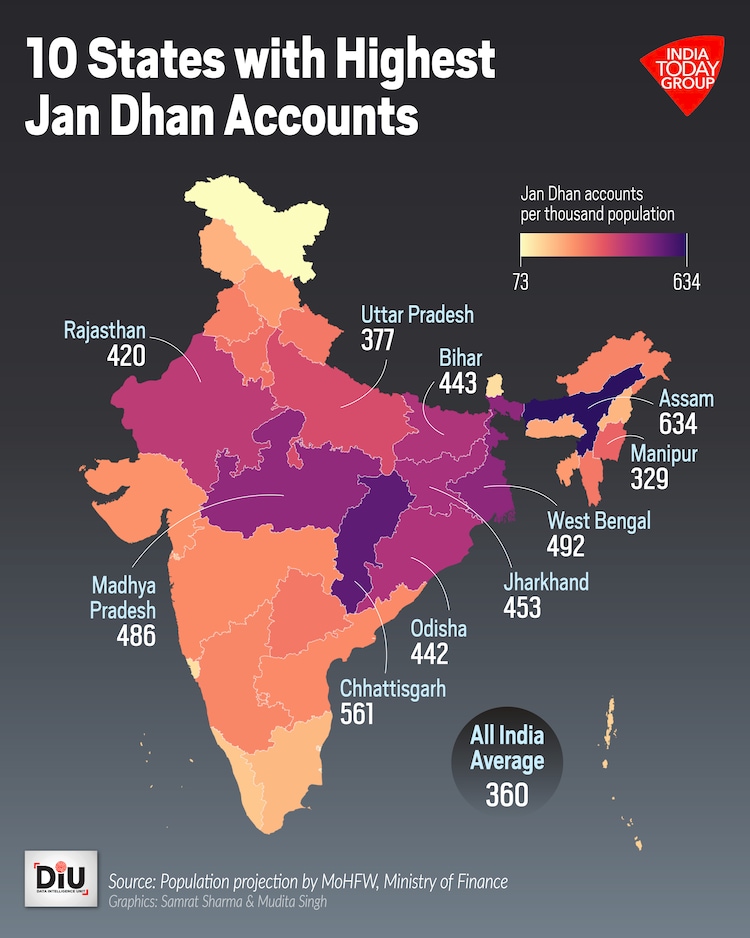
Source: India Today — How Jan Dhan accounts act as a barometer for India's global ... · www.indiatoday.in
Launch year: Jan Dhan Yojana launched in 2014, not 2015 or during UPA government
Account numbers: 48+ crore accounts, not households — multiple family members can have accounts
Insurance confusion: ₹2 lakh accident insurance + ₹30,000 life insurance — these are separate covers
Overdraft eligibility: Only after 6 months of satisfactory account operation, not immediate