In India, which of the following can trade in Corporate Bonds and Government Securities? 1. Insurance Companies 2. Pension Funds 3. Retail Investors Select the correct answer using the code given below:
Contents17
- A1 and 2 only
- B2 and 3 only
- C1 and 3 only
- D1, 2 and 3
Show answer
Answer: (D) 1, 2 and 3
Correct Answer: (d) All three — Insurance Companies, Pension Funds, and Retail Investors can all trade in corporate bonds and government securities.
Insurance companies and pension funds are major institutional players in these markets.
Retail investors can now participate directly through the RBI Retail Direct Scheme (launched 2021), which lets individuals open a 'Retail Direct Gilt' (RDG) account to buy government securities directly.
Corporate bonds can also be bought by retail investors through platforms like Zerodha.
RBI launched the Retail Direct Scheme in 2021, allowing individual investors to buy government securities directly through Retail Direct Gilt accounts.
The question tests whether students know that retail investors can now access both government securities and corporate bonds directly, not just through mutual funds.
UPSC is checking if students understand the democratization of bond markets — that these instruments are no longer restricted to institutional players.
Corporate Bonds
Indian Economy Corporate Bonds
Corporate Bonds: Types, Features & Market Access
Corporate bonds are debt securities issued by companies to raise funds
All three categories — insurance companies, pension funds, retail investors — can trade corporate bonds
Corporate bonds carry higher risk than government securities but offer higher returns
SEBI regulates corporate bond markets in India
What are Corporate Bonds
Corporate bonds are debt instruments issued by companies to raise capital from investors. Unlike shares, bonds represent a loan to the company with fixed interest payments and repayment of principal at maturity.
Corporate Bond Participants
Participant Type | Role | How They Access | Investment Purpose |
|---|---|---|---|
Insurance Companies | Major institutional investors | Direct market access | Match long-term liabilities with assets |
Pension Funds | Large-scale institutional buyers | Through fund managers/direct | Generate steady returns for retirees |
Retail Investors | Individual investors | Stock exchanges, online platforms | Higher returns than bank deposits |
Key Features
Credit rating determines bond quality — AAA (highest) to D (default)
Coupon rate is the annual interest paid to bondholders
Maturity period ranges from 1 year to 30+ years
Face value is typically ₹1,000 or ₹10,000 per bond
Bonds can be secured (backed by assets) or unsecured (debentures)
Trap: Assuming retail investors cannot access corporate bonds — they can through exchanges and platforms
Trap: Confusing corporate bonds with government securities — both allow the same participant categories
Trap: Thinking only institutional investors dominate bond markets — retail participation has increased significantly
Government Securities
Indian Economy Government Securities
Government Securities: Types & Market Structure
Government securities are debt instruments issued by Central/State governments
RBI Retail Direct Scheme (2021) allows retail investors direct access to G-Sec
Zero default risk as they are backed by government guarantee
Primary dealers and banks are traditional large participants
Definition & Purpose
Government securities (G-Sec) are debt instruments issued by the Central and State governments to finance their operations and developmental activities. They are considered the safest investments as they carry sovereign guarantee.
Types of Government Securities
Type | Issuer | Maturity | Key Features |
|---|---|---|---|
Treasury Bills (T-Bills) | Central Government via RBI | 91, 182, 364 days | Zero-coupon, sold at discount |
Government Bonds | Central Government | 2-40 years | Fixed/floating interest, semi-annual payments |
State Development Loans (SDL) | State Governments | 5-20 years | Slightly higher yield than Central G-Sec |
Inflation Indexed Bonds | Central Government | 10+ years | Principal and interest linked to inflation |
Market Access Revolution
RBI Retail Direct Scheme (2021) — retail investors can open Retail Direct Gilt (RDG) accounts
Minimum investment of ₹10,000 for retail investors in primary auctions
Online platform allows buying, selling, and holding G-Sec in demat form
No brokerage fees for primary market purchases through RBI platform
G-Sec Market Structure
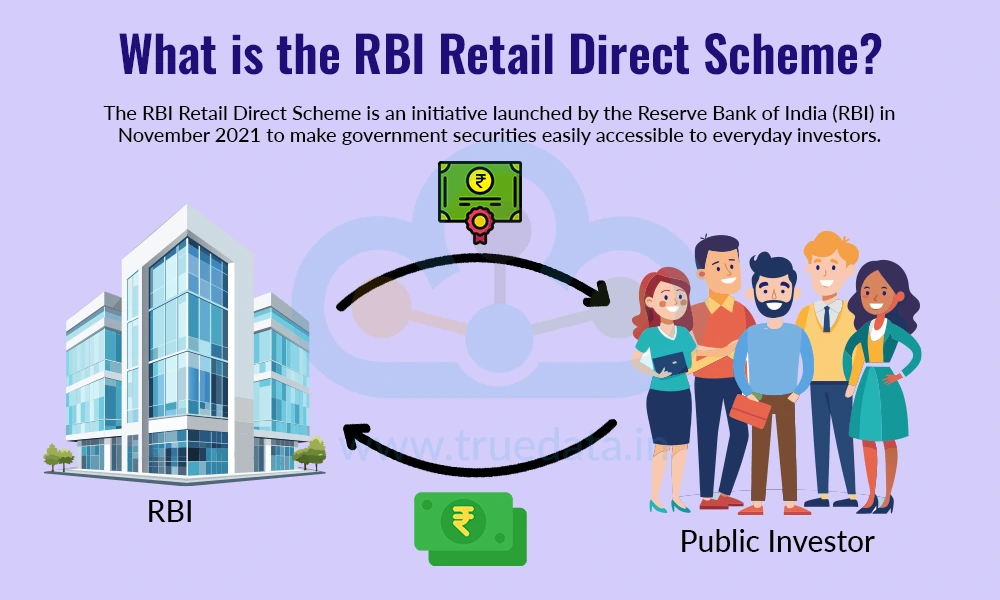
Source: TrueData — What Is RBI Retail Direct? Complete Guide for Beginners · www.truedata.in
Trap: Thinking retail investors cannot buy government securities directly — RBI Retail Direct (2021) changed this
Trap: Assuming only banks and institutions can participate in G-Sec markets
Trap: Confusing T-Bills (short-term) with Government Bonds (long-term)
Institutional Investors in Bond Markets
Indian Economy Insurance Companies Pension Funds
Insurance Companies & Pension Funds: Bond Market Giants
Insurance companies are the largest investors in government securities in India
Pension funds use bonds for long-term asset-liability matching
Both have regulatory mandates to invest in government securities
They provide stability to bond markets due to long-term holding patterns
Institutional Investment Patterns
Institution | G-Sec Mandate | Corporate Bond Role | Investment Horizon | Key Regulator |
|---|---|---|---|---|
Life Insurance | Minimum 50% in G-Sec | Diversification, higher yields | 10-30 years | IRDAI |
General Insurance | Minimum 20% in G-Sec | Short-term liquidity needs | 1-5 years | IRDAI |
EPFO | 45-50% in G-Sec | Equity and corporate debt mix | 20-40 years | Ministry of Labour |
NPS | Varies by scheme | Active corporate bond allocation | 20-60 years | PFRDA |
Why Bonds Match Their Needs
Predictable cash flows from bonds match insurance claim payouts and pension payments
Long maturity bonds align with long-term liabilities of 20-40 years
Government securities provide safety for funds that cannot afford losses
Corporate bonds offer yield pickup over G-Sec for risk-adjusted returns
Question Context
The question tests whether candidates know that bond markets are not exclusive to any one type of investor. All three categories — institutions and retail — can and do participate actively in both corporate and government bond markets.
Trap: Assuming pension funds cannot invest in corporate bonds — they can and do for better returns
Trap: Thinking insurance companies only buy government securities — they actively invest in corporate bonds too
Trap: Believing bond markets are only for institutional investors — retail participation is growing
Retail Investors in Bond Markets
Indian Economy Retail Investors
Retail Bond Investment: Access Revolution Since 2021
RBI Retail Direct Scheme (2021) allows direct G-Sec purchase by individuals
Corporate bonds available through stock exchanges and online platforms
Minimum investment ₹10,000 for G-Sec, varies for corporate bonds
Retail bond investment offers better returns than traditional bank deposits
The Game Changer
Until 2021, retail investors faced barriers in accessing government securities directly. The RBI Retail Direct Scheme revolutionized this by allowing individuals to open Retail Direct Gilt (RDG) accounts and participate in primary auctions alongside institutions.
How Retail Investors Access Bonds
%%{init: {"flowchart": {"wrappingWidth": 460}}}%%
flowchart TD
  s1["`**Open RDG Account**
Register on RBI Retail Direct portal with KYC documents`"]
  s2["`**Choose Investment**
Select from T-Bills, G-Bonds, or corporate bonds on exchanges`"]
  s3["`**Place Order**
Bid in primary auctions or buy from secondary market`"]
  s4["`**Hold & Earn**
Receive periodic interest and principal at maturity`"]
  s1 --> s2
  s2 --> s3
  s3 --> s4
Retail Bond Investment Channels
Channel | Bond Types | Minimum Investment | Key Advantage |
|---|---|---|---|
RBI Retail Direct | Government Securities only | ₹10,000 | Zero brokerage in primary market |
Stock Exchanges (NSE/BSE) | Corporate bonds, some G-Sec | ₹1,000-10,000 | Wide variety, easy trading |
Online Platforms | Corporate bonds, bond funds | ₹5,000-25,000 | User-friendly interface |
Banks & Brokers | All types | Varies | Full-service guidance |
Trap: Believing retail investors cannot access government securities — RBI Retail Direct (2021) enables this
Trap: Assuming bonds are only for large investors — minimum investments are now quite accessible
Trap: Thinking retail participation is negligible — it has grown significantly post-2021 reforms