Consider the following: 1. Cashew 2. Papaya 3. Red sanders How many of the above trees are actually native to India?
Contents16
- AOnly one
- BOnly two
- CAll three
- DNone
Show answer
Answer: (A) Only one
Correct Answer: (a) Only one — Red Sanders is native to India.
Cashew — native to northeastern Brazil.
Portuguese missionaries brought it to India in the 16th century.
Papaya — native to South Mexico and Costa Rica.
India is now the world's largest producer, but the plant originated in the Americas.
Red Sanders (Red Sandalwood) — native to Andhra Pradesh, India.
Its trade is regulated because it's highly valued and at risk of illegal harvesting.
Easy way to remember:
- Many common Indian crops actually originated elsewhere
- cashew from Brazil
- papaya from Mexico
- potato from South America
- chilli from the Americas.
Red Sanders is one of the few that's truly native.
Red sanders is endemic to the Eastern Ghats of Andhra Pradesh and is protected under CITES due to illegal smuggling, while cashew and papaya were introduced from the Americas centuries ago.
UPSC frequently tests whether students can distinguish between native Indian species versus introduced crops that became culturally associated with India over time.
Red Sanders (Red Sandalwood)
Environment Red sanders
Red Sanders: India's Native Sandalwood & Conservation Challenge
Red Sanders is native to Andhra Pradesh — one of the few trees in the question truly indigenous to India
CITES Appendix II species due to over-exploitation and illegal trade
Also called Red Sandalwood or Pterocarpus santalinus — different from regular sandalwood
Highly valued for furniture and medicinal uses in international markets
What Makes It Special
Red Sanders (Pterocarpus santalinus) is a slow-growing tree endemic to the Eastern Ghats of Andhra Pradesh. Unlike common sandalwood, it produces deep red heartwood that's extremely valuable in international markets, especially in China and Japan for furniture and traditional medicine.
Key Conservation Facts
CITES Appendix II listing means international trade requires permits and monitoring
Wildlife Protection Act 1972 covers it under various schedules for protection
Illegal smuggling to China is a major conservation threat — high-value timber
Slow growth rate makes natural regeneration difficult after harvesting
Endemic distribution limited to specific districts in Andhra Pradesh
Red Sanders Distribution
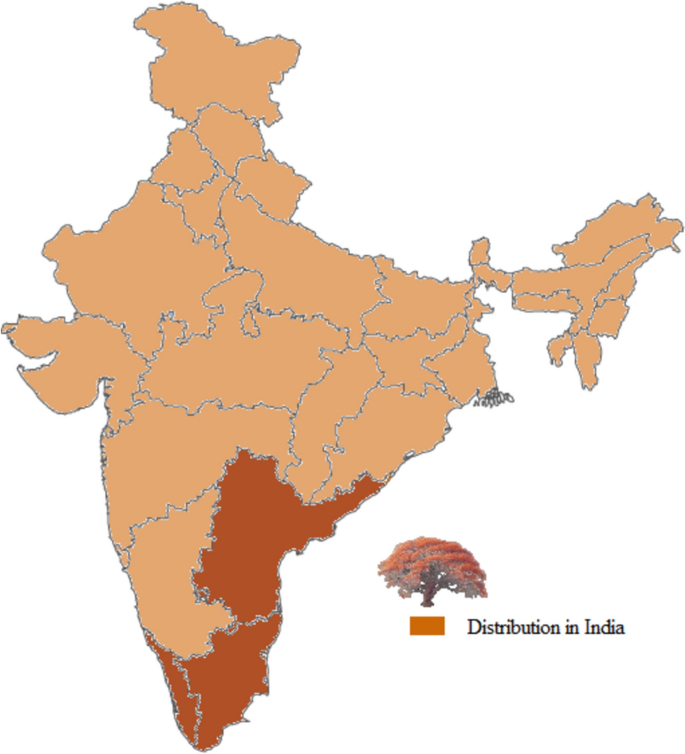
Source: Springer Nature — An overview of forensic analysis methods of Pterocarpus ... · link.springer.com
Trap: Don't confuse Red Sanders with regular Sandalwood — they're different species with different distributions
Trap: The question tests native vs introduced species — Red Sanders is the only indigenous one among the three
Memory aid: Red Sanders = Red state (Andhra Pradesh) — native connection
Cashew - Brazilian Origin
Environment Cashew
Cashew: From Brazil to India via Portuguese Trade
Cashew is native to northeastern Brazil — not India despite being a major crop here
Portuguese missionaries introduced it to India in the 16th century
Goa was the first introduction point, then spread to Karnataka and Kerala
Introduction History
Cashew (Anacardium occidentale) originated in the tropical forests of northeastern Brazil. Portuguese traders brought it to India in the 1500s, initially establishing plantations in Goa. The tree adapted so well to India's coastal climate that many assume it's native.
Current Status in India
Major producing states: Goa, Karnataka, Kerala, Maharashtra, Andhra Pradesh
India is among top 5 global producers but not the original home
Cashew apple also consumed in India — shows successful adaptation
Export commodity — processed cashews are a significant agricultural export
Trap: High production in India ≠ native origin — cashew is a successful introduced species
UPSC pattern: Questions often test native vs naturalized species to catch assumptions
Papaya - Central American Origin
Environment Papaya
Papaya: From Central America to World's Largest Producer
Papaya is native to South Mexico and Costa Rica — Central American origin
India is now the world's largest papaya producer despite it being non-native
Spanish colonizers spread it globally from the Americas
Origin & Global Spread
Papaya (Carica papaya) is native to the tropical regions of southern Mexico and Costa Rica. Spanish and Portuguese explorers carried papaya seeds across their trade routes, establishing it in tropical colonies worldwide during the 16th-17th centuries.
Papaya: Origin vs Current Status
Aspect | Details |
|---|---|
Native Region | South Mexico, Costa Rica (Central America) |
Introduction to India | 16th-17th century via European trade |
Current Global Rank | India is #1 producer (>5 million tonnes annually) |
Major Indian States | Andhra Pradesh, Gujarat, Karnataka, Bihar |
Trap: Largest producer ≠ native origin — India produces most papaya but didn't originate it
Memory aid: Papa-ya from Papa-Spain — Spanish connection to the Americas
Native vs Introduced Species Concept
Environment
Native vs Introduced Species: Key Ecological Distinction
Native species evolved naturally in a region over geological time — no human introduction
Introduced species were brought by humans from their original habitat to new regions
Naturalized species are introduced species that now reproduce successfully without human help
Species Classification by Origin
Type | Definition | Example | Key Marker |
|---|---|---|---|
Native/Indigenous | Evolved naturally in the region | Red Sanders in Andhra Pradesh | No human introduction |
Introduced/Exotic | Brought by humans from elsewhere | Cashew from Brazil to India | Human-mediated arrival |
Naturalized | Introduced but now self-sustaining | Papaya in India (thriving without help) | Reproduces independently |
Invasive | Introduced species causing ecological harm | Lantana camara in Indian forests | Displaces native species |
Why This Distinction Matters
Biodiversity conservation prioritizes protecting native species and their habitats
Ecological relationships — native species have co-evolved with local ecosystems
Agricultural history — many major crops are introduced (wheat, rice, maize all have foreign origins)
Policy implications — different conservation strategies for native vs introduced species
UPSC trap: High production ≠ native origin — don't assume major crops are indigenous
Common confusion: Naturalized vs Native — naturalized means thriving after introduction, not originally native
Question pattern: UPSC tests origin knowledge to challenge assumptions about 'Indian' species
Important Native Trees of India
Environment
India's Native Tree Species: Regional Endemics & Conservation
Western Ghats and Eastern Ghats harbor many endemic tree species found nowhere else
Sal, Teak, Neem, Banyan are classic examples of trees native to India
Many 'Indian' trees are actually introduced — like Eucalyptus (Australian) and Casuarina (Australian)
Native vs Introduced Trees in India
Tree | Status | Origin/Region | Significance |
|---|---|---|---|
Sal (Shorea robusta) | Native | Central & Eastern India | Sacred tree, timber |
Teak (Tectona grandis) | Native | Central & Western India | Premium timber species |
Neem (Azadirachta indica) | Native | Indian subcontinent | Medicinal, pest control |
Red Sanders | Native | Eastern Ghats (AP) | Endemic, CITES protected |
Eucalyptus | Introduced | Australia (1790s) | Fast-growing, plantation |
Casuarina | Introduced | Australia (British period) | Coastal plantation |
Conservation Hotspots
Western Ghats — UNESCO World Heritage site with highest tree endemism in India
Eastern Ghats — Red Sanders and other endemic species, fragmented habitats
Northeast India — part of Indo-Burma biodiversity hotspot with unique tree species
Himalayan region — temperate and alpine tree species found nowhere else in India
Trap: Eucalyptus and Casuarina are widely planted but Australian natives — not Indian
Memory aid: Teak-Sal-Neem are the classic native trio every student should remember
UPSC pattern: Tests assumptions about common trees — many plantation species are exotic