Consider the following plants 1. Groundnut 2. Horse-gram 3. Soybean How many of the above belong to the pea family?
Contents15
- AOnly one
- BOnly two
- CAll three
- DNone
Show answer
Answer: (C) All three
Correct Answer: (c) All three belong to the pea family.
Groundnut (peanut), Horse-gram, and Soybean all belong to the family Fabaceae (also called Leguminosae) — the legume/pea/bean family.
This is one of the largest and most important plant families.
All legumes share a key feature: they have root nodules containing nitrogen-fixing bacteria, which enriches the soil.
Easy way to remember: If it's a 'dal' or bean, it's probably in the Fabaceae family.
Groundnut is technically a legume (not a nut!), which is why it's in this family.
Fabaceae is one of the largest plant families with over 19,000 species including all major pulses, beans, and legumes that form a significant part of human diet.
The question tests a common misconception that groundnut is a nut when it is actually a legume that grows underground, belonging to the same family as peas and beans.
UPSC is checking whether students can identify the scientific classification behind everyday food crops rather than just memorizing plant names.
Fabaceae Family (Legumes)
Environment pea family Groundnut Horse-gram Soybean
Fabaceae Family: Key Members & UPSC Recognition
Fabaceae = Leguminosae = pea/bean/legume family — same thing, different names
All three plants (groundnut, horse-gram, soybean) belong to this family
Groundnut is a legume, not a nut — grows underground but still Fabaceae
Fabaceae is the third largest plant family globally
What is Fabaceae
Fabaceae (also called Leguminosae) is the legume family — one of the largest plant families worldwide. The simple rule: if it's a dal, bean, or pea, it likely belongs here. This family includes food crops, fodder plants, and trees.
Question Plants Classification
Plant | Common Name | Scientific Name | Why It's Fabaceae |
|---|---|---|---|
Groundnut | Peanut | Arachis hypogaea | Legume grown underground, not a true nut |
Horse-gram | Kulthi dal | Macrotyloma uniflorum | Traditional pulse crop, drought-resistant |
Soybean | Soya | Glycine max | Major protein-rich legume crop |
Key Recognition Features
Pod fruits — seeds develop inside pods that split open (like peas)
Compound leaves — most have leaves divided into leaflets
Butterfly-shaped flowers — distinctive petal arrangement
Root nodules — contain nitrogen-fixing bacteria
High protein content — especially in seeds
Trap: Groundnut confusion — despite the name 'nut', it's a legume that grows underground
Trap: Family names — Fabaceae = Leguminosae = pea family (all the same)
Trap: 'Only dal crops' — family includes trees like Acacia and Tamarind too
Nitrogen Fixation in Legumes
Environment
Nitrogen Fixation: Why Legumes Enrich Soil
Rhizobium bacteria in root nodules convert atmospheric nitrogen to ammonia
This process makes nitrogen available to plants and enriches soil
Symbiotic relationship — bacteria get carbohydrates, plant gets nitrogen
The Process
Nitrogen fixation is why legumes are valuable for agriculture. Rhizobium bacteria live in root nodules and convert atmospheric nitrogen (N₂) into ammonia (NH₃) — a form plants can use. This enriches the soil naturally.
Nitrogen Fixation Steps
%%{init: {"flowchart": {"wrappingWidth": 460}}}%%
flowchart TD
  s1["`**Infection**
**Rhizobium bacteria** infect legume roots`"]
  s2["`**Nodule Formation**
Plant forms **root nodules** around bacteria`"]
  s3["`**Nitrogen Conversion**
Bacteria convert **N₂ → NH₃** using nitrogenase enzyme`"]
  s4["`**Nutrient Exchange**
Plant provides **carbohydrates**, gets **fixed nitrogen**`"]
  s5["`**Soil Enrichment**
When plant dies, **nitrogen remains in soil**`"]
  s1 --> s2
  s2 --> s3
  s3 --> s4
  s4 --> s5
Agricultural Importance
Crop rotation — legumes restore soil nitrogen for next crops
Reduced fertilizer need — natural nitrogen fixation cuts input costs
Sustainable farming — maintains soil fertility without chemicals
Green manuring — legume crops plowed into soil as fertilizer
Important Legume Crops
Environment
Major Legume Crops: Food & Commercial
Food legumes include all major dal varieties (arhar, chana, moong, urad)
Commercial legumes include groundnut, soybean for oil and protein
India is the largest producer of pulses globally
Major Food Legumes
Crop | Common Name | Season | Major States |
|---|---|---|---|
Arhar/Tur | Pigeon pea | Kharif | Maharashtra, Karnataka, MP |
Chana | Bengal gram | Rabi | MP, Rajasthan, UP |
Moong | Green gram | Kharif/Summer | Rajasthan, Maharashtra, Andhra |
Urad | Black gram | Kharif/Rabi | MP, UP, Andhra Pradesh |
Masoor | Lentil | Rabi | UP, MP, Bihar |
Horse-gram | Kulthi | Kharif | Karnataka, Andhra, Odisha |
Commercial Legumes
Crop | Primary Use | Major States | Key Feature |
|---|---|---|---|
Groundnut | Oil extraction | Gujarat, Andhra, Tamil Nadu | 40-50% oil content |
Soybean | Oil + protein meal | MP, Maharashtra, Rajasthan | Complete protein with all amino acids |
Sunhemp | Fiber + green manure | Karnataka, Andhra, Bihar | Industrial fiber crop |
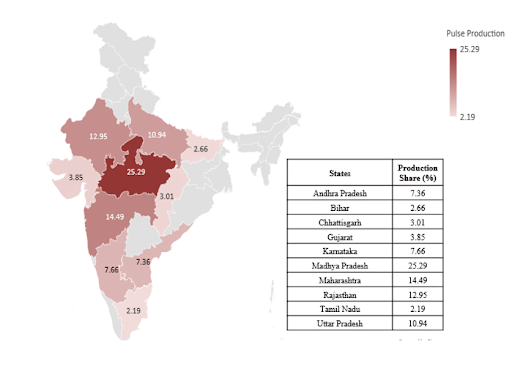
Pulse Production Map
Source: IAS Gyan — NITI Aayog Pulses Report Explained: UPSC Current Affairs · www.iasgyan.in
Plant Family Classification
Environment
Plant Family Classification: Major Families for UPSC
Family is the key taxonomic level UPSC tests — above genus, below order
Fabaceae, Poaceae, Solanaceae are the most important families to know
Each family has diagnostic features — flowers, fruits, leaves
Major Plant Families
Family | Common Name | Key Members | Diagnostic Feature |
|---|---|---|---|
Fabaceae | Legume/Pea family | Dal, beans, groundnut | Pod fruits, nitrogen fixation |
Poaceae | Grass family | Rice, wheat, maize, bamboo | Hollow stems, parallel leaf veins |
Solanaceae | Nightshade family | Potato, tomato, tobacco | 5-petaled flowers, often toxic alkaloids |
Brassicaceae | Mustard family | Mustard, cabbage, radish | Cross-shaped flowers (4 petals) |
Rosaceae | Rose family | Apple, rose, strawberry | 5-petaled flowers, often thorny |
Family Recognition Tips
Flower structure — number and arrangement of petals is key
Fruit type — pods (Fabaceae), grains (Poaceae), berries (Solanaceae)
Leaf pattern — compound vs simple, parallel vs net veins
Special features — thorns, alkaloids, nitrogen fixation
Economic importance — food, medicine, fiber, ornamental use