The organisms 'Cicada, Froghopper and Pond skater' are :
Contents13
- ABirds
- BFish
- CInsects
- DReptiles
Show answer
Answer: (C) Insects
Correct Answer: (c) Insects.
All three are insects:
Cicada — known for their loud buzzing sound, stout bodies, and periodic mass emergences (some species appear only every 13 or 17 years).
Froghopper — small jumping insects whose nymphs produce a frothy foam ('spittle') on plants. Also called spittlebugs.
Pond skater (water strider) — insects that walk on the surface of water using surface tension, feeding on dead insects trapped on the water.
These are all from the insect class, not birds, fish, or reptiles.
Cicadas, froghoppers, and pond skaters are all insects with unique adaptations - cicadas for their periodic mass emergences, froghoppers for producing foam as nymphs, and pond skaters for walking on water using surface tension.
UPSC is testing whether students can distinguish insects from other animal groups by recognizing common names rather than scientific terminology.
Cicadas: Characteristics & Lifecycle
Environment Cicada
Cicadas: The Periodic Emergence Insects
Cicadas are insects famous for loud buzzing sounds and periodic mass emergences
Some species emerge only every 13 or 17 years in synchronized cycles
Have stout bodies and are completely different from birds, fish, or reptiles
What Are Cicadas
Cicadas are large insects belonging to the order Hemiptera. They are famous for their loud buzzing calls produced by males to attract mates. Unlike other insects, many cicada species have extraordinary long lifecycles with synchronized mass emergences.
Key Features
Sound production: Males create loud buzzing using specialized organs called tymbals
Body structure: Stout bodies with large, transparent wings and prominent eyes
Feeding: Adults feed on plant sap using piercing mouthparts
Lifespan: Underground nymphs can live 13-17 years before emerging as adults
Mass emergence: Entire populations emerge simultaneously for reproduction
Not birds: Despite making loud sounds, cicadas are insects, not birds
Not aquatic: Though some live near water, they are terrestrial insects, not fish
Insect classification: Belong to order Hemiptera (true bugs), not Lepidoptera (butterflies) or Coleoptera (beetles)
Froghoppers & Spittlebugs
Environment Froghopper
Froghoppers: The Foam-Producing Insects
Froghoppers are small jumping insects also called spittlebugs
Their nymphs produce frothy foam ('spittle') on plants for protection
Adults are excellent jumpers, hence the name 'froghopper'
Distinctive Behavior
Froghoppers get their name from their remarkable jumping ability. The nymphs are famous for creating white foamy masses on plant stems, which protect them from predators and prevent desiccation while they feed on plant sap.
Identification Features
Spittle production: Nymphs create distinctive white foam on plants
Jumping ability: Adults can jump up to 100 times their body length
Size: Small insects, typically 2-12mm in length
Feeding: Both nymphs and adults suck plant sap
Alternative name: Also called spittlebugs due to foam production
Not amphibians: Despite 'frog' in the name, they are insects, not amphibians
Foam confusion: The white foam is produced by nymphs, not adults
Plant damage: Can be agricultural pests, not beneficial insects
Pond Skaters & Water Striders
Environment Pond skater
Pond Skaters: Masters of Surface Tension
Pond skaters walk on water surface using surface tension
Also called water striders, they feed on dead insects trapped on water
Have specialized hydrophobic legs that don't break water surface
Surface Walking Mechanism
Pond skaters are semi-aquatic insects that exploit surface tension to walk on water. Their legs have hydrophobic hairs that distribute their weight and prevent breaking the water's surface film.
Adaptations & Behavior
Leg structure: Long, thin legs with hydrophobic hairs distribute weight
Feeding strategy: Capture dead or struggling insects on water surface
Movement: Use middle legs as oars and hind legs as rudders
Habitat: Found on ponds, streams, and slow-moving water bodies
Predatory role: Important predators in aquatic ecosystems
Water Walking in Action
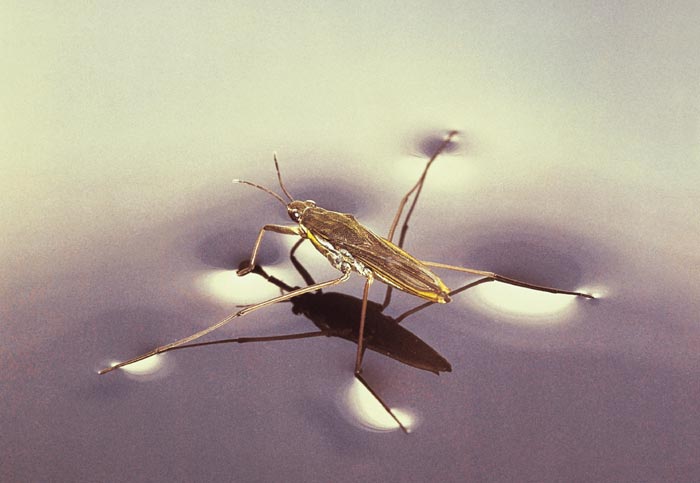
Source: Physics World — Walking on water – Physics World · physicsworld.com
Not aquatic like fish: They live ON water surface, not IN water like fish
Still insects: Despite aquatic lifestyle, they remain terrestrial insects, not aquatic animals
Surface feeders: Feed on surface-trapped prey, not underwater organisms
Insect Classification Basics
Environment Insects
Insect Classification: Key Identifying Features
Insects have six legs and three body segments (head, thorax, abdomen)
Belong to phylum Arthropoda, largest animal group on Earth
Distinguished from birds, fish, and reptiles by body structure and lifecycle
Insects vs Other Animal Groups
Feature | Insects | Birds | Fish | Reptiles |
|---|---|---|---|---|
Body segments | 3 segments | 2 (head+neck, body) | 2 (head, body) | 2 (head, body) |
Legs | 6 legs | 2 legs | No legs (fins) | 4 legs (usually) |
Skeleton | External (exoskeleton) | Internal (bones) | Internal (bones/cartilage) | Internal (bones) |
Wings | 0, 2, or 4 wings | 2 wings (modified) | Fins only | No wings |
Habitat | Mostly terrestrial | Aerial + terrestrial | Aquatic only | Mostly terrestrial |
Why These Are All Insects
Cicadas: Have 6 legs, 3 body segments, and exoskeleton typical of insects
Froghoppers: Show complete metamorphosis and piercing mouthparts of true bugs (Hemiptera)
Pond skaters: Despite aquatic lifestyle, retain all insect characteristics including 6 legs and wings
Habitat confusion: Pond skaters live near water but are still insects, not fish
Sound makers: Cicadas make sounds like birds, but sound production doesn't determine classification
Size variation: Insects range from tiny to large - size alone doesn't determine the group
Lifestyle diversity: Insects can be terrestrial, aquatic, or aerial - habitat doesn't change their classification