If you want to see gharials in their natural habitat, which one of the following is the best place to visit?
Contents14
- ABhitarkanika Mangroves
- BChambal River
- CPulicat Lake
- DDeepor Beel
Show answer
Answer: (B) Chambal River
The Chambal River is the best-known natural habitat for gharials in India.
The National Chambal Sanctuary (also called the National Chambal Gharial Wildlife Sanctuary) is a tri-state protected area spread across Rajasthan, Madhya Pradesh, and Uttar Pradesh, established specifically for the conservation of the critically endangered gharial (a type of crocodilian with a distinctive long, thin snout), the red-crowned roof turtle, and the endangered Ganges river dolphin.
Bhitarkanika Mangroves (Odisha) are known for saltwater crocodiles, not gharials.
Pulicat Lake (Andhra Pradesh/Tamil Nadu) is known for flamingos and other migratory birds.
Deepor Beel (Assam) is a Ramsar wetland known for its avian diversity.
The gharial population in the Chambal has been the subject of conservation news in recent years.
(Source: NCERT Contemporary India-II, Chapter 2)
Gharials are critically endangered crocodilians found in only a few river systems in India, with the Chambal River hosting the largest population.
The National Chambal Sanctuary was specifically established for gharial conservation and spans three states - Rajasthan, Madhya Pradesh, and Uttar Pradesh.
The question tests whether students can distinguish between different wetland ecosystems - riverine sanctuaries for gharials versus coastal mangroves for saltwater crocodiles and lakes for migratory birds.
Gharial: Habitat & Conservation
Environment gharials natural habitat
Gharial: India's Critically Endangered Crocodilian
Gharial is a critically endangered crocodilian with distinctive long, narrow snout
Chambal River (Rajasthan-MP-UP) is the primary natural habitat
National Chambal Sanctuary established specifically for gharial conservation
Only 200-250 breeding adults remain in wild
What Makes Gharials Special
Gharial (Gavialis gangeticus) is India's most endangered crocodilian, easily identified by its distinctive long, narrow snout adapted for catching fish. Unlike other crocodiles, gharials are purely aquatic and cannot perform the high walk on land due to weak legs.
Gharial vs Other Indian Crocodilians
Species | Habitat | Snout Shape | Conservation Status | Key Location |
|---|---|---|---|---|
Gharial | Freshwater rivers | Long & narrow | Critically Endangered | Chambal River |
Mugger Crocodile | Freshwater lakes/rivers | Broad & short | Vulnerable | Various water bodies |
Saltwater Crocodile | Mangroves/estuaries | Broad & powerful | Least Concern | Bhitarkanika, Sundarbans |
Chambal River Habitat

Source: ForumIAS — National Chambal Sanctuary |ForumIAS · forumias.com
Trap: Bhitarkanika is famous for saltwater crocodiles, not gharials - different species entirely
Trap: Don't confuse gharial habitats with general crocodile habitats - gharials need flowing rivers, not mangroves
Trap: Pulicat Lake and Deepor Beel are bird sanctuaries, not crocodilian habitats
National Chambal Sanctuary
Environment Chambal River
National Chambal Sanctuary: Tri-State Conservation Success
India's longest tri-state sanctuary across Rajasthan-MP-UP
Protects 3 endangered species: gharial, red-crowned roof turtle, Ganges dolphin
Covers 5,400 sq km along 425 km of Chambal River
Conservation Significance
World's largest gharial population - over 200 breeding adults
Drug-free river - no industrial pollution due to religious taboos around Chambal
Ravine ecosystem provides ideal nesting sites with sandy banks
Community conservation success with local involvement in protection
Protected Species Profile
Species | IUCN Status | Population in Chambal | Key Threat |
|---|---|---|---|
Gharial | Critically Endangered | ~200 breeding adults | Habitat loss, fishing nets |
Red-crowned Roof Turtle | Critically Endangered | Small population | Egg collection, sand mining |
Ganges River Dolphin | Endangered | ~200 individuals | River fragmentation, pollution |
Trap: It's National Chambal Sanctuary, not just 'Chambal National Park' - different designation
Trap: Covers 3 states (Rajasthan-MP-UP), not just one - unique tri-state model
Other Sanctuaries: Bhitarkanika, Pulicat, Deepor Beel
Environment Bhitarkanika Mangroves Pulicat Lake Deepor Beel
Key Wildlife Sanctuaries: What Each Protects
Sanctuary Comparison
Sanctuary | State | Ecosystem Type | Famous For | Key Species |
|---|---|---|---|---|
Bhitarkanika | Odisha | Mangrove | Saltwater crocodiles | Largest crocs in India |
Pulicat Lake | AP-Tamil Nadu | Brackish lagoon | Flamingos | Migratory birds |
Deepor Beel | Assam | Freshwater wetland | Avian diversity | Resident & migratory birds |
Distinctive Features
Bhitarkanika: Second-largest mangrove in India, home to 23-foot saltwater crocodiles
Pulicat Lake: India's second-largest brackish water lagoon, Ramsar site
Deepor Beel: Ramsar wetland, supports over 200 bird species
Wetland Locations
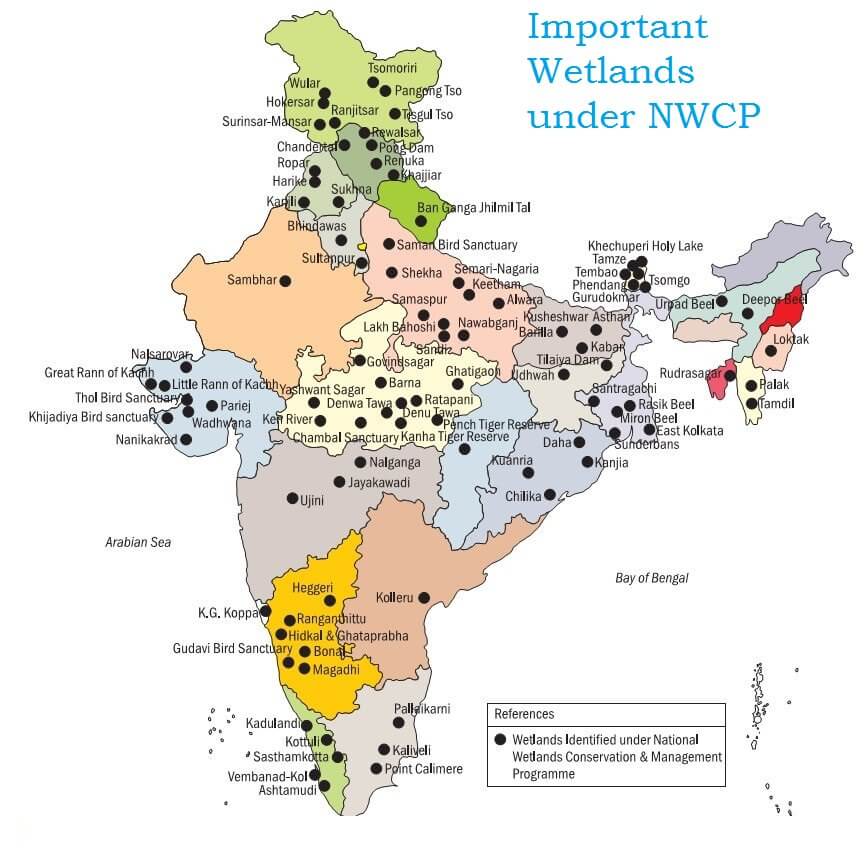
Source: LotusArise — Ramsar Sites in India with Map (Updated in 2026) | UPSC · lotusarise.com
Trap: Bhitarkanika = saltwater crocodiles, Chambal = gharials - don't mix crocodilian habitats
Trap: Pulicat and Deepor Beel are bird sanctuaries, not reptile habitats
Indian Crocodilian Species & Distribution
Environment
India's Three Crocodilian Species: Habitats & Status
India has 3 crocodilian species: gharial, mugger, saltwater crocodile
Each species occupies different aquatic habitats - rivers, lakes, mangroves
Gharial most endangered, saltwater crocodile most stable
Species Distribution
# Indian Crocodilians
## Gharial
- Chambal River
- Girwa River
- Son River
- Critically Endangered
## Mugger Crocodile
- Sariska
- Ranthambore
- Various lakes
- Vulnerable
## Saltwater Crocodile
- Bhitarkanika
- Sundarbans
- Andaman
- Least Concern
Habitat Specialization
Gharial: Deep, flowing rivers with sandy banks for nesting - fish specialist
Mugger: Adaptable to various freshwater bodies - opportunistic predator
Saltwater: Tolerates high salinity in estuaries and mangroves - apex predator
Trap: Gharial = river specialist, Saltwater = mangrove specialist - habitat determines species
Trap: All three are different conservation priorities - gharial most critical