The "Miyawaki method" is well known for the:
Contents14
- APromotion of commercial farming in arid and semi-arid areas
- BDevelopment of gardens using genetically modified flora
- CCreation of mini forests in urban areas
- DHarvesting wind energy on coastal areas and on sea surfaces.
Show answer
Answer: (C) Creation of mini forests in urban areas
The answer is (C) Creation of mini forests in urban areas.
The Miyawaki method, developed by Japanese botanist Akira Miyawaki in the 1980s, creates dense mini-forests in cities:
How it works:
- Plant many NATIVE species very close together
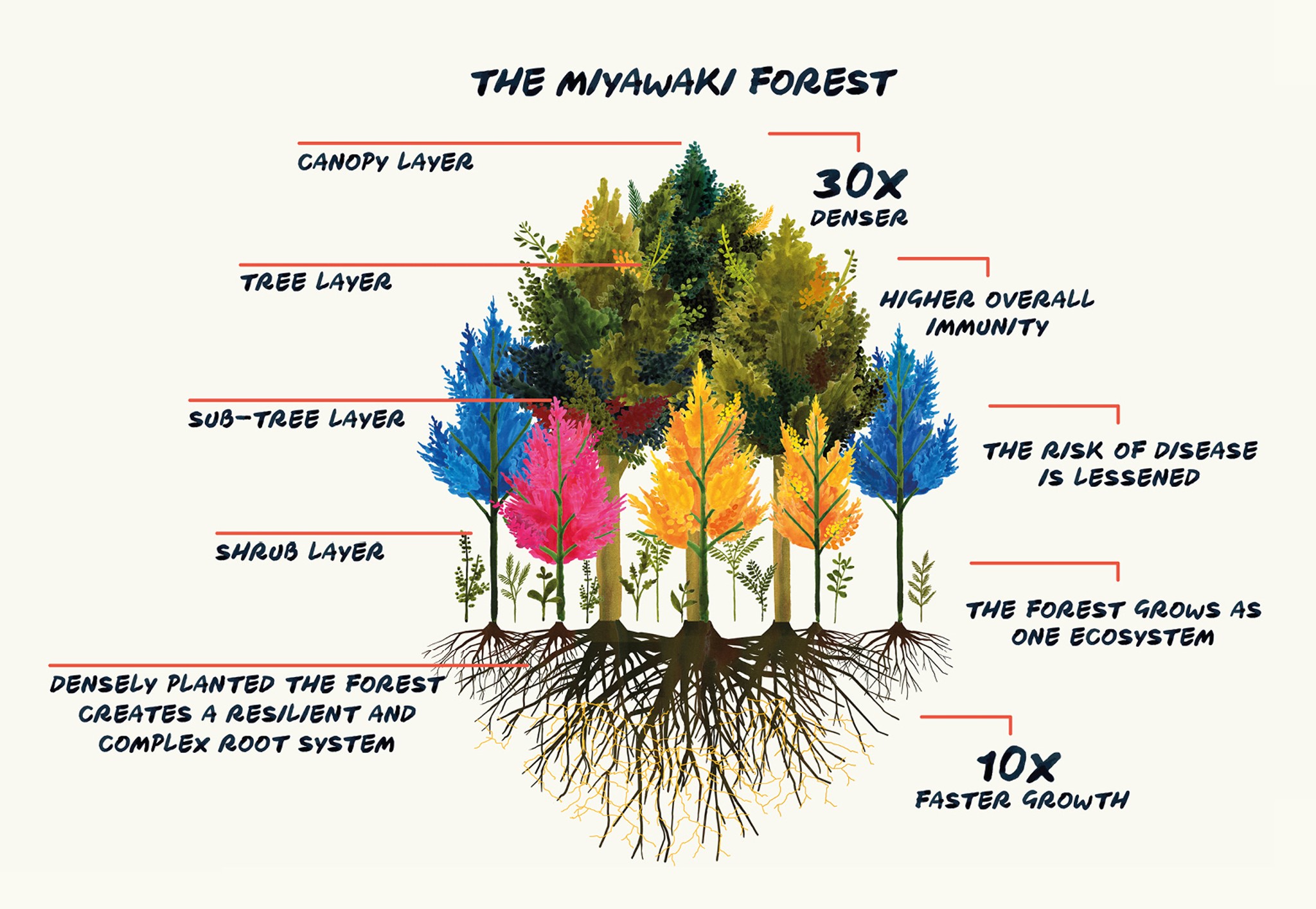
- Mix all forest layers — shrubs, small trees, tall trees — on a small plot
- Plants compete for sunlight, so they grow UPWARD (not sideways)
- Result: A forest that's 30x denser, grows 10x faster, and becomes self-sustaining (no maintenance needed) after just 3 years
Why it's popular for cities: You can create a mini-forest on a plot as small as a parking space! It improves air quality, reduces urban heat, supports biodiversity, and provides green spaces.
The other options have nothing to do with Miyawaki:
- (A) is about farming
- (B) is about GMOs
- (D) is about wind energy.
The Miyawaki method creates dense, fast-growing mini forests by planting native species very close together in urban spaces as small as parking lots.
Urban afforestation became a major policy focus around 2020-22, with cities like Delhi and Bengaluru adopting Miyawaki forests to combat air pollution and urban heat islands.
UPSC is testing whether students can distinguish between different environmental solutions - afforestation vs farming vs genetic modification vs renewable energy.
Miyawaki Method
Environment Miyawaki method mini forests
Miyawaki Method: Creating Dense Urban Mini-Forests
Miyawaki method creates dense mini-forests in urban areas using native species
Forests grow 10x faster and are 30x denser than conventional plantations
Becomes self-sustaining after just 3 years with no maintenance
Developed by Japanese botanist Akira Miyawaki in the 1980s
What It Is
The Miyawaki method is a revolutionary urban forestry technique that creates dense, native forests in extremely small spaces. Unlike traditional tree planting, this method can transform even a parking space-sized plot into a thriving forest ecosystem.
How It Works
%%{init: {"flowchart": {"wrappingWidth": 460}}}%%
flowchart TD
  s1["`**Site Selection**
Choose small urban plot (minimum 20 sq meters)`"]
  s2["`**Native Species Research**
Identify indigenous trees, shrubs, and ground cover of the region`"]
  s3["`**Dense Multi-Layer Planting**
Plant all forest layers together - tall trees, medium trees, shrubs - very close to each other`"]
  s4["`**Competition for Light**
Plants compete for sunlight, forcing rapid vertical growth instead of horizontal spread`"]
  s5["`**Self-Sustaining Forest**
After 3 years, forest maintains itself with no human intervention`"]
  s1 --> s2
  s2 --> s3
  s3 --> s4
  s4 --> s5
Miyawaki vs Traditional Forestry
Aspect | Miyawaki Method | Traditional Plantation |
|---|---|---|
Species Used | Native species only | Often exotic/commercial species |
Planting Density | 3-5 plants per sq meter | 1 plant per 4-9 sq meters |
Growth Rate | 10x faster | Normal growth |
Forest Density | 30x denser | Standard density |
Maintenance Period | 3 years only | 10-20 years continuous |
Space Requirement | 20 sq meters minimum | Large areas needed |
Survival Rate | 90%+ | 60-70% |
Urban Applications
Air quality improvement - Dense vegetation filters more pollutants than sparse trees
Urban heat island reduction - Creates cooling effect in concrete-dominated cities
Biodiversity support - Native plants attract local birds, insects, and small animals
Noise reduction - Dense forest acts as natural sound barrier
Carbon sequestration - Rapid growth means faster CO₂ absorption
Miyawaki Forest Structure
Source: SUGi Project — Why We Use the Miyawaki Method | SUGi · www.sugiproject.com
Not for commercial farming - The method is for creating natural forests, not agricultural production
Only uses native species - No genetically modified plants or exotic species are used
Urban focus - Specifically designed for cities and small spaces, not large rural areas
No connection to wind energy - This is purely a forestry technique, not renewable energy
Urban Forestry in India
Environment
Urban Forestry Initiatives in India
India's urban forest cover is only 2.6% compared to 21.7% national average
Miyawaki forests implemented in Delhi, Mumbai, Bengaluru, and other cities
Part of Smart Cities Mission and National Action Plan on Climate Change
Urban Green Challenge
Indian cities face severe air pollution and urban heat island effects due to rapid urbanization. With over 35% of India's population living in cities, urban forestry has become critical for sustainable development and climate resilience.
Miyawaki Projects in Indian Cities
City | Location | Area | Key Features |
|---|---|---|---|
Delhi | Rajghat, Central Ridge | Multiple sites | Air pollution reduction focus |
Mumbai | Sanjay Gandhi National Park buffer | 10+ locations | Mangrove integration |
Bengaluru | Cubbon Park, Lalbagh periphery | Various plots | IT sector partnership |
Chennai | Pallikaranai wetland area | 5+ sites | Coastal ecosystem restoration |
Chandigarh | Sector parks | Multiple mini-forests | Model city demonstration |
Policy Support
Forest Policy 2019 promotes urban forests and green corridors in cities
Compensatory Afforestation Fund can be used for urban forestry projects
Green Building norms under IGBC encourage Miyawaki forests in commercial complexes
State Forest Departments partnering with municipal corporations for implementation
Urban Forest Coverage
Map of India showing urban forest cover percentage in major cities with color coding for different coverage levels
Most Indian cities have less than 5% forest cover, making urban forestry initiatives crucial
Other Urban Green Solutions
Environment commercial farming genetically modified flora wind energy
Alternative Urban Environmental Solutions
Vertical farming uses controlled environments for commercial crop production in cities
Rooftop gardens with native and food plants provide green cover and urban farming
Urban wind energy installations on buildings and coastal areas generate renewable power
Urban Green Solutions Comparison
Method | Primary Purpose | Space Requirement | Technology Level |
|---|---|---|---|
Miyawaki Forests | Ecosystem restoration, air quality | Small plots (20+ sq m) | Low-tech, natural |
Vertical Farming | Commercial food production | Indoor facilities | High-tech, controlled |
Rooftop Gardens | Food security, green cover | Building rooftops | Medium-tech |
Urban Wind Farms | Renewable energy generation | Open spaces, coastlines | High-tech |
Hydroponic Systems | Soilless cultivation | Indoor/greenhouse | High-tech, water-based |
Integrated Approach
Complementary solutions - Cities can combine Miyawaki forests with rooftop gardens and renewable energy
Different objectives - Forest restoration (Miyawaki) vs food production (vertical farms) vs energy (wind/solar)
Space optimization - Each method suits different urban spaces and land use patterns
Don't confuse purposes - Miyawaki is for forest creation, not commercial farming or energy generation
Genetically modified plants are not part of Miyawaki method - only native species are used
Wind energy harvesting is unrelated to urban forestry techniques