"If rainforests and tropical forests are the lungs of the Earth, then surely wetlands function as its kidneys." Which one of the following functions of wetlands best reflects the above statement?
Contents19
- AThe water cycle in wetlands involves surface runoff, subsoil percolation and evaporation.
- BAlgae form the nutrient base upon which fish, crustaceans, molluscs, birds, reptiles and mammals thrive.
- CWetlands play a vital role in maintaining sedimentation balance and soil stabilization.
- DAquatic plants absorb heavy metals and excess nutrients.
Show answer
Answer: (D) Aquatic plants absorb heavy metals and excess nutrients.
The answer is (D) Aquatic plants absorb heavy metals and excess nutrients.
The analogy is: Lungs filter air → Kidneys filter blood and remove waste.
Similarly, wetlands filter WATER — they remove pollutants, heavy metals, and excess nutrients from water flowing through them.
Aquatic plants in wetlands absorb these harmful substances through their roots, stems, and leaves, effectively "cleaning" the water.
This is why wetlands are called "Earth's kidneys" — they purify water naturally, just like kidneys purify blood.
Why other options don't fit the "kidney" analogy:
(A) Water cycle processes — that's more about circulation, not filtering
(B) Food chains — that's about ecology, not purification
(C) Sedimentation — that's about soil, not waste removal
Wetlands naturally filter water by removing pollutants, heavy metals, and excess nutrients through aquatic plants, making them natural water treatment systems.
The kidney analogy specifically refers to the filtering and purification function - kidneys filter blood to remove waste, wetlands filter water to remove contaminants.
The question tests understanding of wetland functions beyond basic ecology, focusing on their environmental services rather than biodiversity or water cycle processes.
Wetlands as Earth's Kidneys
Environment wetlands kidneys aquatic plants heavy metals excess nutrients
Wetlands Purification: Why They're Called Earth's Kidneys
Wetlands filter water by removing heavy metals and excess nutrients through aquatic plants
Phytoremediation is the process where plants absorb pollutants from water
Kidney analogy: kidneys filter blood waste, wetlands filter water pollutants
Wetlands can remove up to 90% of nitrogen and 80% of phosphorus from water
The Kidney Analogy
Kidneys filter waste from blood and maintain body chemistry balance. Wetlands perform the same function for water systems — they act as natural filters that remove pollutants, heavy metals, and excess nutrients from water flowing through them.
Aquatic plants are the key actors in this filtration process, absorbing harmful substances through their roots, stems, and leaves.
Wetland Purification Mechanisms
Pollutant Type | How Wetlands Remove It | Plant Role | Result |
|---|---|---|---|
Heavy Metals (lead, mercury, cadmium) | Plant uptake & sediment binding | Roots absorb metals from water | Cleaner water downstream |
Excess Nitrogen | Plant absorption & bacterial conversion | Plants use nitrogen for growth | Prevents eutrophication |
Phosphorus | Plant uptake & soil adsorption | Plants absorb phosphates | Reduces algal blooms |
Organic Pollutants | Microbial breakdown on plant surfaces | Plants provide surface area | Natural decomposition |
Key Wetland Plants in Purification
Water hyacinth — extremely effective at absorbing heavy metals, though invasive
Cattails — excellent nitrogen and phosphorus absorption, common in constructed wetlands
Water lilies — absorb nutrients through floating leaves and submerged roots
Mangroves — filter pollutants in coastal wetlands, protect against saltwater intrusion
Reed beds — used in wastewater treatment plants for natural filtration
Question Connection
This 2022 UPSC question tested understanding of ecosystem services — specifically why wetlands are called 'Earth's kidneys'. The trap was recognizing that among water cycle (A), food chains (B), and soil functions (C), only pollutant absorption by aquatic plants (D) matches the kidney analogy of filtering waste.
Trap: Water cycle processes (option A) sound important but don't relate to kidney function — kidneys don't circulate, they filter
Trap: Food webs (option B) describe wetland ecology but not purification — kidneys don't feed organisms
Trap: Sedimentation (option C) relates to soil, not waste removal — kidneys filter blood, not soil
Key insight: Focus on the analogy — what do kidneys actually do? They remove waste and toxins
Wetland Ecosystem Services
Environment wetlands function
Complete Range of Wetland Ecosystem Services
Wetlands provide 4 major ecosystem services: provisioning, regulating, cultural, and supporting
Flood control — wetlands act as natural sponges absorbing excess water
Carbon sequestration — wetlands store more carbon per hectare than forests
Wetland Ecosystem Services
# Wetland Services
## Provisioning
- Fish & seafood
- Freshwater supply
- Timber & fiber
- Medicinal plants
## Regulating
- Water purification
- Flood control
- Climate regulation
- Storm protection
## Cultural
- Recreation
- Tourism
- Spiritual values
- Educational use
## Supporting
- Biodiversity habitat
- Nutrient cycling
- Primary production
- Soil formation
Economic Value of Wetland Services
Service | Economic Value | Global Importance | India Context |
|---|---|---|---|
Flood Control | ₹1-5 lakh per hectare/year | Prevents $23.2 billion damage annually | Crucial for Ganga-Brahmaputra delta |
Water Purification | ₹50,000-2 lakh per hectare/year | Saves water treatment costs | Natural sewage treatment in cities |
Fisheries | ₹30,000-1 lakh per hectare/year | 15% of global fish catch | Supports 14 million fishermen |
Carbon Storage | ₹10,000-50,000 per hectare/year | 30% of global soil carbon | Climate change mitigation |
Wetland Services Diagram
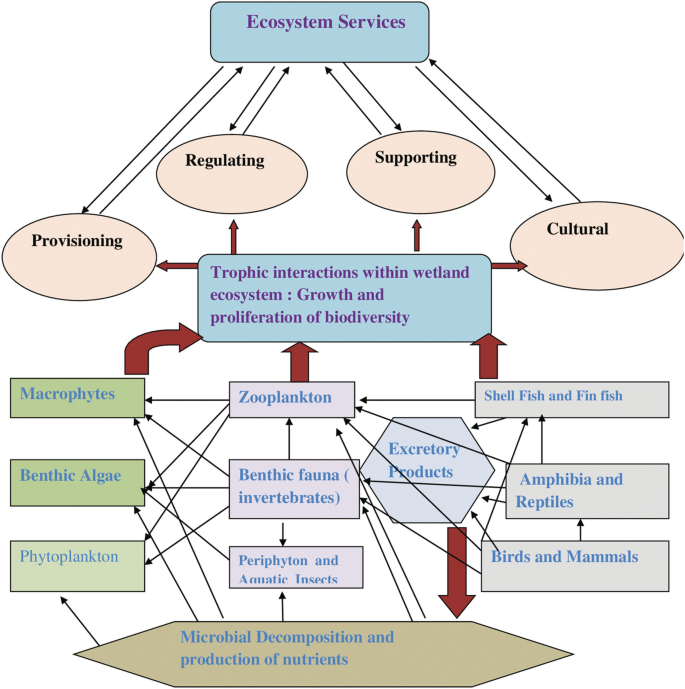
Source: Springer Nature — Ecosystem Services and Values of Wetlands with Special Reference ... · link.springer.com
Phytoremediation Technology
Science And Technology aquatic plants absorb heavy metals
Phytoremediation: Plants as Natural Pollution Cleaners
Phytoremediation uses plants to remove pollutants from soil, water, and air
Plants can absorb, accumulate, or break down contaminants through roots and leaves
Hyperaccumulator plants can absorb 100x more heavy metals than normal plants
How It Works
Phytoremediation is the use of plants to clean up environmental contamination. Plants absorb pollutants through their root systems and either store them safely in plant tissues or break them down into harmless compounds.
This green technology is cost-effective, environmentally friendly, and requires minimal maintenance compared to traditional cleanup methods.
Phytoremediation Process
%%{init: {"flowchart": {"wrappingWidth": 460}}}%%
flowchart TD
  s1["`**Contaminant Contact**
Plant roots encounter pollutants in soil or water`"]
  s2["`**Uptake**
Roots absorb contaminants along with water and nutrients`"]
  s3["`**Translocation**
Pollutants move up through plant tissues via xylem`"]
  s4["`**Storage/Breakdown**
Contaminants stored in leaves/stems or broken down by plant enzymes`"]
  s5["`**Harvesting**
Contaminated plant material removed and disposed safely`"]
  s1 --> s2
  s2 --> s3
  s3 --> s4
  s4 --> s5
Types of Phytoremediation
Type | Mechanism | Best For | Example Plants |
|---|---|---|---|
Phytoextraction | Plants absorb and concentrate contaminants | Heavy metals | Indian mustard, sunflower |
Phytostabilization | Plant roots immobilize contaminants in soil | Large contaminated areas | Willow, poplar trees |
Phytodegradation | Plant enzymes break down contaminants | Organic pollutants | Alfalfa, mulberry |
Rhizofiltration | Roots filter contaminants from water | Groundwater cleanup | Water hyacinth, cattails |
Applications in India
Sewage treatment — Water hyacinth used in East Kolkata Wetlands for natural wastewater treatment
Industrial cleanup — Sunflower plants used near mining areas to absorb heavy metals
Agricultural land — Brassica species planted to clean pesticide-contaminated farmland
Urban pollution — Roadside plants selected for air purification and dust absorption
Remember: Phytoremediation = plants clean pollution; Bioremediation = microorganisms clean pollution
Hyperaccumulator plants are special — they concentrate heavy metals 100-1000x normal levels
Aquatic phytoremediation works in wetlands; terrestrial phytoremediation works on contaminated soil
Wetland Conservation in India
Environment
India's Wetland Conservation Framework & Key Sites
India has 75 Ramsar sites covering over 1.3 million hectares as of 2023
Wetlands Rules 2017 provide legal framework for wetland protection
Sundarbans is India's largest wetland and UNESCO World Heritage Site
Policy Framework
India's wetland conservation operates under the Wetlands (Conservation and Management) Rules 2017, which replaced the 2010 rules. These rules prohibit activities that lead to wetland degradation and establish State Wetland Authorities for monitoring and management.
The National Wetland Conservation Programme launched in 1985-86 provides funding and technical support for wetland conservation projects across the country.
Major Wetland Types in India
Type | Examples | Key Features | Major Threats |
|---|---|---|---|
Coastal Wetlands | Sundarbans, Chilika Lake | Mangroves, lagoons, estuaries | Sea level rise, cyclones |
Freshwater Lakes | Dal Lake, Wular Lake | Natural & artificial lakes | Pollution, encroachment |
Rivers & Streams | Ganga floodplains | Riverine wetlands | Industrial pollution, dams |
High Altitude | Tso Moriri, Pangong Tso | Cold desert wetlands | Climate change, tourism |
Urban Wetlands | Powai Lake, Ulsoor Lake | Man-made water bodies | Sewage, urban expansion |
Recent Ramsar Additions (2022-2023)
Tamil Nadu — Karikili Bird Sanctuary, Pallikaranai Marsh, Pichavaram Mangroves
Odisha — Tampara Lake, Hirakud Reservoir, Ansupa Lake
Haryana — Sultanpur National Park, Bhindawas Wildlife Sanctuary
Mizoram — Pala Wetland (first Ramsar site in the state)
India's Ramsar Sites

Source: EDUBABA — Ramsar Wetland Sites in India – EDUBABA · edubaba.in
Chilika Lake (Odisha) is India's largest brackish water lagoon — not freshwater lake
Keoladeo Ghana (Bharatpur) was India's first Ramsar site in 1981, not Sundarbans
Wetlands Rules 2017 replaced 2010 rules — know the current legal framework