"Biorock technology" is talked about in which one of the following situations?
Contents15
- ARestoration of damaged coral reefs
- BDevelopment of building materials using plant residues
- CIdentification of areas for exploration/extraction of shale gas
- DProviding salt licks for wild animals in forest/protected areas
Show answer
Answer: (A) Restoration of damaged coral reefs
The answer is (A) Restoration of damaged coral reefs.
Biorock technology uses a clever trick to help damaged coral reefs grow back:
How it works: A low-voltage electrical current is passed through a metal structure placed underwater. This causes minerals from seawater (calcium carbonate/limestone) to naturally accumulate on the structure, creating a base for corals to attach and grow.
Corals on Biorock structures grow 3-5 times faster than normal!
It was invented in 1976 and has been used worldwide to:
- Restore damaged coral reefs
- Protect coastlines from erosion
- Support marine ecosystems (fish, shellfish, etc.)
- Build limestone barriers against rising sea levels
The other options are unrelated: (B) is about building materials, (C) is about shale gas, (D) is about wildlife management.
Coral reefs face severe bleaching and damage from climate change, making restoration technologies like Biorock increasingly important for marine conservation.
Biorock uses electrical current to accelerate coral growth by 3-5 times through mineral deposition from seawater, making it a key marine restoration technique.
The question tests knowledge of emerging environmental technologies rather than traditional ecology concepts.
Biorock Technology
Environment Biorock technology coral reefs
Biorock Technology: Coral Reef Restoration Through Electroaccretion
Biorock uses low-voltage electricity to grow limestone structures underwater for coral restoration
Corals grow 3-5 times faster on Biorock structures than on natural reefs
Invented in 1976, now used globally for reef restoration and coastal protection
Creates calcium carbonate base through mineral accretion from seawater
What is Biorock
Biorock technology is an innovative marine conservation method that uses electrical currents to restore damaged coral reefs. The process creates artificial limestone structures that serve as foundations for coral growth and marine ecosystem recovery.
How Biorock Works
%%{init: {"flowchart": {"wrappingWidth": 460}}}%%
flowchart TD
  s1["`**Metal Structure Placement**
Steel framework placed on damaged reef area`"]
  s2["`**Electrical Current Application**
Low-voltage DC current (2-6 volts) passed through structure`"]
  s3["`**Mineral Accretion**
Calcium carbonate precipitates from seawater onto metal`"]
  s4["`**Limestone Formation**
Natural limestone coating forms on structure`"]
  s5["`**Coral Attachment**
Coral larvae settle and grow on limestone base`"]
  s6["`**Ecosystem Recovery**
Fish and marine life return to restored reef`"]
  s1 --> s2
  s2 --> s3
  s3 --> s4
  s4 --> s5
  s5 --> s6
Key Benefits
Accelerated growth: Corals grow 3-5 times faster than on natural substrates
Higher survival rates: Improved coral survival during bleaching events and storms
Coastal protection: Creates barriers against erosion and rising sea levels
Marine biodiversity: Attracts fish, shellfish, and other marine organisms
Self-sustaining: Structures become permanent once corals establish
Applications Worldwide
Region | Purpose | Scale | Key Results |
|---|---|---|---|
Maldives | Reef restoration | Multiple sites | Tourism recovery |
Indonesia | Post-tsunami recovery | Large structures | Fisheries restoration |
Caribbean | Hurricane damage repair | Pilot projects | Coral survival improvement |
Thailand | Bleaching recovery | Research sites | Growth rate studies |
UPSC Connection
This 2022 question tested knowledge of emerging marine conservation technologies. Option A was correct because Biorock specifically targets coral reef restoration. The other options covered unrelated fields - building materials, shale gas extraction, and wildlife management.
Don't confuse Biorock with biocement or other bio-construction materials
Biorock is specifically for marine/underwater applications, not terrestrial ecosystems
The technology uses electrical current, not chemical or biological processes alone
Focus is on coral reefs, not general marine conservation or fish breeding
Coral Reef Conservation Methods
Environment coral reefs restoration
Coral Reef Conservation: Threats, Restoration & Protection Strategies
Coral reefs face threats from climate change, pollution, overfishing and coastal development
Coral bleaching occurs when stressed corals expel symbiotic algae
India has coral reefs in Andaman & Nicobar, Lakshadweep, Gulf of Mannar
Restoration methods include coral farming, transplantation, and artificial structures
Threats to Coral Reefs
# Coral Reef Threats
## Climate Change
- Rising sea temperatures
- Ocean acidification
- Sea level rise
## Human Activities
- Coastal development
- Tourism pressure
- Anchor damage
- Diving impacts
## Pollution
- Agricultural runoff
- Plastic waste
- Chemical pollutants
- Sedimentation
## Fishing
- Overfishing
- Destructive fishing
- Cyanide fishing
- Blast fishing
Restoration Techniques
Method | Process | Time Scale | Success Rate |
|---|---|---|---|
Coral Farming | Grow coral fragments in nurseries | 2-3 years | High |
Transplantation | Move healthy corals to damaged areas | 6-12 months | Moderate |
Artificial Reefs | Deploy structures for coral settlement | 3-5 years | Variable |
Biorock Technology | Electric current mineral accretion | 1-2 years | High |
Coral Probiotics | Beneficial bacteria treatment | 6-18 months | Experimental |
India's Coral Conservation
Gulf of Mannar Marine National Park: First marine national park, 21 islands
Lakshadweep: Pristine atolls with strict tourism regulations
Andaman & Nicobar: Fringing reefs around islands, post-tsunami restoration
Great Nicobar: Critical habitat for endemic species
Coral Triangle Initiative: India participates in regional conservation efforts
India's Coral Locations

Source: ESSO-INCOIS-Indian National Centre for Ocean Information ... — ESSO-INCOIS-Indian National Centre for Ocean Information ... · vacancies.incois.gov.in
Don't confuse coral polyps (animals) with coral algae (zooxanthellae are the symbiotic partners)
Bleaching doesn't mean coral death immediately - corals can recover if stress reduces
India's coral reefs are fringing reefs and atolls, not barrier reefs like Australia's
Gulf of Mannar is between India and Sri Lanka, not in Arabian Sea
Marine Conservation Technologies
Environment
Marine Conservation Technologies: Tools for Ocean Restoration
Artificial reefs provide substrate for marine life colonization
Seagrass restoration uses transplantation and seed dispersal techniques
Marine protected areas use satellite monitoring and underwater sensors
Aquaculture technologies support sustainable seafood production
Technology Categories
Technology Type | Primary Use | Examples | Key Innovation |
|---|---|---|---|
Reef Restoration | Coral recovery | Biorock, artificial substrates | Accelerated growth |
Habitat Creation | Marine biodiversity | Artificial reefs, kelp forests | Ecosystem engineering |
Pollution Control | Water quality | Bioremediation, filtration | Natural processes |
Monitoring Systems | Conservation tracking | Underwater IoT, satellite | Real-time data |
Aquaculture Innovation | Sustainable production | Offshore farms, IMTA | Multi-species systems |
Emerging Technologies
3D printed reefs: Calcium carbonate structures designed to mimic natural reef complexity
Underwater drones: Automated monitoring and maintenance of marine protected areas
Gene banks: Cryopreservation of coral genetic material for future restoration
Probiotics for corals: Beneficial bacteria to enhance coral disease resistance
Ocean cleanup systems: Large-scale plastic removal from marine environments
Artificial Reef Technology
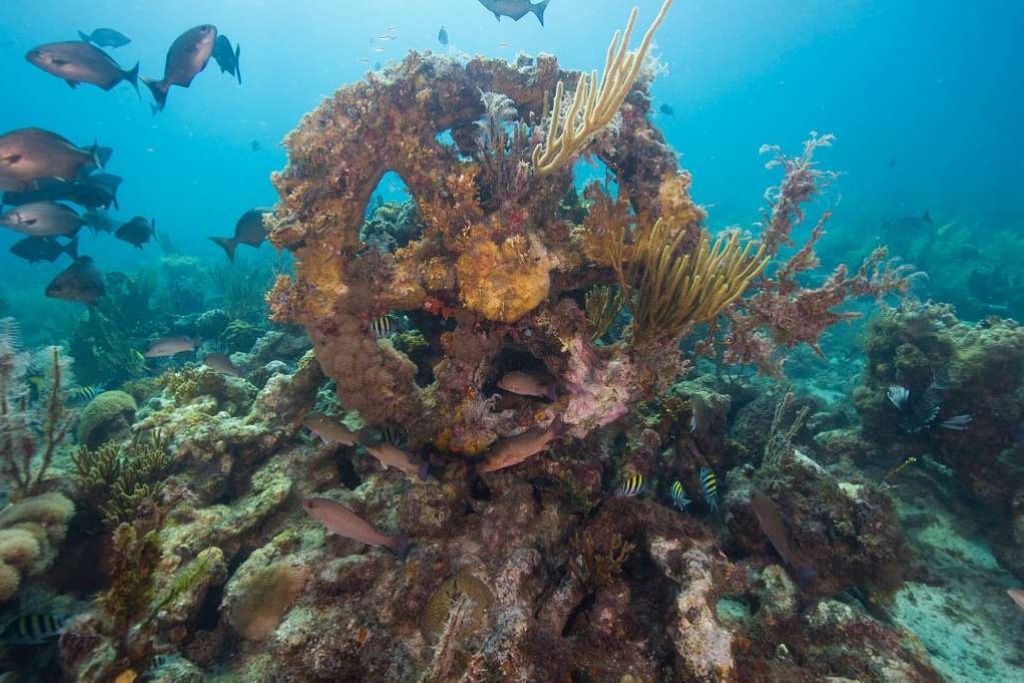
Source: Earth.Org — How Artificial Reefs Are Bringing Back Lost Ocean Ecosystems · earth.org
Biorock is specifically for coral reefs, not general marine conservation
Don't mix aquaculture (farming) with mariculture (marine farming specifically)
Marine protected areas use technology for monitoring, not just legal designation
Seaweed farming is different from seagrass restoration - different ecosystems