The Prime Minister recently inaugurated the new Circuit House near Somnath Temple at Veraval. Which of the following statements are correct regarding Somnath Temple? 1. Somnath Temple is one of the Jyotirlinga shrines. 2. A description of Somnath Temple was given by Al-Biruni. 3. Pran Pratishtha of Somnath Temple (installation of the present day temple) was done by President S. Radhakrishnan. Select the correct answer using the code given below:
Contents17
- A1 and 2 only
- B2 and 3 only
- C1 and 3 only
- D1, 2 and 3
Show answer
Answer: (A) 1 and 2 only
The answer is (A) Statements 1 and 2 only.
Statement 1 is CORRECT:
Somnath Temple is one of the 12 Jyotirlingas (sacred shrines of Lord Shiva).
It's located at Veraval in Gujarat.
"Somnath" means "protector of the moon god."
Statement 2 is CORRECT:
Al-Biruni, the famous Persian scholar who accompanied Mahmud of Ghazni, described the Somnath Temple in his writings.
He noted it was built of stone and was about 100 years old at the time of Mahmud's attack in 1025 AD.
Statement 3 is WRONG:
The Pran Pratishtha (consecration) of the present-day temple was done by President Dr. RAJENDRA PRASAD (India's first President) in 1951, NOT President S. Radhakrishnan (who was the second President).
Important history:
Sardar Vallabhbhai Patel pledged to rebuild the temple in 1947.
He was the first chairman of the Shri Somnath Trust.
The temple was rebuilt on the original site (it's the 7th reconstruction — it was destroyed and rebuilt six times before).
Somnath Temple is one of only 12 Jyotirlinga shrines in India, making it among the most sacred Shiva temples.
The question was triggered by PM inaugurating a Circuit House near Somnath in 2022, bringing the temple into current affairs focus.
The trap is confusing India's first President Rajendra Prasad (who consecrated the temple in 1951) with second President Radhakrishnan.
Somnath Temple - History & Reconstruction
Art And Culture Somnath Temple Veraval
Somnath Temple: History of Destruction & Reconstruction
Located at Veraval, Gujarat - one of the 12 Jyotirlingas
Al-Biruni documented the temple before Mahmud's 1025 AD attack
Current temple consecrated by President Rajendra Prasad in 1951
7th reconstruction - destroyed and rebuilt 6 times in history
Significance
Somnath means 'protector of the moon god' and represents one of India's most sacred Shiva shrines. The temple's repeated destruction and reconstruction symbolizes the resilience of Hindu culture through centuries of invasions.
Key Historical Events
Period | Event | Key Figure |
|---|---|---|
1025 AD | Mahmud of Ghazni destroys temple | Al-Biruni documents temple |
1947 | Pledge to rebuild temple | Sardar Vallabhbhai Patel |
1951 | Pran Pratishtha of current temple | President Rajendra Prasad |
Post-Independence Reconstruction
Sardar Vallabhbhai Patel became first chairman of Shri Somnath Trust
Built on the original site where previous temples stood
Represents India's commitment to preserving ancient heritage
Part of broader temple reconstruction movement after independence
Trap: Rajendra Prasad (1st President) did Pran Pratishtha, NOT S. Radhakrishnan (2nd President)
Confusion: Al-Biruni was with Mahmud of Ghazni, not other medieval invaders
Location: Veraval in Gujarat, not Dwarka or other Gujarat temple towns
Twelve Jyotirlingas of India
Art And Culture Jyotirlinga
The Twelve Jyotirlingas: Sacred Shiva Shrines
12 most sacred Shiva temples across India
Each represents Shiva as Jyotir (pillar of light)
Somnath (Gujarat) is considered the first Jyotirlinga
Spread across 8 states - major pilgrimage circuit
Concept
Jyotirlinga means 'pillar of light' representing Shiva's infinite nature. These 12 shrines are considered swayambhu (self-manifested) lingas where Shiva appeared as a column of light.
The Twelve Jyotirlingas
Jyotirlinga | Location | State | Special Feature |
|---|---|---|---|
Somnath | Veraval | Gujarat | First Jyotirlinga, rebuilt 7 times |
Mallikarjuna | Srisailam | Andhra Pradesh | On Krishna River |
Mahakaleshwar | Ujjain | Madhya Pradesh | Only Dakshinamukhi linga |
Omkareshwar | Omkareshwar | Madhya Pradesh | On Narmada River |
Kedarnath | Kedarnath | Uttarakhand | Highest altitude Jyotirlinga |
Bhimashankar | Pune district | Maharashtra | Western Ghats location |
Kashi Vishwanath | Varanasi | Uttar Pradesh | Most visited pilgrimage site |
Trimbakeshwar | Nashik | Maharashtra | Source of Godavari River |
Vaidyanath | Deoghar | Jharkhand | Known for healing powers |
Nageshwar | Dwarka | Gujarat | Near Krishna's Dwarka |
Rameshwar | Rameswaram | Tamil Nadu | Connected to Ramayana |
Grishneshwar | Aurangabad | Maharashtra | Near Ellora Caves |
Jyotirlinga Locations
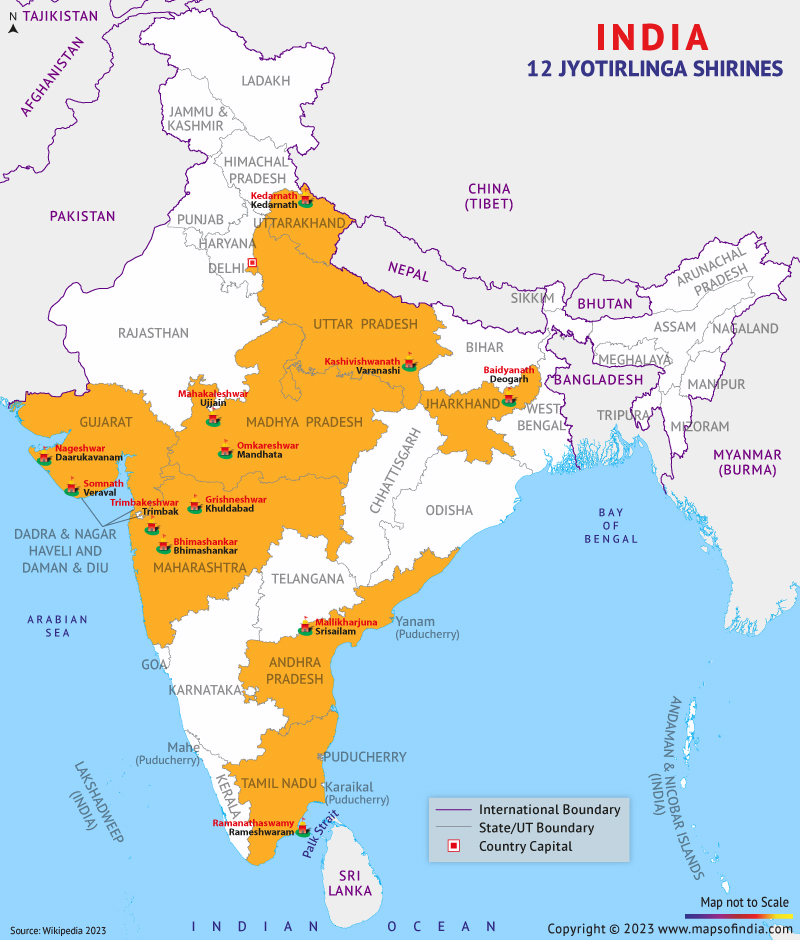
Source: India Map — Jyotirlinga Shrines, Twelve Jyotirlinga Shrines of Shiva · www.mapsofindia.com
Mahakaleshwar (Ujjain) is the only Dakshinamukhi (south-facing) linga
Kedarnath is in Uttarakhand, not Himachal Pradesh
Two Jyotirlingas in Gujarat: Somnath and Nageshwar
Vaidyanath is in Jharkhand (Deoghar), not the one in Maharashtra
Al-Biruni - Medieval Persian Scholar
Ancient And Medieval History Al-Biruni
Al-Biruni: Scholar Who Documented Medieval India
Persian polymath who accompanied Mahmud of Ghazni
Wrote Kitab-ul-Hind - comprehensive study of Indian society
Documented Somnath Temple before 1025 AD destruction
Learned Sanskrit and studied Indian texts directly
Background
Al-Biruni (973-1048 AD) was a Persian scholar from Khwarezm who came to India with Mahmud of Ghazni's campaigns. Unlike typical invaders, he was genuinely interested in understanding Indian civilization.
Al-Biruni's Contributions
Work/Study | Content | Significance |
|---|---|---|
Kitab-ul-Hind | Comprehensive study of Indian society, religion, science | Most detailed medieval account of India |
Temple Documentation | Described Somnath and other temples | Historical evidence of temple architecture |
Scientific Translation | Translated Indian mathematical and astronomical works | Bridge between Indian and Islamic science |
Sanskrit Learning | Studied original texts, not just translations | Scholarly approach to understanding India |
Al-Biruni on Indian Temples
Described Somnath Temple as built of stone, about 100 years old during Mahmud's time
Noted the temple's astronomical significance and mathematical precision
Documented temple rituals, festivals, and religious practices
Provided objective analysis rather than religious criticism
Historical Context
Accompanied 11th century Ghaznavid invasions but remained a scholar
His accounts provide neutral perspective on medieval Indian society
Bridge between Islamic and Hindu intellectual traditions
Contemporary of other travel writers like Ibn Battuta (though later)
Al-Biruni was with Mahmud of Ghazni (11th century), not other medieval rulers
Kitab-ul-Hind is Al-Biruni's work, not to be confused with other travel accounts
He learned Sanskrit - unusual for foreign scholars of his time
Presidents of India - Key Facts
Indian Polity President S. Radhakrishnan President Rajendra Prasad
Presidents of India: Chronology & Key Roles
Rajendra Prasad - 1st President (1950-62), consecrated Somnath
S. Radhakrishnan - 2nd President (1962-67), philosopher-statesman
Presidents serve 5-year terms, elected by Electoral College
Ceremonial head but important constitutional functions
Constitutional Role
The President of India is the ceremonial head of state, elected by an Electoral College comprising elected members of Parliament and State Legislatures. Beyond ceremonial duties, Presidents play crucial roles in government formation and constitutional crises.
First Five Presidents
President | Term | Background | Notable Actions |
|---|---|---|---|
Rajendra Prasad | 1950-1962 | Freedom fighter, lawyer | Somnath consecration, longest serving |
S. Radhakrishnan | 1962-1967 | Philosopher, educator | Teacher's Day named after him |
Zakir Hussain | 1967-1969 | Educationist | First Muslim President |
V.V. Giri | 1969-1974 | Trade unionist | First President elected as independent |
Fakhruddin Ali Ahmed | 1974-1977 | Lawyer, politician | Signed Emergency proclamation |
Presidential Powers & Functions
Executive powers: Appoints PM, dissolves Lok Sabha, summons Parliament
Legislative powers: Assent to bills, can return bills for reconsideration
Emergency powers: Can declare National, State, or Financial Emergency
Judicial powers: Mercy petitions, clemency powers under Article 72
Rajendra Prasad was 1st President, S. Radhakrishnan was 2nd - often confused
Rajendra Prasad served 12 years (1950-62) - longest tenure of any President
Teacher's Day (Sept 5) is Radhakrishnan's birthday, not Rajendra Prasad's
Presidents are elected, not directly appointed by PM or ruling party